Royal Northern College of Music
Graduate School Handbook
Contents
- Introduction
- SECTION 1: INTRODUCTION AND KEY CONTACTS
- SECTION 2: MASTER OF MUSIC in COMPOSITION, COMPOSITION AND PERFORMANCE, CONDUCTING, PERFORMANCE or POPULAR MUSIC
- SECTION 3: MASTER OF PERFORMANCE, MASTER OF PERFORMANCE IN POPULAR MUSIC
- SECTION 4: POSTGRADUATE DIPLOMA: ADVANCED STUDIES IN COMPOSITION, CONDUCTING, PERFORMANCE or POPULAR MUSIC
- SECTION 5: EUROPEAN CHAMBER MUSIC MASTER
- SECTION 6: INTERNATIONAL ARTIST DIPLOMA & HALLÉ/RNCM ADVANCED ORCHESTRAL STRINGS PROGRAMME
- Programme Title: MASTER OF EDUCATION
- Programme Title: POSTGRADUATE DIPLOMA in EDUCATION
- Programme Title: POSTGRADUATE CERTIFICATE IN MUSIC EDUCATION
- SECTION 7: MODULE OUTLINES
- SECTION 8: ASSESSMENT DEADLINES 2026-27
- SECTION 9: COLLEGE REGULATIONS (All Programmes)
- SECTION 10: MARKING GUIDELINES
- SECTION 11: STUDENT SUPPORT, DEVELOPMENT AND WELLBEING
- SECTION 12: SCHOOL-SPECIFIC INFORMATION
Introduction
GRADUATE SCHOOL
Handbook 2026-27
Master of Music/Performance/Education,
European Chamber Music Masters,
Postgraduate Diploma: Advanced Studies / Music Education / International Artist and Hallé/RNCM Advanced Orchestral Strings Programme
Postgraduate Certificate in Music Education

At the time of going to press the information contained within this document was accurate. Notification of any subsequent changes will be made via a notice on the College e-mail system with new and/or updated material posted on Moodle ALTERNATIVE FORMAT If you require a copy of this Handbook in an alternative format you should contact the Head of Academic Services in the first instance. A copy of this Handbook is available on the College’s Virtual Learning Environment, Moodle. |
DOCUMENT RECORD
Document title | Graduate School Handbook |
Version | 2 |
Person responsible | Head of Graduate School |
Author | Head of Graduate School |
Document date | September 2024 |
Last amended | September 2025 |
Effective from | September 2025 – August 2026 |
Next Review date | July 2026 |
History (where discussed/who circulated to/ committees considered by) | Consultation with Head of Graduate School, Heads of Schools, Departments and Programmes Date of Programme Approval by Academic Board: |
SECTION 1: INTRODUCTION AND KEY CONTACTS
The Graduate School at the Royal Northern College of Music offers a suite of Postgraduate Taught (PGT) Programmes at FHEQ Level 7 and several research degrees at Level 8. The PGT degrees are listed below, and they offer a broad range of courses of study, enabling you to deepen your musical specialisms with a variety of emphases as best suits your career aspirations. Programmes are designed to be inclusive wherever possible, offering choice both in terms of learning and teaching methods and also assessment, ensuring that your individual needs as a student are prioritised. The optional research and vocational specialisms in the MMus (and vocational specialisms in MPerf) promote a coherent transition between FHEQ Levels 7 and 8 within the Graduate School. The Graduate School considers research to be an integral component in the training and employment prospects of aspiring professional musicians, contributing skills in self-critical, contextual and communicative awareness to your musical practice. This aligns with the RNCM’s vision in “ensuring research is fully integrated in the culture of the College.” The link between research and practice is central to the RNCM’s vision of itself as a thriving, dynamic, friendly and collegial musical community.
Graduate School Programmes:
Master of Music
- Master of Music in Composition
- Master of Music in Composition and Performance
- Master of Music in Conducting
- Master of Music in Performance
- Master of Music in Popular Music
Master of Performance
- Master of Performance
- Master of Performance in Popular Music
Postgraduate Diploma: Advanced Studies
- Postgraduate Diploma: Advanced Studies in Composition
- Postgraduate Diploma: Advanced Studies in Conducting
- Postgraduate Diploma: Advanced Studies in Performance
- Postgraduate Diploma: Advanced Studies in Popular Music
European Chamber Music Master
International Artist Diploma in Conducting or Performance
Hallé/RNCM Advanced Orchestral Strings Programme
Master of Education
Postgraduate Diploma: Music Education
Postgraduate Certificate: Music Education
In addition, the College teaches the following Collaborative Programmes which are validated by Manchester Metropolitan University (MMU)
Other Handbooks
MPhil/PhD Master of Philosophy in Musicology Master of Philosophy in Music Psychology Master of Philosophy in Music Education Master of Philosophy in Performance Master of Philosophy in Composition |
Doctor of Philosophy in Music Psychology Doctor of Philosophy in Music Education Doctor of Philosophy in Performance Doctor of Philosophy in Composition |
PGCE Postgraduate Certificate in Education with Specialist Instrumental Teaching
KEY PROGRAMME CONTACTS
Heads of Schools of Study
Your Head of School, their deputies and administrators will be your primary contacts for any questions you have regarding your principal study.
Professor David Horne david.horne@rncm.ac.uk
David is the Head of the Graduate School and course leader for the MMus and IAD. He can be contacted if you have any questions or issues while undertaking your studies in any of our programmes.
Dr Simon Clarke simon.clarke@rncm.ac.uk
Simon is the Deputy Head of the Graduate School and course leader for the MPerf and PGDipAS. If you have questions or issues while studying in these programmes, please contact Simon first.
Dr Robert Gardiner robert.gardiner@rncm.ac.uk
Robert is Senior Lecturer in Music Education, MEd course leader and Programme Lead Music Education (PGCE). Please contact Robert if you have questions or issues while studying on these programmes.
Catherine Yates catherine.yates@rncm.ac.uk
Catherine is the Deputy Head of the School of Strings and course leader for the Hallé/RNCM Advance Strings Programme. Please contact Catherine for any questions or issues while studying on this programme.
Lewis Woolcock lewis.woolcock@rncm.ac.uk
Lewis administers the PGT programmes and can be contacted about any administrative issues, including timetabling and coursework submission/deadlines.
Other important College contacts during your studies include:
Professor Jennie Henley jennie.henley@rncm.ac.uk
Jennie is Director of Programmes and has strategic leadership for the academic programmes, including responsibility for undergraduate, postgraduate taught and junior programmes of study.
If you are not sure whom to contact about any issue, please contact David, Simon or Lewis and we will be able to suggest the best colleague to be in touch with. If you have any health or wellbeing issue while studying here, please do not hesitate to contact our Student Disability and Wellbeing Advisors at wellbeing@rncm.ac.uk
PROGRAMME SPECIFICATION
[This information forms part of the Student Contract and is binding for each cohort at point of Application.]
SECTION 2: MASTER OF MUSIC in COMPOSITION, COMPOSITION AND PERFORMANCE, CONDUCTING, PERFORMANCE or POPULAR MUSIC
UCAS Codes: 701F/702F/801F/805F/807F/820F/823F
Awarding Institution: Royal Northern College of Music
Programme Leader: Professor David Horne, Head of Graduate School
INDEX
- Introductory Programme Information
- Admissions and Entry Requirements
- Programme Overview and Modules
- Teaching and Learning Methods
- Assessment and Feedback
INTRODUCTORY PROGRAMME INFORMATION
Duration: 1 or 2 years, full-time only
Award On successful completion of the programme, students will receive: |
Master of Music in: Conducting Composition Composition and Performance Performance Popular Music The optional completion of 90 specified credits offers the additional named award of one of the following Specialisms: Artistic Research Composition Pedagogy Instrumental Pedagogy Music Education Philosophy and Music The specialism and principal study can be listed in any order chosen by the student. For example, a Performance student completing 90 credits of study in Music Education could choose: Master of Music in Performance and Music Education Or Master of Music in Music Education and Performance |
Degree Classification Requirements: Without Specialisation: A Distinction is awarded when the Principal Study mark is 70 or higher, and the average mark for all other modules is 60 or higher. Otherwise, a Pass classification is awarded. All modules must be passed for the degree, 50 is the pass mark. With Specialisation: A Distinction is awarded when the average mark for at least 90 credits of research modules is 70 or higher (with at least 60 credits in this range), and where the average for all other modules, including Principal Study, is 60 or higher. The classification of Distinction in the degree does not mention whether it was awarded in Principal Study and/or the Specialisation. As an example, a Composition student receiving a Principal Study mark of 62 (with the average of the Principal Study and optional module being above 60) and an average at 70 or above in a Music Education Specialisation will receive: Master of Music in Composition and Music Education: Distinction |
Teaching Institution: RNCM
Period of Registration: Minimum: 1 Year Maximum: 3 Years
Academic Year: September to July
OTHER POTENTIAL AWARDS: Programme levels and qualifications (Exit Awards)
Level / Year of study | FHEQ* Level | Credits and Qualification For early departure or non-completion of studies. |
Year 1 or 2 | 7 | Postgraduate Diploma: requires Principal Study at 60 credits and 60–90 credits from any other modules – no Specialism or Degree Classification can be included in the award Postgraduate Certificate: requires 60–90 credits from any modules which may or may not include Principal Study – no Specialism or Degree Classification can be included in the award |
* FHEQ: Framework for Higher Education Qualifications
Date of Writing: | August 2023 |
Period of Approval: | From: September 2024 To: August 2029 |
PROGRAMME AIMS
The Master of Music programme enables you to:
1 | Enter professional life as a future musical ambassador capable of demonstrating compelling artistic identity, integrity and vision |
2 | Perform, create and/or research music as global citizens without boundaries, engaging meaningfully with audiences, the wider artistic community and society. |
3 | Demonstrate autonomy, entrepreneurship, originality, problem solving skills and resilience in artistic or research projects. |
4 | Creatively adapt to and lead a constantly evolving music industry through innovation, experimentation, healthy ambition, supportive, inspirational leadership and collaboration. |
5 | Promote inclusivity in your creativity, including embracing your own and others’ original voices and cultural heritage in music-making or research. |
INTENDED LEARNING OUTCOMES OF THE PROGRAMME
A | Knowledge and Understanding – on successful completion of the programme you will be able to: |
A1 | Demonstrate a systematic understanding of current practices relevant to your discipline and, where applicable, specialism. |
A2 | Demonstrate sophisticated, original and thoughtful musicianship in artistic decisions. |
A3 | Demonstrate expert technical and practical skills in the discipline, with the ability to critically reflect on these through healthy and holistic approaches to music making. |
A4 | Demonstrate comprehensive knowledge of the music relevant to the discipline and the capability to expand this through proactively inclusive programming and/or repertoire knowledge. |
A5 | Demonstrate critical awareness of the relationship between musical practice, theoretical study and research, leading to original insights and, where appropriate, the ability to create robust proposals for research-degree study. |
B | Specialist Subject Skills – on successful completion of the programme you will be able to: |
B1 | Make music with a level of insight, critical maturity, individuality and technical assurance consistent with the ability to enter the profession in the chosen discipline. |
B2 | Demonstrate sophisticated interpretative skills, initiative, creativity and individuality, with the potential for experimentation and risk-taking. |
B3 | Demonstrate mastery in assimilating elements of musical language and expression relevant to the discipline, reflecting on these in performance or creation. |
B4 | Disseminate the knowledge of and insights into your musical practice to the widest range of audiences at an appropriately inclusive level. |
B5 | Demonstrate innovation, entrepreneurship, flexibility and resilience in deploying a range of relevant techniques and/or research methods applicable to your professional activities. |
C | Generic and Graduate Skills – on successful completion of the programme you will be able to: |
C1 | Assimilate and synthesise current research and practice, deploying it theoretically and applying it within the relevant discipline. |
C2 | Command a range of relevant research and dissemination tools, employing appropriate media and technologies. |
C3 | Plan, research and realise individual projects at an advanced level, harnessing independent learning skills for personal career development. |
C4 | Work collaboratively to create a supportive and nurturing creative environment. |
C5 | Communicate verbally with confidence and insight. |
C6 | Work effectively and confidently within a global and culturally diverse environment. |
C7 | Employ a range of technological skills fluently and at an appropriate level of sophistication. |
CRITERIA FOR ADMISSION AND ENTRY
All applicants must pass an RNCM audition, and you are normally expected to hold a bachelor’s degree or equivalent (FHEQ Level 6). While the undergraduate degree will normally be in music, it is not a requirement. Instead, you need to satisfy the College that you have achieved the appropriate standard in your main discipline area and have the potential to develop further towards a professional level.
In exceptional cases, joint principal study is possible, including between different Performance Schools. This requires the agreement of the relevant Heads of School and the Head of the Graduate School. In the case of joint principal study in School of Composition and Performance Schools the degree to be awarded would be MMus in Composition and Performance. You would need to demonstrate readiness for Level 7 study in both disciplines and the final Principal Study assessment would be weighted 50/50 in both.
If taking Joint Principal Study, you will meet with relevant Heads and Head of Graduate School at the start of the programme to ensure you are supported in terms of timetabling and module choices. Joint Principal Study students will normally only be accepted onto the 2-year Programme, but exceptions can be made in the case of exceptional performance at audition and/or UG Principal Study achievement. If you are on the 2-year programme there will be an opportunity after the mid-programme formative assessment to drop one discipline for the remainder of the degree. If you are a 1-year student, you will also be permitted to make this change but will likely have to retain the existing formula for Principal Study tuition due to staff contractual hours.
In joint principal study assessment, you are encouraged to perform one full-length recital in which you demonstrate both disciplines. This could involve, for example, performing on more than one type of instrument, or where one principal study discipline is composition, including performances of your own work. It is also possible to have two separate assessments, at 50% of the normal length of each. As an example, a student studying both composition and flute would be expected to perform a recital of 23 minutes and submit a portfolio of 15–20 minutes. As the nature of the Composition and Performance portfolio is flexible, it would be negotiated on an individual basis. The alternative performance/composition ‘portfolio’ options cited in the Principal Study module outlines are also permitted, again, in negotiation with relevant Heads of School/Graduate School. More information is given in the Performance Principal Study module outline.
For applicants whose first language is not English, an IELTS score of 6.0 (with at least 5.5 in each component, as required by the UKVI) is normally required, exceptions being at the discretion of David Horne as Course Leader, in consultation with Professor Jean Ammar, Senior Tutor in English Language Support. Certain modules require a written IELTS of 6.5 or 7.0.
A 1,000-word sample of writing, normally on music (which may be an excerpt from an existing piece of work you have written), using references, is required if your undergraduate degree was not undertaken at the College.
Occasionally, students may wish to transfer onto another programme (including between the 1- and 2-Year MMus). To assess your suitability and eligibility, formal transfer applications must be made via the electronic form available from the Academic Services Office. All applications for transfer should be submitted to David Horne for consideration no later than 30 November of the academic year in which the transfer is to take effect.
The policies for Accreditation of Prior Learning (APL) and Disclosure and Barring Services (DBS) may be found in the Student Regulation Handbook. All the credits awarded through APL must be endorsed by the Board of Examiners
COURSE OVERVIEW
The MMus has Principal Study at its centre, and as students you can normally expect to devote a significant portion of your time in this area.
The degree requires the completion of 180 credits. The Principal Study module contains 60 credits, all other modules (apart from 60 credit Major Dissertation) have 30 credits. Module selection normally occurs in the week before the start of each academic year.
MMus students can choose to take 90 credits of study (2–3 modules) in a related Specialism preparing them for vocational work or research degree-level study. The specialisms currently offered are:
Artistic Research
Composition Pedagogy
Instrumental Pedagogy
Music Education
Music Psychology
Musicology
Philosophy and Music
Vocal Pedagogy
Apart from Principal Study, no modules are compulsory in the MMus. Fulfilling the QAA Statement Characteristics for Master’s Degrees that they “involve training in research methods”, all Master’s students at the RNCM are required to take a research module from a choice of options, which offer flexibility both in delivery, content and assessment.
The MMus is fulltime, and available either as a 1- or 2-year programme. Students opting for either the 1- or 2-year programme take into consideration the time they can devote to practical training in their Principal Study, balanced with other factors such as cost and career aims.
Conductors may normally only take the 2-year Master’s, due to the demands of the Conducting programme and structure of the learning opportunities.
BENCHMARKING
Programmes are based on national standards for degrees in music through external scrutiny of the programme during development by both academics and professional musicians and by reference to OfS Conditions, Sector Recognised Standards and QAA Benchmarks.
MODULE MAP
Students on the 1-year MMus will complete all their modules within the year. If you are not taking the Major Dissertation, you will select 4 modules in addition to your Principal Study, one of which needs to be a research module.
Students on the 2-year programme will normally take 2 modules each year, in addition to Principal Study, which is spread over two years. The Major Dissertation may be taken over 2 years. Given the nature of performance opportunities available, it is permissible to take the portfolio option for Principal Study in year 1, with the agreement of both the relevant Head of School and David Horne.
The teaching in most modules is delivered over two semesters. Timetable information is available from early September in each academic year, which informs your choices when selecting modules. Assessments are spread over the year to avoid conflicts where practical, with the large majority taking place from April to June. Mid-May to early June is the Principal Study assessment period, and other assessments are largely avoided during this period.
Work placements are not compulsory, but you can choose to take the Professional Placement module, normally involving various placements in the local area. As a performer, you can also normally apply for the various Professional Experience Schemes (PES) through the College, typically involving professional partners in Manchester and Northwest England, and occasionally other national and international partners. Students involved in PES may opt to use this placement for credit in the Professional Placement or Artistic Project module, but it is not a requirement to do so.
Core modules:
The 60-credit Principal Study module is compulsory.
Choice of research modules:
You must choose at least one of the Research modules below:
Dalcroze in Context (30)
Dissertation (minor/major) (30/60)
Music and Environment (30)
Research Methods:
Artistic Research, (30)
Musicology,
Music Education,
Music Psychology,
Philosophy
and Music,
Research Lecture Recital (30)
Repertoire Project (30)
Underrepresented Music and Musicians (30)
If taking only one research module, this may be taken in either year of the 2-year MMus. A Major Dissertation is normally taken over both years of the 2-year MMus with credits awarded in the second year, so that in years 1 and 2 only one other 30-credit module will be selected.
If you have undertaken level-7 research methods training previously you can exceptionally be exempted from the requirement to take a research module, if evidence (e.g., a thesis) is provided. This would be at the discretion of David Horne, following discussion with Simon Clarke. This does not follow the formal APL procedure so you would choose another module to make up the required 180 credits.
Principles of Specialisms
The MMus offers you the opportunity to take a Specialism alongside your Principal Study. A Specialism requires a minimum of 90 credits in specified modules.
Research Specialisms
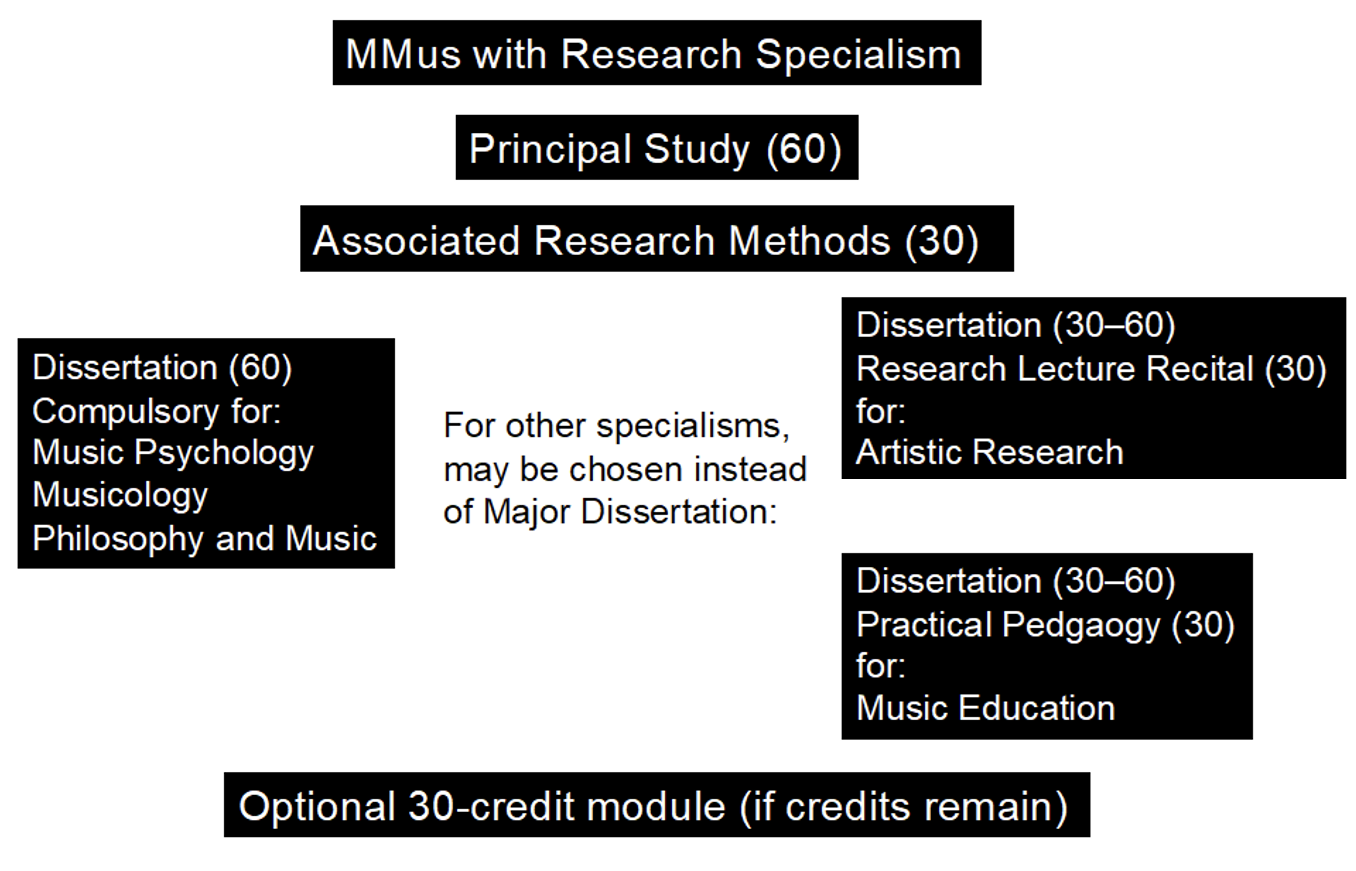
A Research Specialism requires the associated Research Methods module (30 credits).
It is normally complemented by a Major Dissertation (60) but practice-led research modules may be complemented instead by Research Lecture Recital (30) and a Minor (30) or Major (60) dissertation. Music Education may be complemented by Practical Pedagogy (30) and a Minor (30) or Major (60) dissertation.
Artistic Research
Research Methods: Artistic Research (30)
Minor or Major Dissertation (30/60)
Research Lecture Recital (30) may be taken instead of Major Dissertation
Music Education
Research Methods: Music Education (30)
Minor Dissertation (30) (Major Dissertation is permissible in lieu of 30 credits from optional modules)
Practical Pedagogy (30)
Music Psychology
Research Methods: Music Psychology (30)
Major Dissertation (60)
Musicology
Research Methods: Musicology (30)
Major Dissertation (60)
Philosophy and Music
Research Methods: Philosophy and Music (30)
Major Dissertation (60)
Note: in exceptional cases, with the agreement of David Horne and other relevant research pathway leads, you may be able to change your named specialism despite having completed modules required for another. This is to offer flexibility and to acknowledge the evolving nature of research projects and interests.
Vocational Specialisms
A Vocational Specialism requires an associated vocational module (normally 30 credits).
It can be complemented by a Major Dissertation (60) or Research Lecture Recital (30) and a Minor dissertation (30)
Composition Pedagogy
Practical Pedagogy (30)
Minor or Major Dissertation (30/60)
Research Lecture Recital (30) may be taken instead of Major Dissertation
Instrumental Pedagogy
Practical Pedagogy (30)
Minor or Major Dissertation (30/60)
Research Lecture Recital (30) may be taken instead of Major Dissertation
Vocal Pedagogy
Practical Pedagogy (30)
Minor or Major Dissertation (30/60)
Research Lecture Recital (30) may be taken instead of Major Dissertation
Optional Modules
You can select from the practical and vocational 30-credit modules below:
Accompaniment
Arrangement
Artistic Project
Cross-Cultural Approaches to Musicianship
Composition Elective
Conducting Elective
Contemporary Songwriting
Dalcroze Eurhythmics and Dynamic Rehearsal
Electronic Experimental Ensemble
Freelance Musician
Music & Environment (if not selected as a research module)
Musicianship for Vocalists: Consort Singing
Practical Pedagogy
Presenting Research
Professional Audition
Professional Placement
Small Ensemble Performance
Underrepresented Music and Musicians (if not selected as a research module)
Vocal Leadership
More information is available in the Module Outlines
MMus programme route diagrams
MMus without Specialism
MMus with Research Specialism
MMus with Vocational Specialism
TEACHING AND LEARNING METHODS
The Graduate School promotes a diverse, innovative and student-centred approach to learning, with the learning and teaching methods used in the delivery of the programmes designed to reflect the diversity of student experience and to meet individual learning needs. Responding positively to the Office for Students’ most recent guidance on improving access and participation, the Graduate School meets the needs of students with non-traditional qualifications and/or from overseas by providing a not-for-credit module which supports and updates students’ theoretical knowledge of music. Professor Jean Ammar, Senior Tutor (Language Support), offers seminar-based and individual support throughout the academic year across the full range of modules and a pre-sessional course offers incoming students an opportunity to develop the necessary language skills for successful postgraduate study. The Student Disability and Wellbeing Advisors assist students through the design of bespoke learning plans where appropriate, and give individual guidance and further advise the Graduate School on any necessary accommodation for disabled students ensuring that all reasonable adjustments be made in accordance with the 2010 Equality Act. The Graduate School programmes are designed wherever possible to offer flexible routes in learning and teaching, including assessment. The flexible modes of delivery in various modules promote student choice and control over their scheduled commitments.
You will typically have one individual principal study lesson each week during teaching weeks, in addition to school-specific classes and activities. Other modules have various modes of delivery, ranging from those that meet on a regular timetabled schedule, normally every 1 or 2 weeks, to others (e.g., Major Dissertation) where you are expected to arrange periodic meetings with your supervisor. Class sizes will vary depending on the module. In taught modules, minimum cohorts are specified where appropriate and some have upper limits to ensure the quality of the student experience. Normally, you will be able to take the modules you have requested, and the teaching timetable is arranged to avoid any module conflicts. Exceptions will apply in modules (e.g., Conducting) that have entrance or audition requirements.
1 credit is normally equal to 10 hours of study; however, you may find that it is necessary to devote more time to certain modules depending on the assessment schedule and other factors. In the induction meetings you will have an opportunity to ask questions about modules, and to consider the overall timetable (including assessments) when making your module selections.
In addition to cohort induction meetings which introduce the specialisms, there will be an extra meeting timetabled during the induction week (currently called Welcome Week) which discusses the Research and Vocational specialisms in more detail. Additionally, David Horne and Simon Clarke will be available to meet with you during this period on an individual basis if you would like to select modules to form a Specialism. At the end of the first Semester, further meetings will be arranged with you if undertaking Specialisms to ensure that you are fully supported in your educational choices.
The following learning and teaching methods are used throughout your programme, although they will vary according to the module choice. Module outlines indicate which apply.
- Individual lessons in Principal Study offer advanced and specifically customised training. You will negotiate with your specialist tutor(s) the content and style of the Principal Study learning and assessments. Lessons provide a forum for you to enhance key technical and musical skills, as well as making informed choices regarding repertoire and format for recital presentations and/or creative portfolios, preparing for the professional application of your musical training.
- Specialist Classes and Workshops involve formative feedback on practical aspects of performance and/or creative work and often an opportunity to give and receive feedback from fellow students as well as tutors.
- Masterclasses with visiting national and international tutors offer additional expert insights and perspectives on issues related to Principal Study activities.
- Lectures involve discussion of concepts relevant to the module and invite your participation.
- Seminars or other forms of group discussion involve individual or group presentations to develop oral presentation and communication skills, providing opportunities for you to work collaboratively with you peers, under staff supervision.
- One-to-One Supervision on various projects is delivered by tutors with expertise in the general subject area.
- Mentoring includes personalised guidance, sharing expertise and fosters critical thinking,
- Placements offer real-world practical experience, industry insights, networking and time-management, bridging the gap between theory, practice and the application of your skills.
- Essay-Writing develops specific research techniques, acquiring knowledge and presenting ideas and arguments in written form, from short reports on performance events to major research dissertations.
- Reflective Writing promotes your development through analysing your experiences, enhancing creativity and deepening self-awareness.
INDEPENDENT LEARNING
When not in classes, you will typically be involved in many extra-curricular activities, including rehearsals and public concerts, including externally. Where possible, you have various options for receiving credit for such activities, in modules such as Artistic Project and, where applicable, Professional Placement. You are also encouraged to consider whether your own College-initiated or self-directed projects are eligible for Principal Study credit (see the Principal Study module outlines for more information).
ASSESSMENT AND FEEDBACK
Formative Assessment
Formative assessment and feedback underpin the Principal Study 1-2-1 model, with students receiving feedback from their tutors on a weekly basis.
Throughout the programme opportunities for formative feedback arise in the practically orientated modules, and through individual supervision in the research modules. Formative feedback is given in support of your learning across the programme, seeking to integrate your practical proficiency with your aptitude and motivation for research-informed music-making.
Mid-course Formative Assessment
Towards the end of the first year of the two-year programme, or at the beginning of term two of one-year award, you are assessed through a formative mid-course performance or equivalent.
School of Strings, School of Wind, Brass and Percussion, School of Vocal Studies and Opera:
15–20 minutes
School of Keyboard Studies
20 minutes (from a submitted programme of 30 minutes)
The rationale for this is due to the longer length of keyboard recitals.
School of Conducting:
A selected performance event in the first year, normally 35-40 minutes.
School of Composition:
Composers will submit a portfolio of 2 works, one of which can be in progress and undertake a viva of around 15 minutes.
School of Popular Music:
Students will perform for 20 minutes, and composition/production will be assessed through submission of a portfolio, normally 10–15 minutes, and undertake a viva of around 15 minutes.
These are timetabled assessments, intended to reflect the experience of your Principal Study summative assessments, and you receive written feedback.
Formative mid-course assessments are marked by a panel of two internal staff members; no Specialist External Assessor is involved. There is no requirement to pass the formative mid-course assessment, which is instead intended to offer you an opportunity to take stock of progress and to receive formative feedback in written form. While no mark is given, you will be notified of the outcome, ‘pass proceed’ or ‘pass with caution’. Where concerns are raised on progress through a ‘pass with caution’ outcome, this is discussed initially with the Principal Study tutor(s) by the Head of School and/or Deputy, and subsequently in tutorials with the tutor(s) and you. The tutors are expected to report back on progress to the Head of School, normally within two months of the initial report. In exceptional cases a further formative assessment may be arranged. David Horne is kept informed throughout the process.
Summative Assessment
Assessment modes vary by module and aim to promote inclusive approaches to teaching and learning. Many modules have mixed forms of assessment, for example a live or recorded performance/creative portfolio plus written work and/or a viva voce. If you have particular learning needs these can also be accommodated through offering alternative forms of assessments. Module outlines indicate which types of assessment apply in each case and can help you in your selection of modules. Modules normally have one summative assessment point (deadline) at the end of the teaching period. Where there are other assessments required (e.g., viva voce) these are made clear in the module outlines which can be found in Section 8 of this handbook.
Some dissertation projects have pre- or co- requisites. This means you must normally take another module either before or alongside the other. These apply to the following dissertation topics:
Music Education – requires Research Methods: Music Education
Music Psychology – requires Research Methods: Music Psychology
The following dissertation topics require Practical Pedagogy:
Composition Pedagogy
Instrumental Pedagogy
Vocal Pedagogy
Assessment Strategy
The Graduate School Assessment Strategy is underpinned by the following concepts:
- The purpose of assessment is to enable you to demonstrate that you have achieved the intended learning outcomes of the programme at the appropriate standard set for the award.
- Assessment must promote and support learning and therefore occurs in both formative and summative contexts.
- Assessment in the Graduate School should seek to promote independence and innovation among students, preparing them for the demands of the profession.
- Assessment is intended to provide an indication of the level of learning for students, staff, external scrutinisers, Higher Education authorities, professional bodies and other external organisations.
The assessment strategy is designed to emphasise assessment for learning. You are expected to play a significant role in the determination of your own assessment (for example, determining the type of performance/composition assessment to be undertaken), and therefore it is essential that tutors and students are aware of the criteria by which marks are differentiated, the learning outcomes that these assessments measure and the potential for achieving the highest marks by creative enterprise, initiative and commitment to the chosen course of study.
Summative assessment is designed to meet the needs of your real-world professional skills: in each case you should understand the relevance of the assessment activity to your career aspirations. Despite the flexibility at the core of the programme, the equity of assessment is assured by a rigorous process involving Principal Study panels (three examiners ‘blind marking’ and arriving at a mark agreed by all, one to be a specialist external), moderators (module co-ordinators), External Examiners (who observe the marking process and sample work across the programme of study) and appropriate observance of the College’s Assessment Regulations.
The Graduate School will adopt a variety of different methods of assessment consistent with and appropriate to its variety of modes of learning and teaching. The purpose of using a range of methods is to:
- Provide the most appropriate and direct means of measuring the extent to which you achieve the intended learning outcomes of the programme and its constituent modules.
- Allow you to demonstrate your strengths, considering the varied nature of your prior learning experiences and individual learning needs.
- Promote, support and develop different learning experiences and ensure that you have fair and inclusive access to the College’s PGT programmes.
- Encourage recognition of a range of cultural and musical values. Avoid excessive/inappropriate formal examinations.
- In addition, the programme assessment strategy aims to:
- Encourage the development of fair, innovative and rigorous approaches to assessing your work, considering the need for innovation to be underpinned by the concepts listed above.
- Ensure consistency and parity of assessment standards through marking, moderation, and standardisation procedures, as well as the involvement of specialist external assessors and external examiners.
- Engage in regular reviews of assessment procedures through the mechanism of Continuous Monitoring and the Postgraduate Taught Degrees Committee
- Provide regular staff training for those involved in the assessment of the programme.
- Allow your views on assessment to be articulated and considered by the Programme Team. Offer appropriate training for students in any non-standard modes of assessment.
Employ assessment for diagnostic purposes, e.g., at the audition stage, to ensure that the programme accommodates the needs of students with a diversity of needs and backgrounds.
The MMus assessment methods have been designed so that they will relate explicitly to the intended learning outcomes, levels, and learning and teaching methods in the modules. They aim to be inclusive, acknowledging those who are returning to formal study after a break and those who may have challenges in the area of study skills by providing creative alternative methods of presenting work wherever possible.
Each module relates to a series of generic descriptive marking guidelines, which are summarised below. The use of marking guidelines is intended to ensure comparability of standards internally within the RNCM, to demonstrate these standards externally and to promote transparency to the student body. Full Marking Guidelines can be found in Section 9 of this Postgraduate Student Handbook.
PROGRESSION
You must pass all modules you select for credit and 180 credits are required for the MMus. If you do not pass a module on the first attempt, the Board of Examiners will normally give you a resit opportunity. No further resits are permitted. If you are on the 2-year MMus and fail a module (after resit) in the first year, you will be given the option to complete the 2nd year of your studies and take all other modules/assessments, but you will not have enough credits for the MMus. Please see Section 1 for details of ‘exit awards’ that are available.
Academic Malpractice
You are encouraged to take ownership of your studies given flexibility, so that you can choose topics that are of direct interest to you and support you in your career aspirations. It is important that the work you present for assessment is your own, this upholds fairness and maintains academic integrity for all students. If you are found by the Academic Malpractice Committee to have failed to submit original work, this can have serious consequences, including the loss of your degree or studentship. More information on Academic Malpractice policies is contained in the Student Regulations Handbook.
FEEDBACK
Feedback and marks are normally returned to students three weeks after the deadline for assessment submissions. Exceptions to this include when there is a longer assessment period, for example, for final recitals/portfolios, and/or when viva voces are part of the assessment. Feedback deadlines are published annually in the handbook.
All assessment is either double marked, or single marked with moderation. Principal Study final recitals are marked by a panel of three. The panel initially submits blind marks and subsequently enters discussion to reach a final agreed mark.
Final recitals and portfolios involve a specialist external assessor in the marking process. All marking is scrutinised by an External Examiner who samples work and monitors the examination process while visiting College.
SECTION 3: MASTER OF PERFORMANCE, MASTER OF PERFORMANCE IN POPULAR MUSIC
UCAS Code: W310/M486
Awarding Institution: Royal Northern College of Music
Programme Leader: Dr Simon Clarke, Deputy Head of Graduate School
INDEX
- Introductory Course Information
- Admissions and Entry Requirements
- Course Overview and Modules
- Teaching and Learning Methods
- Assessment and Feedback
1. INTRODUCTORY COURSE INFORMATION
Award On successful completion of the course, students will receive: | Duration | Mode of study |
Master of Performance or Master of Performance in Popular Music A Distinction is awarded when the Principal Study mark achieved is 70 or above, and the average mark for all other modules is 60 or above. | 12 or 24 months | Full-time |
No part-time study is permitted.
Teaching Institution: RNCM
Period of Registration: Minimum:1 Year Maximum: 3 Years
Academic Year: September to July
OTHER POTENTIAL AWARDS: Programme levels and qualifications (Exit Awards)
Level/ Year of study | FHEQ* Level | Credits and Qualification For early departure or non-completion of studies. |
Year 1 or 2 | 7 | Postgraduate Diploma (requires Principal Study at 60 credits and 60–90 credits from any other modules – no classification can be included in the award) Postgraduate Certificate (requires 60–90 credits from any modules which may or may not include Principal Study – no classification can be included in the award) |
* FHEQ: Framework for Higher Education Qualifications
Date of Writing: | August 2023 |
Programme Approval: | From: September 2024 To: August 2029 |
Programme Aims
The programme aims to:
The Master of Performance programme enables you to:
1 | Enter professional life as future musical ambassadors through demonstrating compelling artistic identity, integrity and vision |
2 | Perform and where relevant create music as global citizens without boundaries, engaging meaningfully with audiences, the wider artistic community and society. |
3 | Demonstrate autonomy, entrepreneurship, originality, problem solving skills and resilience in artistic projects. |
4 | Creatively adapt to and lead a constantly evolving music industry through innovation, experimentation, healthy ambition, supportive, inspirational leadership and collaboration. |
5 | Develop advanced skills in instrumental teaching, including appropriate practical knowledge of pedagogy. |
6 | Demonstrate advanced practical knowledge and knowledge of the music profession, its expectations and requirements in a range of areas, including the professional recording environment. |
A | Knowledge and Understanding – on successful completion of the programme you will be able to: |
A1 | Demonstrate a systematic understanding of current practices relevant to the discipline, including in practical pedagogy and studio recording. |
A2 | Demonstrate sophisticated, original and thoughtful musicianship in artistic decisions. |
A3 | Demonstrate expert technical and practical skills in the discipline, with the ability to critically reflect on these through healthy and holistic approaches to music making. |
A4 | Demonstrate comprehensive knowledge of the music relevant to your discipline and the capability to expand this through proactively inclusive programming or repertoire knowledge. |
A5 | Demonstrate critical awareness of the relationship between musical practice, theoretical study, and research. |
B | Specialised Subject Skills – on successful completion of the programme you will be able to: |
B1 | Make music with the level of insight, critical maturity, individuality and technical assurance consistent with the ability to enter the profession in the chosen discipline. |
B2 | Demonstrate sophisticated interpretative skills, initiative, creativity and individuality, with the potential for experimentation and risk-taking. |
B3 | Demonstrate mastery in assimilating elements of musical language and expression relevant to the discipline, reflecting on these in performance or creation, and in the recording studio environment. |
B4 | Disseminate the knowledge of and insights into your musical practice to the widest range of audiences at an appropriately inclusive level. |
B5 | Demonstrate innovation, entrepreneurship, flexibility and resilience in deploying a range of relevant techniques applicable to their professional activities, including demonstration of teaching experience. |
C | Generic, Intellectual and Graduate Skills – on successful completion of the programme you will be able to: |
C1 | Work collaboratively, demonstrating maturity and initiative. |
C2 | Plan for and manage dynamic situations flexibly and positively. |
C3 | Work autonomously and with a high degree of self-motivation, employing sophisticated self-critical skills. |
C4 | Engage in self-reflective practice. |
C5 | Communicate verbally with confidence and insight. |
C6 | Work effectively and confidently within a global and culturally diverse environment |
C7 | Employ a range of technological skills fluently and at an appropriate level of sophistication. |
2. CRITERIA FOR ADMISSION AND ENTRY
Admission to the MPerf programme is by competitive audition. Applicants must normally hold a first degree or equivalent (or be deemed by the RNCM to be of equivalent professional standing). This qualification need not be in music, but all candidates must satisfy the RNCM at audition that they have already achieved a high standard of performance in their principal study discipline and have the potential to develop further towards a professional level of attainment. For applicants whose first language is not English, the normal standard (International English Language Testing System: IELTS, or equivalent) for entry to the MPerf is 5.5 in each component (or CEFR B2 as recognised by UKVI.) Where an applicant’s IELTS score is marginally below that indicated, entry may still be possible (subject to the approval of Simon Clarke as course leader, in consultation with the Senior Language Tutor, Professor Jean Ammar) with extra language support offered through the RNCM’s Pre-Sessional English Summer Course and in-session English Language provision.
Accreditation of Prior Learning (APL) does not apply to this programme. The MPerf is designed to provide a comprehensive course of study over either 1 or 2 years, with the Recording Project module and guaranteed Practical Pedagogy placements exclusive to the programme; any exemptions (e.g., via APL) would lead to a dilution of the intensive performance-orientated nature of the course.
Programme Transfer
It is not possible for you to transfer from the MPerf (either 1-year or 2-year) to other PGT programmes. You may not normally transfer onto the MPerf from other PGT programmes. If you have successfully completed Practical Pedagogy in the MMus and wish to take the MPerf, you would not be permitted to repeat it on the MPerf but would instead be required to complete an appropriate extra Option from the full list available in the MMus programme, upon approval of Simon Clarke. As credit transfer via APL is not possible, students who have previously completed an MMus/PGDipAS need to repeat any of the optional modules if necessary.
Strict conditions apply to transfer either way between the 1-year and 2-year MPerf as the Recording Project is scheduled over both years of the 2-year programme. A student on the 1-year MPerf may transfer to the 2-year MPerf no later than the end of term 1, with the approval of Simon Clarke as course leader. A student on the 2-year MPerf may normally only transfer to the 1-year MPerf within the first four weeks of term 1, again with the approval of Simon Clarke.
3. COURSE OVERVIEW
The MPerf has Principal Study at its centre, and you can normally expect to devote a significant portion of their time in this area.
The main emphasis is on establishing a practical skills base at a professional level and in several distinct and highly specialised areas. Students taking the 2-year programme will normally take 60 credits of assessment in the first year and 120 credits (including 60 credits of Principal Study assessment) in the second, while receiving 600 learning hours in Principal Study (and 40 hours contact time) in the first year. Students opting for the 1-year programme undertake all 180 credits of assessment within the year. Students opting for either the 1- or 2-year programme take into consideration the time they can devote to practical training in their Principal Study and other factors such as cost and career aspirations.
The core module of Recording Project is exclusive to the MPerf, and the guaranteed placements in the core Practical Pedagogy module further underpin the distinctiveness of the programme. As a masters-level qualification, however, the overarching rationale is grounded on the development of collaborative, reflective, critical and self-critical skills appropriate to successfully pursuing a career as a professional musician.
As principal study activities intersect all PGT programmes, MPerf students are naturally integrated into the Graduate School as a whole. This is further underpinned through the option to select modules, including the research module choice, from those available to all PGT students.
Programme structure, content, credit framework
1 credit is normally equal to 10 hours of study; however, you may find that it is necessary to devote more time to certain modules depending on the assessment schedule and other factors. In the induction meetings you will have an opportunity to ask questions about modules, and to consider the overall timetable (including assessments) when making your module selections.
There will be an extra meeting timetabled during the Induction Week (Welcome Week) which discusses the Research and Vocational specialisms in more detail. MPerf students wishing to take the Pedagogy (Vocational) Specialisms will have an opportunity to meet Simon Clarke individually to discuss their options in more detail.
If you are on the 1-year MPerf you will take the following modules:
Principal Study (60 credits)
Practical Pedagogy (30)
Recording Project (30)
Research Module choice (30)
Optional Module (30)
If you are on the 2-year MPerf you will normally take the following modules:
Year 1
Principal Study (no credits, continues in Year 2 with assessment)
Recording Project (no credits, continues in Year 2 with assessment)
Optional Module (30)
Research Module Choice (30)
Year 2
Principal Study (60)
Practical Pedagogy (30)
Recording Project (30)
Choice of research modules:
You must choose at least one of the Research modules below:
Dalcroze in Context (30)
Dissertation (minor) (30)
Music and Environment (30)
Research Methods: Artistic Research, Music Education, Music Psychology, Musicology, or Philosophy and Music (30)
Research Lecture Recital (30)
Repertoire Project (30)
Underrepresented Music and Musicians (30)
Some Research modules require a higher IELTS than 5.5 (see Module Outlines) so may not be available to all MPerf students.
Optional Modules
You can choose one practical or vocational 30-credit module from the list below:
Accompaniment
Arrangement
Artistic Project
Composition Elective
Conducting Elective
Contemporary Songwriting
Cross-cultural Approaches to Musicianship
Dalcroze Eurhythmics and Dynamic Rehearsal
Electronic Experimental Ensemble
The Freelance Musician
Music & Environment (if not selected as a research module)
Musicianship for Vocalists: Consort Singing
Practical Pedagogy
Presenting Research
Professional Audition
Professional Placement
Small Ensemble Performance
Underrepresented Music and Musicians (if not selected as a research module)
Vocal Leadership
Work-Placement | The optional Professional Placement module involves various self-directed work- placement opportunities and Practical Pedagogy involves a teaching placement. |
Timetables | Normally available one week before term begins, although enrolment figures may lead to alterations being made during the first week of term. Students are expected to schedule their own one-to-one tuition with designated tutors and normally receive information on tutor and supervision allocation within the first two weeks of the first term. |
MPerf program diagram:
MPerf with Pedagogy Specialism
4. TEACHING AND LEARNING METHODS
The Graduate School promotes a diverse, innovative, and student-centred approach to learning, with the learning and teaching methods used in the delivery of the programmes designed to reflect the diversity of student experience and to meet your individual learning needs. Responding positively to the Office for Students’ most recent guidance on improving access and participation, the Graduate School meets the needs of students with non-traditional qualifications and/or from overseas by providing a not-for-credit module which supports and updates students’ theoretical knowledge of music. Professor Jean Ammar, Senior Tutor (Language Support) offers seminar-based and individual support throughout the academic year across the full range of modules and a pre-sessional course offers incoming students an opportunity to develop the necessary language skills for successful postgraduate study. The Student Disability and Wellbeing Advisors assist students through the design of bespoke learning plans where appropriate, gives individual guidance and further advises the Graduate School on any necessary accommodation for disabled students ensuring that all reasonable adjustments be made in accordance with the 2010 Equality Act. The Graduate School programmes are designed wherever possible to offer flexible routes in learning and teaching, including assessment. The flexible modes of delivery in various modules promote student choice and control over their scheduled commitments.
You will typically have one individual principal study lesson each week during teaching weeks, in addition to school-specific classes and activities. Other modules have various modes of delivery, ranging from those that meet on a regular timetabled schedule, normally every 1 or 2 weeks, to others (e.g., Major Dissertation) where you are expected to arrange periodic meetings with your supervisor. Class sizes will vary depending on the module. In taught modules, minimum cohorts are specified where appropriate and some have upper limits to ensure the quality of the student experience. Normally, you will be able to take the modules you have requested, and the teaching timetable is arranged to avoid any module conflicts. Exceptions will apply in modules (e.g., Conducting) that have entrance or audition requirements.
The following learning and teaching methods are used throughout your programme, although they will vary according to the module choice. Module outlines indicate which apply.
- Individual lessons in Principal Study offer advanced and specifically customised training. You will negotiate with your specialist tutor(s) the content and style of the Principal Study learning and assessments. Lessons provide a forum for you to enhance key technical and musical skills as well as making informed choices regarding repertoire and format for recital presentations and/or creative portfolios, preparing for the professional application of your musical training.
- Specialist Classes and Workshops involve formative feedback on practical aspects of performance and/or creative work and often an opportunity to give and receive feedback from fellow students as well as tutors.
- Masterclasses with visiting national and international tutors offer additional expert insights and perspectives on issues related to Principal Study activities.
- Lectures involve discussion of concepts relevant to the module and invite your participation.
- Seminars or other forms of group discussion involve individual or group presentations to develop oral presentation and communication skills, providing opportunities for you to work collaboratively with you peers, under staff supervision.
- One-to-One Supervision on various projects is delivered by tutors with expertise in the general subject area.
- Mentoring includes personalised guidance, sharing expertise and fostering critical thinking.
- Placements offer real-world practical experience, industry insights, networking and time-management, bridging the gap between theory, practice and the application of your skills.
- Essay-Writing develops specific research techniques, acquiring knowledge and presenting ideas and arguments in written form, from short reports on performance events to major research dissertations.
- Reflective Writing is a valuable tool for exploring your creative process, enhancing self-awareness, and refining your artistic and other skills.
INDEPENDENT LEARNING
When not in classes, you will typically be involved in many extracurricular activities, including rehearsals and public concerts, including externally. Where possible, you have various options for receiving credit for such activities, in modules such as Artistic Project and, where applicable, Professional Placement. You are also encouraged to consider whether your own College-initiated or self-directed projects are eligible for Principal Study credit (see the Principal Study module outlines for more information).
5. ASSESSMENT AND FEEDBACK
Formative Assessment
Formative assessment and feedback underpin the Principal Study 1-2-1 model, with students receiving feedback from their tutors on a weekly basis.
Throughout the programme opportunities for formative feedback arise in the practically orientated modules, and through individual supervision in the research modules. Formative feedback is given in support of your learning across the programme, seeking to integrate your practical proficiency with your aptitude and motivation for research-informed music-making.
Mid-course Formative Assessment
Towards the end of the first year of the two-year programme, or at the beginning of term 2 of the one-year award, you are assessed through a formative mid-course performance or equivalent.
School of Strings, School of Wind, Brass and Percussion, School of Vocal Studies and Opera:
15–20 minutes
School of Keyboard Studies
20 minutes (from a submitted programme of 30 minutes)
The rationale for this is due to the longer length of keyboard recitals.
School of Popular Music:
Students will perform for 10–20 minutes, and composition/production will be assessed through submission of a portfolio, normally 10–15 minutes and undertake a viva of around 15 minutes.
These are timetabled assessments, intended to reflect the experience of your Principal Study summative assessments, and you receive written feedback.
Formative mid-course assessments are marked by a panel of two internal staff members; no Specialist External Assessor is involved. There is no requirement to pass the formative mid-course assessment, which is instead intended to offer you an opportunity to take stock of progress and to receive formative feedback in written form. While no mark is given you will be notified of the outcome, ‘pass proceed’ or ‘pass with caution’. Where concerns are raised on progress through a ‘pass with caution’ outcome, this is discussed initially with the Principal Study tutor(s) by the Head of School and/or Deputy, and subsequently in tutorials with the tutor(s) and you. The tutors are expected to report back on progress to the Head of School, normally within two months of the initial report. In exceptional cases a further formative assessment may be arranged. Simon Clarke is kept informed throughout the process.
Summative Assessment
Assessment modes vary by module and aim to promote inclusive approaches to teaching and learning. Many modules have mixed forms of assessment, for example a live or recorded performance / creative portfolio plus written work and/or a viva voce. If you have particular learning needs these can also be accommodated through offering alternative forms of assessments. Module outlines indicate which types of assessment apply in each case and can help you in your selection of modules. Modules normally have one summative assessment point (deadline) at the end of the teaching. Where there are other assessments required (e.g., viva voce) these are made clear in the module outlines, which can be found in Section 8 of this handbook.
Some dissertation projects have pre- or co- requisites. This means you must take another module either before or alongside the other. These apply to the following dissertation topics:
Music Education – requires Research Methods: Music Education
Music Psychology – requires Research Methods: Music Psychology
Instrumental Pedagogy – requires Practical Pedagogy
Vocal Pedagogy – requires Practical Pedagogy
Assessment Strategy
The Graduate School Assessment Strategy is underpinned by the following concepts:
- The purpose of assessment is to enable you to demonstrate that you have achieved the intended learning outcomes of the programme at the appropriate standard set for the award.
- Assessment must promote and support learning and therefore occurs in both formative and summative contexts.
- Assessment in the Graduate School should seek to promote independence and innovation among students, preparing them for the demands of the profession.
- Assessment is intended to provide an indication of the level of learning for students, staff, external scrutinisers, Higher Education authorities, professional bodies and other external organisations.
The assessment strategy is designed to emphasise assessment for learning. You are expected to play a significant role in the determination of your own assessment (for example, determining the type of performance/composition assessment to be undertaken), and therefore it is essential that tutors and students are aware of the criteria by which marks are differentiated, the learning outcomes that these assessments measure and the potential for achieving the highest marks by creative enterprise, initiative and commitment to the chosen course of study.
Summative assessment is designed to meet the needs of your real-world professional skills: in each case you should understand the relevance of the assessment activity to your career aspirations. Despite the flexibility at the core of the programme, the equity of assessment is assured by a rigorous process involving Principal Study panels (three examiners ‘blind marking’ and arriving at a mark agreed by all, one to be a specialist external), moderators (module co-ordinators), External Examiners (who observe the marking process and sample work across the programme of study) and appropriate observance of the College’s Assessment Regulations.
The Graduate School will adopt a variety of different methods of assessment consistent with and appropriate to its variety of modes of learning and teaching. The purpose of using a range of methods is to:
- Provide the most appropriate and direct means of measuring the extent to which you achieve the intended learning outcomes of the programme and its constituent modules.
- Allow you to demonstrate your strengths, considering the varied nature of prior learning experiences and individual learning needs.
- Promote, support, and develop different learning experiences and ensure that you have fair and inclusive access to the College’s PGT programmes.
- Encourage recognition of a range of cultural and musical values. Avoid excessive/inappropriate formal examinations.
In addition, the programme assessment strategy aims to:
- Encourage the development of fair, innovative and rigorous approaches to assessing student work, considering the need for innovation to be underpinned by the concepts listed above.
- Ensure consistency and parity of assessment standards through marking, moderation and standardisation procedures, as well as the involvement of specialist external assessors and external examiners.
- Engage in regular reviews of assessment procedures through the mechanism of Continuous Monitoring and the Postgraduate Taught Degrees Committee
- Provide regular staff training for those involved in the assessment of the programme.
- Allow your views on assessment to be articulated and considered by the Programme Team. Offer appropriate training for students in any non-standard modes of assessment.
Employ assessment for diagnostic purposes, e.g., at the audition stage, to ensure that the programme accommodates the needs of students with a diversity of needs and backgrounds.
The MPerf assessment methods have been designed so that they will relate explicitly to the intended learning outcomes, levels, and learning and teaching methods in the modules. They aim to be inclusive, acknowledging those who are returning to formal study after a break and those who may have challenges in study skills by providing creative alternative methods of presenting work wherever possible (see Modes of Assessment below).
Each module relates to a series of generic descriptive marking guidelines, which are summarised below. The use of marking guidelines is intended to ensure comparability of standards internally within the RNCM, to demonstrate these standards externally and to promote transparency to the student body. Full Marking Guidelines can be found in Section 9 of this Postgraduate Student Handbook.
Progression:
The core Principal Study (60 credits), Practical Pedagogy, Recording Project and Research Module Elective (all 30 Credits) are the core modules in the programme.
On the 1-year MPerf you must pass all modules to achieve 180 credits. On the 2-year MPerf you must pass all modules (60 credits) in the first year.
It is possible to progress to the 2nd year provided 30 credits have been passed. This will only permit you to achieve a PGDip/PGCert exit award without classification. All exit awards are detailed in the Introductory Course Information above.
Students who fail to pass any modules in the 1st year of a 2-year MPerf will not normally be allowed to progress to the 2nd year of study, and the studentship will be terminated.
The pass mark in all modules is 50%. The Board of Examiners will permit one opportunity for re-sitting any module to be capped at 50%.
Academic Malpractice
You are encouraged to take ownership of your studies and are given flexibility, so that you can choose topics that are of direct interest to you and support you in your career aspirations. It is important that the work you present for assessment is your own, this upholds fairness and maintains academic integrity for all students. If you are found by the Academic Malpractice Committee to have failed to submit original work, this can have serious consequences, including the loss of your degree or studentship. More information on the Academic Malpractice policies are contained in the Student Regulations Handbook.
Feedback
Feedback on summative assessments is given in written form and is normally delivered electronically, either through email or via Moodle. Feedback is normally delivered within three weeks of work being submitted. Exceptions to this include when there is a longer assessment period, for example, for final recitals/portfolios, and/or when viva voces are part of the assessment. Feedback deadlines are published annually in the handbook.
All assessment is either double marked, or single marked with moderation. Principal Study final recitals are marked by a panel of three. The panel initially submits blind marks and subsequently enters into discussion to reach a final agreed mark.
Final recitals and portfolios involve a specialist external assessor in the marking process. All marking is scrutinised by an External Examiner who samples work and monitors the examination process while visiting College.
SECTION 4: POSTGRADUATE DIPLOMA: ADVANCED STUDIES IN COMPOSITION, CONDUCTING, PERFORMANCE or POPULAR MUSIC
UCAS Code: 620F/601F
Awarding Institution: Royal Northern College of Music
Programme Leader: Dr Simon Clarke, Deputy Head of Graduate School
INDEX
- Introductory Course Information p.1
- Admissions and Entry Requirements p.3
- Course Overview and Modules p.4
- Teaching and Learning Methods p.4
- Assessment and Feedback p.7
- INTRODUCTORY COURSE INFORMATION
Award On successful completion of the course, students will receive: | Duration | Mode of study |
Postgraduate Diploma in Advanced Studies in: Composition Conducting Performance Popular Music | 12 months | Full-time |
No part-time study is permitted.
Teaching Institution: RNCM
Period of Registration: Minimum: 1 Year Maximum: 2 Years
Academic Year: September to July
OTHER POTENTIAL AWARDS: Programme levels and qualifications
FHEQ* Level | Credits and Qualification For early departure or non-completion of studies. |
7 | Postgraduate Certificate |
* FHEQ: Framework for Higher Education Qualifications
Date of Writing: | August 2023 |
Programme Approval: | From: September 2024 To: August 2029 |
Programme Aims
The programme aims to:
1 | Prepare and assist you for entry into professional practice, providing professionally competitive musical training in the Principal Study discipline. |
2 | Enhance significantly the breadth and depth of your musical experience leading to a thorough understanding, realisation and application of the techniques relevant to your chosen discipline, and the capacity to contribute reflective, mature and confident leadership in the profession as creative and adaptable practitioners. |
3 | Build on previous master’s level work through a flexible range of modules reflecting the realities of a dynamic and evolving profession, including industry- focused, enquiry-based learning and the application of professional standards in musicianship, personal and corporate responsibility and self-presentation. |
4 | Provide the framework for a critical appraisal of current challenges, insights and practices immediately relevant to the music profession, and an understanding of knowledge, techniques and career-strategies to enable students to contribute at the forefront of the discipline. |
5 | Offer access, at an advanced level, to the RNCM’s programme of performance activities and opportunities, working in collaboration with professional partners as relevant and appropriate to your needs, promoting independent learning and the advancement of your professional development. |
6 | Consolidate your specialised transferable skills necessary for employment, continuing professional development, advancement and leadership within the profession. |
A | Knowledge and Understanding – on successful completion of the programme you will be able to: |
A1 | Understand comprehensively the scope of experience of the professional musician in your discipline, from the inception of projects through to their execution at a level commensurate with entry to, and sustained excellence within, the profession. |
A2 | Demonstrate originality and enterprise in the selection and realisation of coherent, broad- ranging repertoire lists, reflecting a systematic understanding of complementary musical styles and performance practices. |
A3 | Apply the knowledge gained from practical interaction with a variety of professionals together with a thorough understanding of a wide range of musical contexts (for example solo work, ensemble work and professional musical responsibilities) to create and develop ongoing professional relationships and opportunities. |
A4 | Demonstrate advanced understanding, and qualities, of leadership, self-direction and personal insight relevant to the practical and organisational demands of the profession |
A5 | Evaluate critically current research and advanced scholarship (including pedagogical methodologies, where appropriate) in the discipline, in order to propose new hypotheses and approaches to music-making, their interpretation and dissemination. |
A6 | Continue to develop your knowledge and understanding of the relevant range of musical styles and the most advanced techniques, professional practices and technologies once employed. |
B | Specialised Subject Skills – on successful completion of the programme you will be able to: |
B1 | Perform, compose or conduct to a professional level of musical insight, critical maturity, individuality and technical assurance consistent with the competitive ability to enter the profession in the chosen discipline. |
B2 | Govern your own learning/creation of repertoire relevant to your professional aspirations, ensuring its readiness for performance in a limited time, responding in a professional manner to the particular demands of concert programmers and audiences. |
B3 | Articulate a rationale in support of specific musical-stylistic preferences, the application of techniques and technologies in performance, and draw on highly developed and current learning methodologies in order to communicate knowledge effectively to specialist and non-specialist audiences. |
B4 | Lead and to follow, in a variety of practical musical contexts (ensemble performance or direction, relationship with collaborative performers), as appropriate to the variety of professional scenarios encountered in a portfolio career. |
C | Generic, Intellectual and Graduate Skills – on successful completion of the programme you will be able to: |
C1 | Negotiate complex and unpredictable situations, propose solutions and apply them, both as a leader and a member of a team. |
C2 | Present yourself competitively in the fullest range of professional contexts. |
C3 | Conceive, research and realise individual projects at an advanced level, harnessing independent learning skills for continuous career development. |
C4 | Demonstrate initiative, independence and creativity in devising career opportunities and the ability to promote them successfully through relevant media and technologies |
1. CRITERIA FOR ADMISSION AND ENTRY
Admission is by competitive audition. A Master’s degree in a relevant field is a prerequisite, and for applicants whose first language is not English who have not undertaken a Master’s degree at the College, an IELTS score of 6.0 (with at least 5.5 in each component, as required by the UKVI) is normally required, exceptions being at the discretion of HGS
Language of Study
All learning, teaching, and assessment in the Graduate School is conducted in English.
Accreditation of Prior Learning
Accreditation of Prior Learning (APL) does not normally apply to the Postgraduate Diploma in Advanced Studies
2. COURSE OVERVIEW
The PGDipAS has Principal Study at its centre, and you can normally expect to devote a significant portion of your time in this area. Two optional 30-credit modules or a 60-credit Dissertation will complete the 120 credits for the degree.
The PGDipAS has Principal Study at its centre, and you can normally expect to devote a significant portion of your time in this area. Two optional 30-credit modules or a 60-credit Dissertation will complete the 120 credits for the degree.
MODULE MAP
Principal Study is core – 60 credits
You will select two optional modules (or major dissertation) – 60 credits
Optional Modules
Full details of optional modules are set out in Section 8.
Indicative list:
Accompaniment Arrangement Artistic Project Composition Elective Conducting Elective Contemporary Songwriting Cross-cultural approaches to Musicianship Dalcroze in Context Dalcroze Eurhythmics and Dynamic Rehearsal Electric Experimental Ensemble The Freelance Musician Research Lecture Recital | MAJOR Dissertation or MINOR Dissertation: Music and Environment Musicianship for Vocalists: Consort Singing Research Methods Presenting Research Practical Pedagogy Professional Placement Professional Audition Repertoire Project Small Ensemble Performance Underrepresented Music and Musicians Vocal Leadership |
Work-Placement | The optional Professional Placement module involves various self-directed work- placement opportunities. |
Timetables | Normally available one week before term begins, although enrolment figures may lead to alterations being made during the first week of term. Students are expected to schedule their own one-to-one tuition with designated tutors and receive information on tutor and supervision allocation. |
PGDipAS module diagram:
3. TEACHING AND LEARNING METHODS
The Graduate School is guided by a central aim of the College’s Strategic Plan to offer programmes that are defined by their ‘quality, breadth and contemporary relevance.’ The Strategic Plan’s aspiration that ‘performance and research will be fully integrated with all aspects of students’ learning’ is underpinned by practically-oriented learning and teaching informed by research throughout the programme. This aim is further supported by the broadest range of expert tutorial staff active in the fields of performance, composition and research.
The College’s position as a vibrant performing arts centre in the Northwest of England permeates all areas of the Graduate School programmes and promotes the first aim of the College’s Learning and Teaching Strategy through developing ‘the highest quality performance-based learning experience’.
The Graduate School promotes a diverse, innovative and student-centred approach to learning, with the learning and teaching methods used in the delivery of the programmes designed to reflect the diversity of student experience and to meet their individual learning needs. Responding positively to the Office for Students’ most recent guidance on improving access and participation, the Graduate School meets the needs of students with non-traditional qualifications and/or from overseas by providing a not-for-credit module which supports and updates students’ theoretical knowledge of music. Professor Jean Ammar, Senior Tutor (Language Support) offers seminar-based and individual support throughout the academic year across the full range of modules and a pre-sessional course offers incoming students an opportunity to develop the necessary language skills for successful postgraduate study. The Student Disability and Wellbeing Advisors assist students through the design of bespoke learning plans where appropriate, give individual guidance and further advise the Graduate School on any necessary accommodation for disabled students ensuring that all reasonable adjustments be made in accordance with the 2010 Equality Act. The Graduate School programmes are designed wherever possible to offer flexible routes in learning and teaching, including assessment. The flexible modes of delivery in various modules promotes student choice and control over their scheduled commitments.
The Principal Study module reflects the College’s Learning and Teaching Strategy aspirations through promoting student-teacher partnership and collaboration from the outset through bespoke learning routes and artistic decision-making.
The variety of modes of delivery reflects the practically based pedagogical principles and values of the Graduate School’s learning and teaching strategy, informed by experiential, reflective and communicative approaches to learning and teaching. The commitment to inclusive learning and teaching, where diversity of experience is valued and utilised, is acknowledged in the creation of opportunities for peer collaboration and support for learning permeating the delivery of the curriculum. Peer collaboration and problem solving are embedded in both the delivery and formative assessment processes of various Principal Study modules, while several modules make use of participant-led activity, independent study, reflective practice and the compilation of evidence-based portfolios.
The majority of optional modules are practical and vocational in nature, complementing the core Principal Study. As students on the PGDipAS will already possess a Master’s degree, there is no requirement for core research modules, although you are offered a range of research modules in tandem with the MMus programme, including those that give support in writing research-degree application proposals. The range of optional modules in the PGDipAS therefore encourages you to take ownership of your own course of study, from a more practical orientation to training directed towards higher research degrees study. It is normally not possible to repeat modules if you have undertaken a Master’s degree at the College, the one exception being Small Ensemble Performance.
The following learning and teaching methods are used:
- Individual lessons in Principal Study offer advanced and specifically customised training. You will negotiate with your specialist tutor(s) the content and style of the Principal Study learning and assessments. Lessons provide a forum for you to enhance key technical and musical skills as well as making informed choices regarding repertoire and format for recital presentations and/or creative portfolios, preparing for the professional application of your musical training.
- Specialist Classes and Workshops involve formative feedback on practical aspects of performance and/or creative work and often an opportunity to give and receive feedback from fellow students as well as tutors.
- Masterclasses with visiting national and international tutors offer additional expert insights and perspectives on issues related to Principal Study activities.
- Lectures involve discussion of concepts relevant to the module and invite your participation.
- Seminars or other forms of group discussion involve individual or group presentations to develop oral presentation and communication skills, providing opportunities for you to work collaboratively with your peers, under staff supervision.
- One-to-One Supervision on various projects is delivered by tutors with expertise in the general subject area.
- Mentoring includes personalised guidance, sharing expertise and fostering critical thinking.
- Placements offer real-world practical experience, industry insights, networking and time-management, bridging the gap between theory, practice and the application of your skills.
- Essay-Writing develops specific research techniques, acquiring knowledge and presenting ideas and arguments in written form, from short reports on performance events to major research dissertations.
- Reflective Writing is a valuable tool for exploring your creative process, enhancing self-awareness, and refining your artistic and other skills
INDEPENDENT LEARNING
When not in classes, you will typically be involved in many extra-curricular activities, including rehearsals and public concerts, including externally. Where possible, you have various options for receiving credit for such activities, in modules such as Artistic Project and, where applicable, Professional Placement. You are also encouraged to consider whether your own College-initiated or self-directed projects are eligible for Principal Study credit (see the Principal Study module outlines for more information).
4. ASSESSMENT AND FEEDBACK
Formative Assessment
Formative assessment and feedback underpin the Principal Study 1-2-1 model, with students receiving feedback from their tutors on a weekly basis.
Throughout the programme opportunities for formative feedback arise in the practically orientated modules, and through individual supervision in the research modules. Formative feedback is given in support of your learning across the programme, seeking to integrate your practical proficiency with your aptitude and motivation for research-informed music-making.
Mid-course Formative Assessment
At the beginning of term 2, you are assessed through a formative mid-course performance or equivalent)
School of Strings, School of Wind, Brass and Percussion, School of Vocal Studies and Opera:
15–20 minutes
School of Keyboard Studies
20 minutes (from a submitted programme of 30 minutes)
The rationale for this is due to the longer length of keyboard recitals.
School of Conducting:
a selected performance event in the first year (normally 40 minutes)
School of Composition:
Composers will submit a portfolio of works, normally 10–15 minutes and undertake a viva of around 15 minutes.
School of Popular Music:
Students will perform for 10–20 minutes, and composition/production will be assessed through submission of a portfolio, normally 10–15 minutes and undertake a viva of around 15 minutes.
These are timetabled assessments, intended to reflect the experience of your Principal Study summative assessments, and you receive written feedback.
Formative mid-course assessments are marked by a panel of two internal staff members; no Specialist External Assessor is involved. There is no requirement to pass the formative mid-course assessment, which is instead intended to offer you an opportunity to take stock of progress and to receive formative feedback in written form. While no mark is given you will be notified of the outcome, ‘pass proceed’ or ‘pass with caution’. Where concerns are raised on progress through a ‘pass with caution’ outcome, this is discussed initially with the Principal Study tutor(s) by the Head of School and/or Deputy, and subsequently in tutorials with the tutor(s) and you. The tutors are expected to report back on progress to the Head of School, normally within two months of the initial report. In exceptional cases a further formative assessment may be arranged. Simon Clarke is kept informed throughout the process.
Summative Assessment
Assessment modes vary by module and aim to promote inclusive approaches to teaching and learning. Many modules have mixed forms of assessment, for example a live or recorded performance/creative portfolio plus written work and/or a viva voce. If you have particular learning needs these can also be accommodated through offering alternative forms of assessments. Module outlines indicate which types of assessment apply in each case and can help you in your selection of modules. Modules normally have one summative assessment point (deadline) at the end of the teaching period. Where there are other assessments required (e.g., viva voce) these are made clear in the module outlines, which can be found in Section 8 of this handbook.
Some dissertation projects have pre- or co- requisites. This means you must take another module either before or alongside the other. These apply to the following dissertation topics:
Music Education – requires Research Methods: Music Education
Music Psychology – requires Research Methods: Music Psychology
Compositional Pedagogy – requires Practical Pedagogy
Instrumental Pedagogy – requires Practical Pedagogy
Vocal Pedagogy – requires Practical Pedagogy
Assessment Strategy
The Graduate School Assessment Strategy is underpinned by the following concepts:
- The purpose of assessment is to enable you to demonstrate that you have achieved the intended learning outcomes of the programme at the appropriate standard set for the award.
- Assessment must promote and support learning and therefore occurs in both formative and summative contexts.
- Assessment in the Graduate School should seek to promote independence and innovation among students, preparing them for the demands of the profession.
- Assessment is intended to provide an indication of the level of learning for students, staff, external scrutinisers, Higher Education authorities, professional bodies and other external organisations.
The assessment strategy is designed to emphasise assessment for learning. You are expected to play a significant role in the determination of your own assessment (for example, determining the type of performance/composition assessment to be undertaken), and therefore it is essential that tutors and students are aware of the criteria by which marks are differentiated, the learning outcomes that these assessments measure and the potential for achieving the highest marks by creative enterprise, initiative and commitment to the chosen course of study.
Summative assessment is designed to meet the needs of your real-world professional skills: in each case you should understand the relevance of the assessment activity to your career aspirations. Despite the flexibility at the core of the programme, the equity of assessment is assured by a rigorous process involving Principal Study panels (three examiners ‘blind marking’ and arriving at a mark agreed by all, one to be a specialist external), moderators (module co-ordinators), External Examiners (who observe the marking process and sample work across the programme of study) and appropriate observance of the College’s Assessment Regulations.
The Graduate School will adopt a variety of different methods of assessment consistent with and appropriate to its variety of modes of learning and teaching. The purpose of using a range of methods is to:
- Provide the most appropriate and direct means of measuring the extent to which you achieve the intended learning outcomes of the programme and its constituent modules.
- Allow you to demonstrate your strengths, considering the varied nature of prior learning experiences and individual learning needs.
- Promote, support and develop different learning experiences and ensure that you have fair and inclusive access to the College’s PGT programmes.
- Encourage recognition of a range of cultural and musical values. Avoid excessive/inappropriate formal examinations.
In addition, the programme assessment strategy aims to:
- Encourage the development of fair, innovative and rigorous approaches to assessing student work, considering the need for innovation to be underpinned by the concepts listed above.
- Ensure consistency and parity of assessment standards through marking, moderation and standardisation procedures, as well as the involvement of specialist external assessors and external examiners.
- Engage in regular reviews of assessment procedures through the mechanism of Continuous Monitoring and the Postgraduate Taught Degrees Committee
- Provide regular staff training for those involved in the assessment of the programme.
- Allow your views on assessment to be articulated and considered by the Programme Team. Offer appropriate training for students in any non-standard modes of assessment.
- Employ assessment for diagnostic purposes, e.g., at the audition stage, in order to ensure that the programme accommodates the needs of students with a diversity of profiles and backgrounds.
The assessment methods have been designed so that they will relate explicitly to the intended learning outcomes, levels, and learning and teaching methods in the modules. They aim to be inclusive, acknowledging those who are returning to formal study after a break and those who may have challenges in the area of study skills by providing creative alternative methods of presenting work wherever possible (see Modes of Assessment below).
Each module relates to a series of generic descriptive marking guidelines, which are summarised below. The use of marking guidelines is intended to ensure comparability of standards internally within the RNCM, to demonstrate these standards externally and to promote transparency to the student body. Full Marking Guidelines can be found in Section 9 of this Postgraduate Student Handbook.
Progression:
As a one-year programme there are no progression requirements.
The pass mark in all modules is 50%. The Board of Examiners may permit one opportunity for re-sitting any module (normally when the first mark achieved between 40-49%), to be capped at 50%.
Feedback
Feedback on summative assessments is given in written form and is normally delivered electronically, either through email or via Moodle. Feedback is delivered within three weeks of work being submitted, the exception being final Principal Study assessments where assessments may take place over an extended period of time and where students should not receive marks until the current examination period has been completed.
All assessment is either double marked, or single marked with moderation. 60-credit assessments in Principal Study are marked by a panel of three. In such cases the panel initially submit blind marks and subsequently enter discussion to reach a final agreed mark.
Final recitals and portfolios involve a specialist external assessor in the marking process. All marking is scrutinised by an External Examiner who samples work and monitors the examination process while visiting College.
SECTION 5: EUROPEAN CHAMBER MUSIC MASTER
Programme Title: European Chamber Music Master
Awarding Institution: Royal Northern College of Music
Programme Leader: Professor David Horne, Head of Graduate School
INDEX
- Introductory Course Information p.1
- Admissions and Entry Requirements p.3
- Course Overview and Modules p.3
- Teaching and Learning Methods p.5
- Assessment and Feedback p.8
APPENDIX 1: p.12
EUROPEAN CHAMBER MUSIC MASTER CONSORTIUM AGREEMENT
1. INTRODUCTORY COURSE INFORMATION
Award On successful completion of the course, students will receive: | Duration | Mode of study |
European Chamber Music Master (ECMAster) | 24 months | Full-time |
No part-time study is permitted.
Teaching Institution: RNCM and European Partners
Period of Registration: Minimum: 2 Year Maximum: 3 Years
Academic Year: September to July
Degree Classification
A Distinction is awarded when the Principal Study mark achieved is 70 or above, and the average mark for all other modules is 60 or above. In line with current exchange agreements, credits awarded at partner institutions are necessary for the degree, but do not contribute to the classification.
The Principal Study mark is awarded jointly to the ensemble. All other module marks are awarded individually.
OTHER POTENTIAL AWARDS: Programme levels and qualifications
The collaborative nature of the programme, and the requirement to engage with two international institutions in addition to the RNCM, does not permit any exit awards.
Date of Writing: | August 2023 |
Programme Approval: | From: September 2024 To: August 2029 |
Programme Aims
The programme aims to:
1 | Provide you with expert, customised and flexible musical training to a professional level as chamber musicians working and studying in an international environment. |
2 | Equip you with a comprehensive international musical experience and requisite understanding of the techniques and most recent innovations applicable to your practice, enabling you to enter the profession as mature, reflective, confident, entrepreneurial and creative practitioners. |
3 | Provide a flexible scheme of complementary modules, including at European partner institutions, incorporating enquiry-based critical learning and self-directed initiatives appropriate to the needs and career aspirations of multi-faceted professional musicians, including research study. |
4 | Provide the framework to enable you to master complex and specialised research-based work to inform Principal Study activity, employing the advanced skills for conducting substantive and innovative practice-led research within the chamber music discipline. |
5 | Offer access, at a highly specialised level, to the RNCM’s programme of public performance activities and opportunities, working with professional partners corresponding to your needs, fostering independent learning and to continue to advance your professional development. |
6 | Give you the broadest possible range of transferable skills necessary for employment, including knowledge of the music profession, self-promotion, exercising initiative, personal responsibility, creative risk-taking, complex decision-making and appropriate communications in a range of formats and forums, including IT. |
A | Knowledge and Understanding – on successful completion of the programme you will be able to: |
A1 | Demonstrate practical skills as chamber musicians to a professional level of musical and research-led insight, interpretative critical maturity, technical assurance and creative risk-taking commensurate with the ability to enter the profession. |
A2 | Demonstrate comprehensive knowledge and understanding of a stylistic cross- section of the relevant repertories in chamber music and engage with it critically and dynamically, including in a range of international contexts. |
A3 | Demonstrate systematic knowledge and understanding of musical styles, techniques, and principles in the appropriate historical, international, research and vocational contexts. |
A4 | Demonstrate highly specialised knowledge and critical awareness of the relationship between musical practice, theoretical study and research, leading to new insights. |
A5 | Demonstrate an ability to deal with complex issues systematically and creatively, communicating these effectively through practical and presentational skills to a range of participants and audiences. |
A6 | Demonstrate the capacity for continued self-direction, innovation, entrepreneurship and originality in resolving problems, combining music practice with contextual knowledge and a professional level of outward facing musical responsibility. |
B | Specialised Subject Skills – on successful completion of the programme you will be able to: |
B1 | Perform chamber music to a professional level of musical insight, critical maturity, individuality and technical assurance consistent with the ability to enter the profession in the chosen discipline. |
B2 | Demonstrate an exemplary capacity for sophisticated interpretation, initiative, creativity and individuality. |
B3 | Demonstrate mastery in recognising and identifying elements of musical language and expression, and in reproducing and reflecting on these in performance, notation and verbal presentation or the written word. |
B4 | Disseminate your knowledge of and insights into your musical practice and repertoires to a variety of audiences at a sophisticated level through appropriate media, utilising relevant technology. |
B5 | Demonstrate innovation, entrepreneurship and flexibility in deploying a range of relevant techniques and research methods applicable to your professional activities. |
C | Generic, Intellectual and Graduate Skills – on successful completion of the programme you will be able to: |
C1 | Assimilate and synthesise current research and practice in an international context, deploying it theoretically and/or applying it within the relevant discipline. |
C2 | Command a range of relevant research and dissemination tools, employing appropriate media and technologies. |
C3 | Plan, research and realise individual projects at an advanced level, harnessing independent learning skills for personal career development. |
C4 | Negotiate unpredictable situations and assume responsibility for making complex decisions within a range of forums, either individually or as part of a team. |
C5 | Demonstrate initiative, independence and creativity in devising career opportunities and the ability to promote them successfully through relevant media and technologies. |
2. CRITERIA FOR ADMISSION AND ENTRY
All ECMA entrants must pass an RNCM audition and hold a first degree or equivalent (normally in Music: FHEQ Level 6). You must be able to satisfy the College that you have already achieved an advanced standard in your main discipline area and have the potential to develop further towards a professional level of attainment.
For applicants whose first language is not English, an IELTS score of 5.5 (with at least 5.0 in each of component) is normally required, exceptions being at the discretion of HGS.
The programme is intended to be highly selective and competitive with one chamber music group being admitted in any year to each institution.
Due to the collaborative nature of this Programme, it is not possible for ECMAster students to transfer on to other College programmes.
Accreditation of Prior Learning (APL) may not be applied to the ECMAster.
Language of Study
All learning, teaching, and assessment in the Graduate School is conducted in English. While external partners may offer some modules in other languages it is expected, as with current Erasmus+ partnerships that RNCM students will have the option to undertake their learning, teaching and assessment in English.
3. COURSE OVERVIEW
The ECMAster is a collaborative programme with several European partners: Fondazione Scuola di Musica di Fiesole Onlus (SMF) Norges musikkhøgskole, Oslo (NMH) Universität für Musik und darstellende Kunst Wien (mdw) Conservatoire national supérieur de musique et de danse de Paris (CNSMDP) Koninklijk Conservatorium, Den Haag (KC) Lietuvos muzikos ir teatro akademija, Vilnius (LMTA) The ECMA is focused around your Principal Study as members of an established chamber music group, which forms the major component in each year of study. As a programme involving two separate exchanges, those modules completed at the College contribute towards the degree classification while credits completed at partner institutions contribute towards the necessary degree credits. Complementary modules build relevant vocational skills, including a core research module. The flexibility of these options affords choice over the nature of your teaching and learning, and where assessments on College modules occur during the exchange semesters, you will receive tutorial and other support through the College VLE and, where appropriate, tutorial support via online live communication. The programme lasts two years and is divided into 4 Semesters.* ECTS all at FHEQ Level 7. | |||
ECMAster timetable | RNCM equivalent | ||
Semester 1 – 30 ECTS | Year 1, Term 1 | ||
Semester 2 (RNCM students exchange out, partner institutions exchange in) – 30 ECTS | Year 1, Terms 2 and 3 | ||
Semester 3 (RNCM students exchange out) – 30 ECTS | Year 2, Term 1 | ||
Semester 4 – 30 ECTS | Year 2, Terms 2 and 3 | ||
*Semesters rather than terms or years of programme will be employed for the remainder of the document. ECTS will also be used, with 1 ECTS = 2 UK Credits. The programme consists of 120 ECTS Principal Study (15 ECTS) in Semester 2 ECMA RNCM students will spend Semesters 2 and 3 at partner institutions as follows: 2. Fiesole, Oslo or Vienna | |||
3. The Hague, Paris or Vilnius
ECMA students from partner institutions will exchange in Semester 2.
In principle the regulations of Erasmus+ will govern the students’ exchanges at partner institutions. While they vary in terms of credit structures on modules, students must receive the equivalent of 30 ECTS in each Semester, therefore ensuring a unified learning outcome between partners.
There will be the requirement for all ECMAster students in all institutions to meet periodically for intensive training sessions. These will not be credit-bearing.
MODULE MAP
Modules undertaken at the RNCM Core modules:
Semester 1- Small Ensemble Performance 15 ECTS
Semester 4- Principal Study (Chamber Music) 15 ECTS
Research Module Choice 15 ECTS
Choice of research modules:
You must choose one of the 15 ECTS Research modules below: Minor Dissertation
Research Lecture Recital Repertoire Project
Optional Modules in Semester 1
Practical and vocational 15 ECTS modules are offered to ECMAster students from the list below: Arrangement
Composition Elective Freelance Musician
Musicianship for Instrumentalists Professional Audition Professional Placement
Where modules are assessed in Semester 2, you are on exchange, online tutorial guidance and feedback will be offered to support you in your independent learning and completion of coursework.
Optional Modules in Semester 2
Incoming exchange students will be offered the following 15 ECTS modules: Arrangement
Composition Elective Contemporary Song Writing
Freelance Musician (starts in Semester 1)
Cross-cultural approached to Musicianship for (starts in Semester 1) Professional Audition
Where a module begins in Semester 1, while students are at their home institution, any teaching materials, including lectures, will be made available to students to ensure that they are familiarised with the learning and teaching up until the start of Semester 2. Where appropriate, further tutorial guidance will be given.
Modules undertaken at partner institutions
These will vary by institution, consisting of a mix of practical and vocational modules. While some individual modules may be fewer than the RNCM’s 15 ECTS system, they will be able to add up to 15 ECTS per Semester.
Work-Placement | The optional Professional Placement module involves various self-directed work- placement opportunities. |
Timetables | Normally available one week before term begins, although enrolment figures may lead to alterations being made during the first week of term. Students are expected to schedule their own one-to-one tuition with designated tutors and will receive information on tutor and supervision allocation. |
4. TEACHING AND LEARNING METHODS
The Graduate School is guided by a central aim of the College’s Strategic Plan to offer programmes that are defined by their “quality, breadth and contemporary relevance.” The Strategic Plan’s aspiration that “performance and research will be fully integrated with all aspects of students’ learning” is underpinned by practically oriented learning and teaching informed by research throughout the programme. This aim is further supported by the broadest range of expert tutorial staff active in the fields of performance, composition and research.
The College’s position as a vibrant performing arts centre in the Northwest permeates all areas of the Graduate School programmes and promotes the first aim of the College’s Learning and Teaching Strategy through developing “the highest quality performance-based learning experience”. The teaching and learning in Principal Study and other practical modules encourage student engagement with the widest possible range of the College’s performance programme as part of their degree.
Students are advised at all stages of their study to plan for future careers in the music profession and to seek out relevant opportunities and collaborations, fulfilling the second aim of the Learning and Teaching Strategy to “inspire in students an entrepreneurial and professional ethos”. Modules including Professional Placement and Freelance Musician allow students to build and reflect on these activities substantively as part of their degree, while other modules in areas such as Arrangement, Composition, Conducting, and Professional Audition strengthen complementary practical skills relevant to the profession.
The Graduate School promotes a diverse, innovative, and student-centred approach to learning, with the learning and teaching methods used in the delivery of the programmes designed to reflect the diversity of student experience and to meet their individual learning needs. Responding positively to the Office for Students’ most recent guidance on improving access and participation, the Graduate School meets the needs of students with non-traditional qualifications and/or from overseas by providing a not-for-credit module which supports and updates students’ theoretical knowledge of music. Professor Jean Ammar, Senior Tutor (Language Support) offers seminar-based and individual support throughout the academic year across the full range of modules and a pre-sessional course offers incoming students an opportunity to develop the necessary language skills for successful postgraduate study. The Student Disability and Wellbeing Advisors assist students through the design of bespoke learning plans where appropriate, gives individual guidance and further advises the Graduate School on any necessary accommodation for disabled students ensuring that all reasonable adjustments be made in accordance with the 2010 Equality Act. The Graduate School programmes are designed wherever possible to offer flexible routes in learning and teaching, including assessment. The flexible modes of delivery in various modules promotes student choice and control over your scheduled commitments.
The Principal Study module reflects the College’s Learning and Teaching Strategy aspirations through promoting student-teacher partnership and collaboration from the outset through bespoke learning routes and artistic decision-making.
The range of optional modules in the ECMAster promotes the complementary practical training necessary to embark on professional careers as Chamber Music performers.
The following learning and teaching methods are used:
- Individual lessons in Principal Study offer advanced and specifically customised training. You will negotiate with your specialist tutor(s) the content and style of the Principal Study learning and assessments. Lessons provide a forum for you to enhance key technical and musical skills as well as making informed choices regarding repertoire and format for recital presentations and/or creative portfolios, preparing for the professional application of your musical training.
- Specialist Classes and Workshops involve formative feedback on practical aspects of performance and/or creative work and often an opportunity to give and receive feedback from fellow students as well as tutors.
- Masterclasses with visiting national and international tutors offer additional expert insights and perspectives on issues related to Principal Study activities.
- Lectures involve discussion of concepts relevant to the module and invite your participation.
- Seminars or other forms of group discussion involve individual or group presentations to develop oral presentation and communication skills, providing opportunities for you to work collaboratively with you peers, under staff supervision.
- One-to-One Supervision on various projects is delivered by tutors with expertise in the general subject area.
- Mentoring includes personalised guidance, sharing expertise and fosters critical thinking,
- Placements offer real-world practical experience, industry insights, networking, and time-management, bridging the gap between theory, practice and the application of your skills.
- Essay-Writing develops specific research techniques, acquiring knowledge and presenting ideas and arguments in written form, from short reports on performance events to major research dissertations.
- Reflective Writing is a valuable tool for exploring your creative process, enhancing self-awareness, and refining your artistic and other skills
CONTACT HOURS
You are taught primarily through a combination of group and one-to-one tuition, seminars and lectures. Principal Study tuition is at the core of the student experience, typically offering around 30 hours during the academic year, with a mix of solo tuition and as part of your chamber group. The contact time for other modules is around 20 hours for seminars and lectures and 3 hours for individual supervision. In addition, a large number of activities are offered throughout the year which do not directly contribute towards credits, such as orchestral rehearsals and concerts, class-specific classes, masterclasses and seminars, opera rehearsals and productions and other internal and external performance events.
INDEPENDENT LEARNING
It is envisaged that a student will be involved in teaching or study for up to 20 hours for each ECTS credit awarded. When not attending lessons, tutorials, lectures, seminars or other timetabled sessions you will be expected to continue learning independently through self-study. Typically, this will involve practicing in your chamber group, your solo instrument, studying music through listening and/or reading scores, working on individual and group projects, reading books and journal articles in addition to undertaking research in the library, preparing coursework assignments and presentations, and preparing for examinations. Your independent learning is supported by a range of excellent facilities, including the library, practice rooms and state-of-the art performance venues. Part of your College commitments may also include rehearsals, performances and internal and external work placements.
OVERALL WORKLOAD
While your actual contact hours depend on the optional modules you select, and those offered by partner institutions, the following information indicates how much time you will normally need to allocate to different activities while at the RNCM.
Principal Study: 2×15 ECTS modules, each with 15 contact hours, and a total of 300 learning hours. Taken in Semesters 1 and 4.
Most other 15 ECTS modules typically involve 10–20 hours of contact time with a total of 300 learning
hours over the module’s duration.
Programme | Annual learning hours | Annual contact hours |
ECMAster | 1200 | 50–90 |
5. ASSESSMENT AND FEEDBACK
Principal Study is normally assessed through examination.
The following modules are assessed primarily through coursework, though may have examination components (such as a viva voce).
Arrangement Composition Elective Freelance Musician Minor Dissertation
Musicianship for Instrumentalists Repertoire Project
The following modules are assessed primarily through coursework, though may have coursework components (such as an annotated bibliography).
Accompanying
Research Lecture Recital Professional Audition
In all cases assessments are undertaken or submitted at the end of the module. Examinations and coursework submissions normally occur once in a module.
The Graduate School Assessment Strategy informs all postgraduate taught programmes and is underpinned by the following concepts:
- The purpose of assessment is to enable students to demonstrate that they have achieved the intended learning outcomes of the programme at the appropriate standard set for the award.
- Assessment must promote and support learning and therefore occurs in both formative and summative contexts.
- Assessment in the Graduate School should seek to promote independence and innovation among students, preparing them for the demands of the profession.
- Assessment is intended to provide an indication of the level of learning for students, staff, external scrutinisers, Higher Education authorities, professional bodies and other external organisations.
The assessment strategy is designed to emphasise assessment for learning. You are expected to play a significant role in the determination of your own assessment (for example, determining the type of performance/composition assessment to be undertaken), and therefore it is essential that tutors and students are aware of the criteria by which marks are differentiated, the learning outcomes that these assessments measure and the potential for achieving the highest marks by creative enterprise, initiative and commitment to the chosen course of study.
Summative assessment is designed to meet the needs of students’ real-world professional skills: in each case you should understand the relevance of the assessment activity to your career aspirations. Despite the flexibility at the core of the programme, the equity of assessment is assured by a rigorous process involving Principal Study panels (three examiners ‘blind marking’ and arriving at a mark agreed by all, one to be a specialist external), moderators (module co-ordinators), External Examiners (who observe the marking process and sample work across the programme of study) and appropriate observance of the College’s Assessment Regulations.
The Graduate School will adopt a variety of different methods of assessment consistent with and appropriate to its variety of modes of learning and teaching. The purpose of using a range of methods is to:
- Allow you to demonstrate your strengths, considering the varied nature of prior learning experiences and individual learning needs.
- Promote, support and develop different learning experiences and ensure that all students have fair
- access to the College’s PGT programmes.
- Encourage student involvement.
- Encourage recognition of a range of cultural and musical values. Avoid excessive/inappropriate formal examinations.
In addition, the programme assessment strategy aims to:
- Encourage the development of fair, innovative and rigorous approaches to assessing student work, considering the need for innovation to be underpinned by the concepts listed above.
- Ensure consistency and parity of assessment standards through marking, moderation and standardisation procedures, as well as the involvement of specialist external assessors and external examiners.
- Engage in regular reviews of assessment procedures through the mechanism of Continuous Monitoring and the Postgraduate Taught Degrees Committee
- Provide regular staff training for those involved in the assessment of the programme.
The programmes’ assessment methods have been designed so that they will relate explicitly to the modules’ intended learning outcomes, levels, and learning and teaching methods. They aim to be inclusive, acknowledging those who are returning to formal study after a break and those who may have challenges in the area of study skills by providing creative alternative methods of presenting work wherever possible (see Modes of Assessment below).
Each Course module relates to a series of generic descriptive marking guidelines. The use of marking guidelines is intended to ensure comparability of standards internally within the RNCM, to demonstrate these standards externally, and to promote transparency to the student body. Full Marking Guidelines can be found in Section 6.4 of this Postgraduate Student Handbook.
Modes of Assessment
Formative Assessment
Formative assessment and feedback underpin the Principal Study 1-2-1 model, with students receiving feedback from their tutors on a weekly basis.
Throughout the programme opportunities for formative feedback arise in the practically orientated modules, and through individual supervision in the research modules. Formative feedback is given in support of your learning across the programme, seeking to integrate your practical proficiency with your aptitude and motivation for research-informed music-making.
Towards the end of the first year of the two-year programme, or at the beginning of term 2 of one-year award, you are assessed through a formative mid-course performance of 10-20 minutes duration (or equivalent) (0% weighting).
Formative mid-course assessments are marked by a panel of two internal staff members; no Specialist External Assessor is involved. There is no requirement to pass the formative mid-course assessment, which is instead intended to offer you an opportunity to take stock of progress and to receive formative feedback in written form. While no mark is given you will be notified of the outcome, ‘pass proceed’ or ‘pass with caution’. Where concerns are raised on progress through a ‘pass with caution’ outcome, this is discussed initially with the Principal Study tutor(s) by the Head of School and/or Deputy, and subsequently in tutorials with the tutor(s) and you. The tutors are expected to report back on progress to the Head of School, normally within two months of the initial report. In exceptional cases a further formative assessment may be arranged. David Horne is kept informed throughout the process.
Summative Assessment
Assessment modes vary by module and aim to promote inclusive approaches to teaching and learning. Many modules have mixed forms of assessment, for example a live or recorded performance/creative portfolio plus written work and/or a viva voce. If you have particular learning needs these can also be accommodated through offering alternative forms of assessments. Module outlines indicate which types of assessment apply in each case and can help you in your selection of modules. Modules normally have one summative assessment point (deadline) at the end of the teaching period. Where there are other assessments required (e.g., viva voce) these are made clear in the module outlines, which can be found in Section 8 of this handbook.
Progression:
The core Principal Study in Chamber Music (15 ECTS) and Research Module Elective (15 ECTS) are the only core modules in the programme.
Students must pass all modules (60 ECTS) in the first year.
The pass mark in all modules is 50%. The Board of Examiners will permit one opportunity for re-sitting any module , to be capped at 50%.
Students must pass modules taken at partner institutions according to their respective regulations.
The College takes academic malpractice seriously and the Academic Integrity Committee meets periodically to consider any cases that arise. Penalties can vary with the most serious cases leading to termination of the studentship. The Student Regulation Handbook outlines the relevant procedures and policies.
Feedback
Feedback on summative assessments is always given in written form and is normally delivered electronically, either through email or via Moodle. Feedback is delivered within three weeks of work being submitted, the exception being final Principal Study assessments where assessments may take place over an extended period of time and where students should not receive marks until the current examination period has been completed.
All assessment is either double marked, or single marked with moderation. Final recitals are marked by a panel of three. In such cases the panel initially submit blind marks and subsequently enter discussion to reach a final agreed mark.
The RNCM Academic Regulations may be found on the College Website.
APPENDIX 1: EUROPEAN CHAMBER MUSIC MASTER CONSORTIUM AGREEMENT
Consortium Agreement on the European Chamber Music Master
The ECMAster is an advanced two-year programme which aims to educate students in chamber music ensembles to act as strong, independent and innovative chamber musicians, and to meet the high professional standards that are expected in tomorrow’s music scene.
Chamber groups:
The programme is open to established ensembles with a standard instrument combination:
- String quartets
- Piano trios
- String trios
- Piano quartets
- Wind quintets
- Brass quintets
- Saxophone quartets
- Other ensembles with an established original repertoire of sufficient scope, after specific approval by the home institution and the host institutions for semesters 2 and 3. These ensembles must have a minimum of three and a maximum of five musicians.
The programme consists of modules as described below, with each partner institution contributing the relevant course offerings. The general programme description will be the foundation for the institutions’ individually developed programme description. The number of ECTS credits in each subject area may differ slightly from institution to institution. Semesters 1 and 4 are flexible for the home institutions to decide, but semesters 2 and 3 will be subject to mutual agreement between home and host institutions with regards to the recognition of the study content.
ECTS per semester
Subject area | ECTS | 1. | 2. | 3. 4. | |
Chamber Music / Performance | 45–75 | 15–25 | 15–25 | 15–25 0–15 | |
Electives / institution specific subjects | 15–45 | 5–15 | 5–15 | 5–15 | |
Master project | 30 | 0–5 | 15–30 | ||
Sum | 120 | 30 | 30 | 30 | 30 |
Students will have elective courses and/or institution specific subjects each semester in semesters 1–3. The programme description from each institution will specify if electives or institution specific subjects, or a combination, will apply. Each institution is free to decide if the students should choose electives from the course portfolio offered at the institution, or if they want to impose on students specific subjects to be followed. If the latter applies, the Consortium Programme Board must approve these mandatory subjects to ensure that no two institutions offer the same subjects.
Credits are to be awarded to individual students at the end of each semester, in accordance with local rules and requirements concerning assessment.
The students pursue the programme in a given order, spending semester one at their home institution, semesters two and three at two of the partner institutions, and the final semester back at their home institution.
The order of rotation is as follows:
SEMESTERS | 1 | Home institution |
2 | Oslo, Manchester or The Hague | |
3 | Vienna, Vilnius or Fiesole | |
4 | Home institution |
In principle, the rotation is organised as Erasmus+ exchanges and the courses to be pursued by each ensemble/student during semesters 2 and 3 are regulated and recognised by learning agreements.
According to Erasmus+ regulations, students will have the same rights as local students when they spend semesters at host institutions. All institutions will assist in securing housing for their incoming students.
10. Joint intensive modules (ECMA sessions)
The ensembles are committed to attend a minimum of 6 ECMA sessions within the two years, normally one session in semesters 1 and 4, and two sessions in semesters 2 and 3. All ensembles should visit each partner country and should therefore make sure they attend a minimum of one ECMA session in each institution they do not visit for a full semester. Each institution must put up funds for travel and accommodation for three ECMA sessions for their home ensembles. Intensive modules are organized by ECMA. Ensembles may also attend ECMA sessions at institutions/venues that are not partners in the joint master programme. Participation in such ECMA sessions, and participation in more than 6 sessions, is subject to approval by ECMA and the hosting organisation/institutions.
11. Contact person
Each ensemble is assigned a contact person at the home institution, normally a member of the permanent staff. The contact person follows the ensemble throughout the programme. Each ensemble is also assigned a contact person at each of the exchange institutions. Contact persons should communicate regularly. The contact person at the home institution is responsible for the coordination of this communication.
12. Quality Assurance
Each institution will perform quality assurance measurements according to their own QA-systems. In addition, there will be a joint evaluation of the whole programme every two years. This evaluation is coordinated by the Programme Board. Each ECMA session is evaluated separately by the ECMA administration.
13. Eligibility requirements and admission
a. Eligibility requirements
In order to be eligible to apply for the programme, applicants must have completed a bachelor’s degree in music performance or equivalent qualifications pursuant to requirements at the home institution. Applicants must be a member of an established ensemble, and all ensemble members must apply at the same time and to the same institution. Equal opportunity regulations of each institution apply.
b. Joint admission criteria
In all areas listed below, applicants must demonstrate skills and experience at a level sufficient to commence the programme, individually and as an ensemble.
Applicants must
- have advanced instrumental and musical skills,
- have the relevant skills and experience in chamber music,
- have the ability to reflect upon and make independent artistic choices.
Application procedure
Applications are to be submitted to the institution the ensemble wishes to be considered their home institution.
Entrance auditions should be made by each institution individually and the results must be ready by 15 March. Shortly after this, the Programme Board should meet and agree on the layout for each ensemble’s study plan (who will go where when). It is encouraged that all institutions also use external representatives from one of the cooperating institutions in their entrance auditions.
Participation of external representatives through online systems is possible.
It is strongly recommended to hold live auditions, but live auditions via online systems may be allowed.
It is possible to apply to several institutions, but it is helpful in the admissions process to be aware of this. Lists of applicants should be shared between the institutions to discover any applicants with multiple applications.
The application must include:
- A curriculum vitae containing the applicant’s relevant artistic activities.
- A description of the ensemble’s activities.
- Documentation of a bachelor’s degree or equivalent (to be completed before the commencement of the master study).
- A master project proposal according to the requirements of the home institution. Institutions might require further documentation.
Ensembles apply for host institutions for semesters 2 and 3 when they apply for the programme. The Programme Board will decide mobility offers to all accepted ensembles, which they will receive when they are offered a place in the programme.
d) Audition
The audition includes:
- A prepared ensemble programme of 60 minutes of at least three contrasting works or movements in different styles relevant for the ensemble type.
- An interview Number of admissions
The normal number of admissions to the programme is up to one ensemble per institution per year. Exceptions to this must be approved by the Programme Board.
14. Assessment
Assessment will be conducted according to general and local programme descriptions. The participation of external members from partner institutions in the assessment panel is strongly recommended, as is the use of the joint assessment criteria as developed in the ‘ECMA Next Step’ project.
15. Programme Board
A programme board consisting of one representative appointed by each institution [the RNCM representative is David Horne or Jeremy Young] will meet at least once a year to decide admissions and other issues on the agenda. By the decision of the programme board, one of the institutions in the Consortium will have the Chair and the administrative coordinating responsibility. This leadership and administrative responsibility should take turns among the institutions who have the infrastructure to manage this. Efforts will be made to bring together the legal representatives of the partner institutions to discuss and be informed about the programme.
16. Finance Ensembles
- Each institution will fund the participation of their home ensemble to ECMA sessions, even when they are spending their semesters abroad as specified in number 10.
- Institutions intend to facilitate semesters 2 and 3 as Erasmus+ exchanges and the students shall be prioritised for Erasmus+ grants.
Programme Board - Each institution will cover their own expenses for Programme Board meetings External jury members
- Costs of external admission panel members will be shared between the inviting and the sending institution, unless otherwise agreed by the institutions. If possible, it should be combined with Erasmus+ teacher mobility in which Erasmus+ rules and regulations apply.
Fees - Students will be liable for the fees that apply for their home institution, also while abroad.
Promotion - If decided by the Programme Board, costs of promotion will be shared between institutions
17. Promotion of the programme
Each institution will promote the programme on their individual websites. Partners commit to make all programme descriptions (both local and general) available online for possible applicants to access. The Consortium agrees that all partners should be made visible in all local promotion of the programme. Information about the ECMAster will also be published on the website of ECMA.
18. New partners
Potential new partners shall be discussed by the Programme Board and approved by all partners in the Consortium.
19. Duration and Termination
This agreement shall apply from 1 August 2018 to 31 July 2024, with the first admission of students in 2019, commencing their studies in the autumn semester 2019.
During the spring semester of 2022, the Programme Board shall conduct a review of the agreement and give a recommendation to the institutions whether or not to extend the agreement on the same terms and conditions.
Parties to this agreement shall be entitled to terminate their commitment to this Agreement by 1 August every year, with effect from the admission for the coming year. The institution still has a duty to complete its obligations towards students already admitted to the programme.
SECTION 6: INTERNATIONAL ARTIST DIPLOMA & HALLÉ/RNCM ADVANCED ORCHESTRAL STRINGS PROGRAMME
UCAS Code: IADP/WX3
Awarding Institution: Royal Northern College of Music
Programme Leaders: Professor David Horne, Head of Graduate School
(International Artist Diploma)
Catherine Yates, Deputy Head of School of Strings (Hallé/RNCM Advanced Orchestral Strings Programme)
INDEX
- Introductory Course Information p.1
- Admissions and Entry Requirements p.3
- Course Overview and Modules p.3
- Teaching and Learning Methods p.4
- Assessment and Feedback p.5
1. INTRODUCTORY COURSE INFORMATION
Award On successful completion of the course, students will receive: | Duration (months) | Mode of study |
Postgraduate International Artist Diploma in Solo Performance | 9 months | Full-time only |
Postgraduate International Artist Diploma in Conducting | ||
Post Graduate Diploma: Hallé/RNCM Advanced Orchestral Strings Programme |
Awarding and Teaching Institution: RNCM
Period of Registration: Minimum: 12 Months / Conducting 21 Months
Maximum: 21 Months / Conducting 42 Months
Academic Year: September to June
OTHER POTENTIAL AWARDS
None
Date of Writing: | August 2023 |
Programme Approval: | From: September 2024 To: August 2029 |
PROGRAMME AIMS
The programme aims to:
1 | Provide exceptional performers the advanced musical training to create future musical ambassadors capable of demonstrating outstanding artistic identity, integrity and vision at the highest professional level in their field. |
2 | Equip exceptional performers with a depth of musical experience and comprehensive understanding of the techniques applicable to their chosen discipline to enable them to progress to an international career. |
3 | Equip you with a systematic detailed understanding and critical awareness of the relationship between current knowledge and practice within their chosen discipline. |
4 | Offer you appropriately high profile internal and external public performance opportunities to continue to advance their professional development. |
5 | Provide individual career development guidance to ensure that students are fully prepared for the challenges of establishing and sustaining a freelance international career. |
INTENDED LEARNING OUTCOMES OF THE PROGRAMME
Knowledge and Understanding (Intellectual Skills) – on successful completion of the programme you will be able to: | |
1 | Demonstrate exceptional knowledge and understanding of the requirements of discipline, to a level of musical insight, critical maturity, creative application and technical assurance of the ability to establish and sustain a successful career as an international performer in your chosen field of specialism. |
2 | Demonstrate advanced knowledge and understanding of an appropriately professional cross-section of the repertory of the Principal Study discipline. |
3 | Demonstrate a professional level of ability in negotiating performance issues systematically and imaginatively, `communicating this to a highly advanced performing standard. |
4 | Demonstrate exceptional self-direction and originality in tackling and solving problems, and the highest professional standards within musical organisations and institutions. |
Practical Skills – on successful completion of the programme you will be able to: | |
1 | Synthesise theory and practice for identification, analysis and solution of musical and technical problems. |
2 | Demonstrate highly informed and discriminating attitudes to a diverse range of music and its performance related to the Principal Study discipline. |
3 | Plan and undertake exceptional individual/ensemble performance at an international level. |
Generic and Graduate Skills – on successful completion of the programme you will be able to: | |
1 | Work collaboratively, demonstrating a high level of personal and interpersonal maturity. |
2 | Work autonomously and with an extremely high degree of self-motivation, employing exceptional self-critical skills. |
3 | Communicate with a professional level of confidence and insight. |
4 | Demonstrate imagination and creativity in overcoming challenges. |
CRITERIA FOR ADMISSION AND ENTRY
Admission to the International Artist Diploma or Hallé/RNCM Advanced Orchestral Strings programme is by competitive audition (detailed information and guidance on the audition process is available on the RNCM website). Entrants must demonstrate at audition exceptional ability and evidence of, or the potential for, an international career. All candidates are required to audition in person at the RNCM, and should normally hold an undergraduate degree, or demonstrate equivalence through professional experience.
For applicants whose first language is not English, the normal International English Language Testing System (IELTS), or equivalent standard for entry to the PG Diploma is 5.5. In exceptional circumstances, the normal IELTS level may be reduced from 5.5 to a minimum of 5.0, subject to the approval of the Programme Leader.
Accreditation of Prior Learning (APL) does not apply to this programme.
Eligibility:
International Artist Diploma in Performance
This course is available to a maximum of four students from any of the performance schools each year who demonstrate at audition exceptional ability, and the clear potential for an international career as performers. You will normally have already completed postgraduate studies in performance at a conservatoire or similar specialist environment and be in a position to benefit from working intensively upon solo performance to facilitate your final transition from student to professional practitioner.
International Artist Diploma in Conducting
This course is available to a maximum of one student each year who demonstrates at audition exceptional ability, and the clear potential for an international career as a conductor. You will normally have already completed postgraduate studies in performance at a conservatoire or similar specialist environment and be in a position to benefit from working intensively upon conducting to facilitate your final transition from student to professional practitioner.
Post Graduate Diploma: Hallé and RNCM Advanced Orchestral Strings Programme
This course is normally available to a maximum of ten string students (who must be eligible to work in the UK) per annum who demonstrate at audition exceptional ability, and the potential for national/international careers as orchestral musicians / future section leaders. You will normally have already completed postgraduate studies in performance at a conservatoire or similar specialist environment and be able to benefit from a focused period of working intensively to facilitate your final transition from student to professional practitioner.
2. COURSE OVERVIEW
The International Artist Diploma and Hallé/RNCM Advanced Orchestral Strings Programme focus on developing students skills and effectively preparing them for an international career as a performer (including as soloists, ensemble and orchestral musicians) or conductor. Individual career development support and guidance will be given by members of the RNCM’s Performance and Programming Team and mentors from the Hallé (Hallé/RNCM Advanced Orchestral Strings Programme), many of whom hold or have held in the past prominent positions in external arts organisations.
All elements of the programme are delivered at FHEQ Level 7 and are compulsory, forming a comprehensive framework for the advanced education and training of international performers.
Level / Year of study | FHEQ Level | HE Qualification |
Year 1 | 7 | International Artist Diploma Post Graduate Diploma: Hallé/RNCM Advanced Orchestral Strings Programme |
Work-Placement | The Hallé/RNCM Advanced Orchestral Strings Programme strand involves placements with the Hallé Orchestra in Manchester for the duration of the degree, as orchestral playing is the primary focus. The Conducting Fellow (IAD) will typically undertake a range of placements with the RNCM’s professional partners. The IAD Performance strands do not offer placements given the individual nature of the learning and teaching. |
Timetables | As there are no taught modules in the programmes, all learning and teaching is arranged between tutors and students on an individual basis. |
3. TEACHING AND LEARNING METHODS
The focus of the learning and teaching methods is 1:1 tuition and mentored practice. Other methods include masterclasses, solo / chamber ensembles and directed ensemble performance opportunities, and specialist classes and workshops.
The teaching and learning philosophy and strategy that underpins this suite of courses is that of a bespoke, student-centred approach that focuses on the development of the individual. You will put into practice the skills they have acquired through public performance, gaining the experience and exposure that will be necessary for you to pursue your aspirations as outstanding professional musicians. The extensive and continual formative feedback you will receive on a 1:1 and class basis throughout your course, and the summative feedback you will receive after your performances will enable them to
reflect on your progress as individuals within the RNCM, whilst external feedback from competitions and masterclasses will help you to benchmark your progress against national and international peers.
The programme strands employ a variety of learning and teaching methods including:
One-to-one teaching
Masterclasses
Small group teaching
Group coaching Mentoring
Professional experiences with professional partners, by audition
INDEPENDENT LEARNING
When not attending timetabled sessions, you will be expected to continue learning independently through self-study. This will involve practicing and/or repertoire study, working on individual and group projects, undertaking research in the library and externally and preparing for your assessed and other performances. Your independent learning is supported by a range of excellent facilities, including the library, practice rooms and state-of-the art performance venues.
When not attending timetabled sessions, you will be expected to continue learning independently through self-study. This will involve practicing and/or repertoire study, working on individual and group projects, undertaking research in the library and externally and preparing for your assessed and other performances. Your independent learning is supported by a range of excellent facilities, including the library, practice rooms and state-of-the art performance venues.
OVERALL WORKLOAD
Due to the nature of each programme, they comprise no discrete modules, nor are they credit weighted. The large number of independent learning hours reflects the high level of achievement and autonomy expected for students on the programme. Numbers below are only indicative given the varying disciplinary demands (e.g., pianists’ learning hours are weighted towards on-to-one training and masterclasses, whereas vocalists may spend more time in opera rehearsals and coaching); flexibility of study is promoted, and students are encouraged to take full advantage of the RNCM’s many masterclass and public performance opportunities.
Learning hours Solo Performance/Conducting
1200 learning hours in total comprising:
- 75–150 hours contact
- 1050–1125 hours independent learning
Learning hours Hallé/RNCM Advanced Orchestral Strings Programme
1200 learning hours in total comprising:
- 310 hours contact, including c.60 hours of orchestral training
- 890 hours independent learning
4. ASSESSMENT AND FEEDBACK
The assessment strategy for the International Artist Diploma and Hallé/RNCM Advanced Orchestral Strings Programmes focuses exclusively on output in relation to the demonstration of consolidated skills through public performances, professional orchestral and other engagements and exit audition (for the Hallé/RNCM Advanced Orchestral Strings Programme). This promotes independent learning and presents challenges like those that will be faced in the profession. Due to the exceptionally high level of practical achievement that is required on this course, assessment will be on a Pass-Fail basis only, with public performances and/or exit audition being assessed. Assessment components Two public performances, typically consisting of: Instrumentalist: an evening recital as part of the RNCM’s public programme of events, and a concerto appearance with an RNCM partner ensemble. Singer: an evening recital as part of the RNCM’s public programme of events, and a major operatic role in an RNCM production. Conducting: an evening concert with the RNCM Symphony Orchestra as part of the RNCM’s public programme of events, conducting a performance of an RNCM operatic production. Assessment components ‘Hallé/RNCM Advanced Orchestral Strings Programme’: Practical work with the Hallé including performance, presentation & communication skills and exit audition. To qualify for the awards of PG International Artist Diploma or PG Diploma in Hallé/ RNCM Advanced Orchestral Strings Programme, students must pass all assessments. In addition to the summative assessments above students are given feedback through individual tuition, mentorship and participation in public masterclasses. |
Feedback
Students receive written feedback on all assessments, and this is delivered to the students within 3 weeks of the assessment dates.
The RNCM Academic Regulations may be found on the RNCM Website.
Potential Awards – (pass/fail, no other classification)
Award Title |
International Artist Diploma in: Solo Performance Conducting |
Post Graduate Diploma: Hallé/RNCM Advanced Orchestral Strings Programme |
- To qualify for the award you must successfully complete all assessed components of the course at the first attempt.
- In the event of failure in any component of the course, you will be permitted one resit opportunity. This will normally be of equivalent length to the first attempt but may not be replicate the original conditions. For example, a concerto performance re-sit may involve piano (instead of orchestral) accompaniment.
- Students who are unable to complete the course within the designated duration are not permitted to interrupt.
- There are no other exit awards.
IAD PROGRAMME OUTLINES
International Artist Diploma in Solo Performance/Conducting
Programme Title: | International Artist Diploma in Solo Performance/Conducting | ||
Award: | Postgraduate Diploma | Code: | GSIADSOLO |
Lecturer(s) responsible: | Head of Graduate School (in liaison with relevant Heads of School) | ||
Learning Hours: | 1200 hours | ||
Level: | FHEQ Level 7, FQ-EHEA Second Cycle | ||
Aims:
The RNCM International Solo Performance course aims to provide for a limited number of students identified as having exceptional ability at audition an effective transition between advanced studies and entry to the music profession as soloists. As well as giving students the opportunity further to develop and hone their performance skills through intensive one-to-one tuition, access to a professional pianist, high- profile internal and external public performance opportunities, the option of a 4–6 week period of study on exchange at a partner international conservatoire, and specialist classes in presentation and communication skills, the course will provide individual career development guidance to ensure that participants are fully prepared for the challenges of establishing and sustaining a freelance international solo career.
Learning Outcomes:
On completion of this course, you will be able to:
- Perform or conduct to the exceptional level required to establish and sustain a successful international career as a soloist.
- Perform or conduct with confidence and conviction in high-profile public settings.
- Demonstrate presentation and communication skills commensurate with your ability as a performer or conductor
- Rehearse and perform effectively and efficiently with collaborative musicians.
- Play an active part in developing your career, drawing upon the services of external agencies/stakeholders and applying business and transferable skills as appropriate [non-assessed].
Indicative Content:
This course will focus on the development of the individual with regard to effective preparation for an international career as a soloist. Working with renowned RNCM and international tutors, you will further develop and hone your artistic, technical, presentation and communication skills, whilst expanding and diversifying your repertory, and preparing for high-profile internal and external concerts and competitions. Opportunities to perform in masterclasses given by eminent visiting artists will complement intensive 1:1 study. Individual career development support and guidance will be given by members of the RNCM’s Performance and Programming Team, many of whom have held prominent positions in external arts organisations. The large number of independent learning hours reflects the high level of achievement and autonomy expected for students on the programme. This is flexible and you are encouraged to take advantage of the RNCM’s many masterclass and public performance opportunities.
Learning Hours: Total: 1200
Taught: 75–150
These hours will be negotiated between the student and the relevant Head of School with the agreement of the Course Leader and will naturally vary according to discipline and understanding the advanced skills of the students. There will be a mix of individual lessons (typically once a week during teaching weeks), rehearsals, workshops and coaching, depending on the aspirations and particular discipline of the student.
Independent Learning: 1,125
Mode of Delivery:
This Course will be delivered by:
- One-to-one teaching
- Rehearsals
- One-to-one and group tutorials
- Small classes
- Masterclasses
Learning & Teaching Methodologies:
The teaching and learning philosophy and strategy that underpins this course is that of a bespoke, student-centred approach that focuses on the development of the individual. You will put into practice the skills you have acquired through public performance in a recital and concerto context, thus gaining the experience and exposure that will be necessary for you to pursue your aspirations as solo performers. The extensive and continual formative feedback you will receive on a 1:1 and class basis throughout their course, and the summative feedback you will receive after your recital and concerto performances will enable you to reflect on your progress as individuals within the RNCM, whilst external feedback from competitions and masterclasses will help you to benchmark your progress against national and international peers.
Assessment:
The assessment strategy for this course focuses exclusively on output in relation to the demonstration of consolidated skills through two public performances. This strategy reinforces independent learning and presents challenges similar to those that will be faced in the external profession.
Due to the exceptionally high level of practical achievement that is expected (and required) on this course, assessment will be on a Pass-Fail basis only, with both components being assessed. Although the two assessments will normally be scheduled at different points in the academic year, a degree of flexibility will apply in accordance with the constraints of the RNCM’s overall artistic programme. You will be notified of the dates of your performances as early as possible in the academic year in which you are registered. The form of the performances will vary, depending on your skills and the nature of your disciplines. The performances will typically be featured in internal and external public performances, such as Opera, Session/Symphony Orchestra, RNCM recitals/showcases and performances (e.g., concertos) with external partner organisations.
Marking Guidelines:
This course will follow the Postgraduate Diploma: International Artist marking guidelines.
Reassessment:
In the event of failure at the first attempt, one re-sit opportunity will be offered, as detailed above. Exceptional mitigating circumstances may be brought to the attention of the Board of Examiners through application to the Extenuating Circumstances Committee.
Postgraduate Diploma: Hallé/RNCM Advanced Orchestral Strings Programme
Programme Title: | Hallé/RNCM Advanced Orchestral Strings Programme | ||
Award: | Postgraduate Diploma | Code: | GSIADSTRING |
Lecturer(s) responsible: | Catherine Yates, Deputy Head of Strings | ||
Learning Hours: | 1200 hours | ||
Level: | FHEQ Level 7, FQ-EHEA Second Cycle | ||
Eligibility:
This course is available to a maximum of ten string students (who must be eligible to work in the UK) per annum who demonstrate at audition exceptional ability, and the potential for national/international careers as orchestral musicians / future section leaders. Students will normally have already completed postgraduate studies in performance at a conservatoire or similar specialist environment and be in a position to benefit from a focused period of working intensively to facilitate their final transition from student to professional practitioner.
Aims:
The Hallé/RNCM Advanced Orchestral Strings Programme aims to provide for a limited number of students identified as having exceptional ability at audition an effective transition between advanced studies and entry to the music profession as orchestral musicians / future section leaders. As well as offering orchestral training and high-profile external public performance opportunities with the Hallé, the course enables students further to develop and hone their individual performing and orchestral skills through one-to-one tuition with eminent orchestral string players employed as tutors at the RNCM (e.g., section leaders), and to develop skills in other areas such as people management, chamber music and education workshop delivery. Complementing this work is mentoring to support the development of the skills (musical and personal) required of future potential principal players.
Learning Outcomes:
On completion of this course, you will be able to:
- Perform to the exceptional level required to establish and sustain a successful national/International career as an orchestral musician / future section leader [Assessment 1]
- Perform with confidence and conviction in high-profile public settings as an orchestral musician [Assessment 1]
- Demonstrate education workshop skills at a level commensurate with the needs of a professional orchestral musician / potential future section leader [Assessment 2]
- Demonstrate the leadership, people-management, and communication and presentation skills required of a potential section leader [Assessments 1 & 2]
- Play an active part in developing your careers, drawing upon the services of external agencies/stakeholders and applying business and transferable skills as appropriate [non-assessed]
Indicative Content:
This course focuses on the development of the individual with regard to effective preparation for a career as an orchestral musician, and potentially a future section leader. Working with renowned international conductors, experienced section leaders, and as a member of a team of professional orchestral musicians, you will further develop and hone your musical, technical and rehearsal skills, whilst expanding your orchestral repertory and performing in a number of high-profile public concerts with the Hallé. Mentoring throughout the course from experienced Hallé players and managers will enable you to recognise and start to develop the musical and personal leadership, people-management, and communication and presentation skills required for successful high-level orchestral careers.
Learning Hours: Total: 1200
Taught: 310 (230 orchestral training – c.180 hours Hallé session plus RNCM training of c.50 hours); 9 hours of 1:1 Principal Study lessons; c.41 hours sectional experience); 20 hours of education workshop training and experience; 10 hours of classes in School of Strings Health and Wellbeing events) Independent Learning: 890
Mode of Delivery:
This Course will be delivered by:
- Orchestral rehearsals and performances
- One-to-one Principal Study lessons
- Small classes
- Group coaching
Learning & Teaching Methodologies:
The teaching and learning philosophy and strategy that underpins this course is that of a bespoke, student-centred approach that focuses on the development of the individual. You will put into practice the skills you acquire through public performance and education workshops with the Hallé, thus gaining the experience and exposure that will be necessary for you to pursue your aspirations as orchestral musicians. The extensive and continual formative feedback you will receive from conductors, section leaders, your mentors and RNCM/Hallé tutors, and the summative feedback you will receive after concert performances enables you to reflect on your development as an individual, and to benchmark your progress against professional peers.
Assessment:
The assessment strategy for this course focuses exclusively on output in relation to the demonstration of consolidated skills through practical and education work with the Hallé, both of which will also evidence leadership, presentation & communication skills. Assessment is continuous and you will receive one report at the end of the programme. These reports are completed by your mentor, with input from other Hallé musicians. This strategy reinforces independent learning and presents challenges commensurate with those that will be faced in the external profession.
Due to the exceptionally high level of practical achievement that is expected (and required) on this course, assessment will be on a Pass-Fail basis only. Assessment points will take place throughout the academic year, although a degree of flexibility will apply in accordance with the constraints of the Hallé’s overall artistic and educational programmes. You will be notified of the dates of your assessments as early as possible in the academic year in which you are registered.
Marking Guidelines:
This course will follow the Postgraduate Diploma (International Artist) and Hallé/RNCM Advanced Orchestral Strings Programme marking guidelines.
Marking Guidelines – International Artist Diploma / Hallé/RNCM Advanced Orchestral Strings Programme
Outcome | Marking Guidelines |
PASS | Achievement at a level commensurate with entry to the profession as an international soloist, operatic singer, string section leader, conductor Demonstrates exceptional technical accomplishment and musical fluency, interpretative individuality, insight and strong sensitivity to style. Displays assuredness and confidence when working at a professional level, both individually and in an ensemble context. Clear and advanced evidence of persuasive communication and presentation skills are displayed throughout the assessment. There may be an ability to take risks artistically that are both brilliantly conceived and successfully executed. |
FAIL | Achievement at a level not commensurate with entry to the profession as an international soloist, operatic singer, string section leader, conductor Fails to demonstrate exceptional technical accomplishment and musical fluency, interpretative individuality and insight and strong sensitivity to style. Displays limited assuredness and confidence when working at a professional level, both individually and in an ensemble context. There will be an absence of advanced evidence of persuasive communication and presentation skills throughout the assessment. |
Note: The guidelines may be used and interpreted:
- in relation to the relevant Level of study, and the repertoire performed.
- in cases of disagreement between professional examiners; they are not intended to replace their expert judgments.
- to provide a framework for oral and/or written feedback to students to enhance and promote your subsequent learning and development.
Assessment and Feedback
The assessment strategy for these programmes is that it focuses exclusively on output in relation to the demonstration of consolidated skills through public performances or complete rehearsal schedules. This strategy reinforces independent learning and presents challenges like those that will be faced in the external profession.
Due to the exceptionally high level of practical achievement that is expected (and required) on this course, assessment is on a Pass-Fail basis in accordance with the published marking guidelines. Each assessment is normally scheduled at different points in the academic year; however, a degree of flexibility is built in to consider the constraints of the RNCM’s overall artistic programme. You will be notified of the dates of your performances as early as possible in the academic year in which you are registered.
Performances are assessed by a highly experienced panel comprising a Specialist External Assessor and two senior members of RNCM staff, typically the Programme Leader and the relevant Head of School. When your teacher is the Head of School, the third panel member will usually be the Deputy Head of School.
There are no formative assessments in this programme due to the following reasons:
- The expectations at the point of audition are so high that the RNCM would normally expect applicants to be of a professional level.
- The programme of study is designed to replicate the professional and there are therefore two public performances (the assessments) or extensive rehearsals schedules with space for the you to grow, explore and mature in between.
- You receive regular feedback from their tutors.
- It is expected that many students will spend some time travelling to receive lessons across the UK and, in some instances, abroad. Also, many students on these courses take part in international competitions and performances. Formative assessment is therefore often not possible.
Classification
- To qualify for the award you must successfully complete all assessed components of the course at the first attempt.
- In the event of failure in any component of the course, you will be offered one re-sit, as detailed above
- If you are unable to complete the course within the designated duration you will not normally be permitted to intercalate but may re-audition for competitive entry in a subsequent academic year.
Programme Title: MASTER OF EDUCATION
UCAS Code: 901F
Awarding Institution: Royal Northern College of Music Programme Leader: Dr Robert Gardiner
INDEX
- Introductory Programme Information
- Admissions and Entry Requirements
- Programme Overview and Modules
- Teaching and Learning Methods
- Assessment and Feedback
1. INTRODUCTORY PROGRAMME INFORMATION
Award On successful completion of the programme, students will receive: | Duration | Mode of study |
Master of Education (MEd) Degree classification requirements: A Distinction is awarded when the average of all module marks is 70% or above. Otherwise, a Pass classification is awarded. The MEd has a discrete pathway: MEd in Conducting for Community and Youth Ensembles Requires the Education Practice module (60 credits) to involve conducting and working with your own external group and taking the Conducting module as the optional 30 credit module | 1 year FT 2 years PT | Full or part time |
Awarding and Teaching Institution: RNCM
Period of Registration: Minimum: 1 Year Maximum: 3 Years
Academic Year: September to September
OTHER POTENTIAL AWARDS: Programme levels and qualifications (Exit Awards)
Level/ Year of study | FHEQ* Level | Credits and Qualification For early departure or non-completion of studies. |
Year 1 or 2 | 7 | Postgraduate Diploma in Education: requires 120 credits, including completion of the Music Education: Philosophy, Theory and Practice, and Education Practice modules. Postgraduate Certificate in Music Education: requires 90 credits, including completion of the Music Education: Philosophy, Theory and Practice, or Conducting module. Degree Classifications are included in the above exit awards, with the same formula as the MEd Postgraduate Certificate: 60 credits No Degree Classification is possible with this exit award. No further exit awards are possible. |
* FHEQ: Framework for Higher Education Qualifications/ Sector Recognised Standards
Date of Writing: | August 2023 |
Period of Approval: | From: September 2024 To: August 2029 |
PROGRAMME AIMS
The Master of Education and PGDip in Education (or Community Conducting) programmes enables you to:
1 Develop knowledge of a range of relevant and current educational concepts as it informs your own practice as educators and/or community conductors. |
2 Demonstrate critical and ongoing reflection of your own practice as educators |
3 Creatively respond to ever-changing developments in pedagogy and music education through innovation, adaptability, flexible approaches to your practice, and supportive, inspiring leadership and collaboration. |
4 Promote healthy and holistic approaches to learning and teaching informed by principles of social justice, equality, diversity and inclusion. |
5 Become an educator with the ability to work in complex musical situations and respond to complex and diverse issues proactively and creatively. |
INTENDED LEARNING OUTCOMES OF THE PROGRAMME
A | Knowledge and Understanding – on successful completion of the programme you will be able to: |
A1 | Demonstrate systematic understanding of current practices relevant to your own teaching and/or conducting. |
A2 | Demonstrate sophisticated, original, and thoughtful pedagogical concepts in your teaching and/or conducting. |
A3 | Demonstrate expert theoretical skills and the ability to put them into practice, with the ability to critically reflect on these through healthy approaches to teaching and learning. |
A4 | Demonstrate critical engagement with a comprehensive knowledge of the concepts relevant to your area of teaching and/or conducting |
A5 | Demonstrate originality in your development of knowledge and understanding of pedagogical concepts through research. |
B | Specialist Subject Skills – on successful completion of the programme you will be able to: |
B1 | Demonstrate flexible and responsive leadership in a variety of teaching and learning activities. |
B2 | Reflect on, develop, and refine your teaching and/or conducting practice. |
B3 | Critique, evaluate and apply research methodologies in your practice. |
B4 | Disseminate the knowledge of and insights into your practice fluently and concisely to the widest range of audiences at an appropriately inclusive level. |
B5 | Demonstrate innovation, entrepreneurship, flexibility and resilience in drawing on a range of relevant pedagogical techniques and/or research methods applicable to your practice. |
C | Generic and Graduate Skills – on successful completion of the programme you will be able to: |
C1 | Assimilate and synthesise current research and practice as it relates to your own field, deploying it theoretically and/or applying it within the relevant discipline. |
C2 | Command a range of relevant research and dissemination tools, employing appropriate media and technologies |
C3 | Plan, research and realise individual projects at an advanced level, harnessing independent learning skills for personal career development. |
The PGCert in Music Education or Community Conducting enables you to:
1 Demonstrate critical and ongoing reflection of your own practice as educators. |
2 Creatively respond to ever-changing developments in pedagogy and music education through innovation, adaptability, flexible approaches to your practice, and supportive, inspiring leadership and collaboration. |
3 Promote healthy and holistic approaches to learning and teaching informed by principles of social justice, equality, diversity and inclusion. |
4 Become an educator with the ability to work in complex musical situations and respond to complex and diverse issues proactively and creatively. |
INTENDED LEARNING OUTCOMES OF THE PROGRAMME
A | Knowledge and Understanding – on successful completion of the programme you will be able to: |
A1 | Demonstrate sophisticated pedagogical concepts in your teaching/community conducting practice. |
A2 | Demonstrate expert practical and teaching skills and the ability to put them into practice, with the ability to critically reflect on these through healthy approaches to teaching and learning. |
A3 | Demonstrate critical engagement with a comprehensive knowledge of the concepts relevant to your area of teaching and/or conducting. |
B | Specialist Subject Skills – on successful completion of the programme you will be able to: |
B1 | Demonstrate flexible, adaptive and responsive leadership in a variety of practical activities. |
B2 | Reflect on, develop, and refine your pedagogical and/or conducting practice. |
B3 | Disseminate the knowledge of and insights into your practice fluently and concisely to the widest range of audiences at an appropriately inclusive level. |
B4 | Demonstrate innovation, entrepreneurship, flexibility and resilience in drawing on a range of relevant pedagogical techniques applicable to your practice. |
C | Generic and Graduate Skills – on successful completion of the programme you will be able to: |
C1 | Assimilate and synthesise current relevant practical concepts as they relate to your own field, deploying it theoretically and/or applying it within the relevant discipline. |
C2 | Command a range of relevant practical and pedagogical tools, employing appropriate media and technologies. |
C3 | Plan, research and realise individual projects at an advanced level, harnessing independent learning skills for personal career development. |
2. CRITERIA FOR ADMISSION AND ENTRY
If applying for the MEd (PGDip/PGCert), you are normally expected to hold a Bachelor’s degree or equivalent (FHEQ Level 6). While the undergraduate degree will normally be in music, it is not a requirement. At interview, you instead will need to satisfy the College that you have the necessary musical background and demonstrate potential to successfully complete the programme. If you do not have an undergraduate degree, it may be possible to be undertake the programme if we are satisfied that the relevance of your previous work experience and academic potential suitably qualify you for admission. You can contact Robert Gardiner if you have any questions about this.
If your first language is not English, an IELTS score of 7.0 is normally required, exceptions being at the discretion of the admissions panel; if you are continuing from previous RNCM programmes, no further IELTS will be required, and your ability would be assessed at interview.
A 1,000-word sample of writing, normally on music (which may be an excerpt from an existing piece of work you have written), using references, is required if you did not take an undergraduate degree at the College.
It is possible to transfer from the PGDipEd/ PGCertEd onto the MEd, but it is not possible to transfer from the MEd/ PGDipEd/ PGCertEd to any other PG programme, except for the named exit awards.
The policies for Accreditation of Prior Learning (APL) and Disclosure and Barring Services (DBS) may be found in the Student Regulation Handbook. It may be possible, for example, to take credits from a PGCE toward the MEd degree. All credits awarded through APL must be endorsed by the Board of Examiners.
3. COURSE OVERVIEW
The MEd has music education at its core, and your own practice (as educators and/or community music conductors) is central to the programme, forming the Education Practice module.
The degree requires the completion of 180 credits. This includes 4 compulsory modules (with indicated credits):
Music Education: Philosophy, Theory and Practice MEPTP (30)
Research Methods: Music Education RMME (30)
Dissertation (Minor 30, Major 60)
Education Practice (Minor 30, Major 60)
If undertaking a Minor Dissertation and/or Minor Education Practice , the credits will be completed by taking one or two optional modules (30 credits each) from the Graduate School modules available to MEd students (information below). The optional module selection normally occurs in the week before the start of each academic year. Overseas students will normally be expected to take the Practical Pedagogy module to complement their studies, but this is not a core requirement and can be waived in discussion with Robert Gardiner.
The MEd is full-time over 1-year or part-time over 2-years. Students taking the part-time route would normally take MEPTP and RMME in the 1st year, and Minor/Major Dissertation plus Optional Module (if required) in the 2nd year. The Major Education Practice can run over both years in the part-time route.
As the MEd is aimed at students who would normally have their own teaching and/or conducting practice, it is designed to offer you flexibility where possible. Where practical, there may be opportunities for creating new Education Practice experiences, usually with RNCM partners. While MEPTP and RMME are timetabled modules (alongside the Optional Module, depending on selection) but may offer blended or asynchronous learning and teaching options where appropriate. The Dissertation and Education Practice modules are based on flexible supervision and mentoring.
Meetings in Induction Week (also called Welcome Week) will introduce you to the modules and give you further information on any optional module you may wish to take. You will also meet individually with Robert Gardiner to discuss your plans for the programme, including Education Practice options. If you have no previous experience in Higher Education, Robert Gardiner will meet with you periodically during the first 6 months of the programme (PT or FT) to ensure that you are able to manage the demands of the programme and to offer further support as required.
BENCHMARKING
Programmes are based on national standards for degrees in music through external scrutiny of the programme during development by both academics and professional musicians and by reference to nationally agreed standards; QAA Benchmarks and Code of Practice.
MODULE MAP
In addition to the compulsory modules above, you can elect one 30-credit elective from most other modules from the Graduate School suite of programmes.
The following mix of practical, research and vocational modules may be taken:
Accompaniment
Arrangement
Composition Elective
Conducting Elective
Contemporary Songwriting
Cross-cultural Approaches to Musicianship
Dalcroze Eurhythmics and Dynamic Rehearsal
Electronic Experimental Ensemble
Freelance Musician
Music & Environment
Musicianship for Vocalists: Consort Singing
Practical Pedagogy
Presenting Research
Professional Audition
Professional Placement
Repertoire Project
Research Lecture Recital
Small Ensemble Performance
Underrepresented Music and Musicians
Vocal Leadership
The teaching in most modules is delivered over two semesters, and in a variety of formats. Timetable information is available from early September in each academic year, which informs your choice in module selection. Most assessments in the MEd will typically occur towards the end of each year, although some optional modules may have earlier assessments. Module outlines in Section 8 give more information on teaching delivery and assessment.
Practical experience is integral to the MEd as you will normally be expected to lead your own teaching and/or community music conducting practice.
4. TEACHING AND LEARNING METHODS
Most modules on the MEd will involve a mix of group teaching, individual supervision and mentoring.
Music Education: Philosophy & Theory and Research Methods: Music Education are taught primarily through seminars (normally with around 5–10 students) and supplemented with individual supervision as you work towards assessments.
The Dissertation is particularly flexible and is taught primarily through individual supervision. Occasional group sessions may be arranged to discuss generic dissertation issues (e.g., formatting, referencing, resources).
Education Practice is mentored and will involve periodic meetings, including observations, with the mentor throughout the module.
Other teaching and learning methods will depend on the elective module chosen, and more information is given in the module outlines.
INDEPENDENT LEARNING
When not attending lectures, seminars, or other timetabled sessions you will be expected to continue learning independently through self-study. Indicative activities might include researching diverse teaching methods and constructing lesson/session plans, as well as undertaking research in the library, reading journal articles, books, and preparing coursework assignments and presentations. You may also keep an educational journal to reflect on your teaching practices, including reflecting on mentor feedback, and explore supplementary resources to enhance your pedagogical skills.
5. ASSESSMENT AND FEEDBACK
Assessment modes vary by module and aim to promote inclusive approaches to teaching and learning. Many modules have mixed forms of assessment, for example written work and/or a viva voce. If you have particular learning needs these can also be accommodated through offering alternative forms of assessments. Module outlines indicate which types of assessment apply in each case and can help you in your selection of modules. Modules normally have one summative assessment point (deadline) at the end of the teaching period. Where there are other assessments required (e.g., viva voce) these are made clear in the module outlines, which can be found in Section 8 of this handbook.
PROGRESSION
You must pass all modules you select for credit and 180 credits are required for the MEd. If you do not pass a module on the first attempt, the Board of Examiners will normally give you a resit opportunity. No further resits are permitted. If you are taking the MEd part-time and fail a module (after resit) in the first year, you will be given the option to complete the 2nd year of your studies and take all other modules/assessments, but you will not have enough credits for the MEd. Please see Section 1 for details of ‘exit awards’ that are available.
FEEDBACK
Feedback and marks are normally returned to you three weeks after the deadline for assessment submissions. Exceptions to this include when there is a longer assessment period, for example, when viva voces are part of the assessment. Feedback deadlines are published annually in the handbook.
All assessment is either double marked, or single marked with moderation.
All marking is scrutinised by an External Examiner who samples work and monitors the examination process while visiting College.
ACADEMIC MALPRACTICE
You are encouraged to take ownership of your studies given flexibility, so that you can choose topics that are of direct interest to you and support you in your career aspirations. It is important that the work you present for assessment is your own, this upholds fairness and maintains academic integrity for all students. If you are found by the Academic Malpractice Committee to have failed to submit original work, this can have serious consequences, including the loss of your degree or studentship. More information on Academic Malpractice policies is contained in the Student Regulations Handbook.
Programme Title: POSTGRADUATE DIPLOMA in EDUCATION
UCAS Code: tbc
Awarding Institution: Royal Northern College of Music Programme Leader: Dr Robert Gardiner
INDEX
- Introductory Programme Information
- Admissions and Entry Requirements
- Programme Overview and Modules
- Teaching and Learning Methods
- Assessment and Feedback
1. INTRODUCTORY PROGRAMME INFORMATION
Award On successful completion of the programme, students will receive: | Duration | Mode of study |
Postgraduate Diploma in Education (PGDipEd) Degree classification requirements: A Distinction is awarded when the average of all module marks is 70% or above. Otherwise, a Pass classification is awarded. The PGDipEd has a discrete pathway: PGDipEd in Conducting for Community and Youth Ensembles Requires the Education Practice module (60 credits) to involve conducting and working with your own external group and taking the Conducting module as the optional 30 credit module | 1 year FT | Full time |
Awarding and Teaching Institution: RNCM
Period of Registration: Minimum: 1 Year Maximum: 2 Years
Academic Year: September to September
OTHER POTENTIAL AWARDS: Programme levels and qualifications (Exit Awards)
Level/ Year of study | FHEQ* Level | Credits and Qualification For early departure or non-completion of studies. |
Year 1 | 7 | Postgraduate Certificate in Music Education: requires 90 credits, including completion of the Music Education: Philosophy, Theory and Practice, or Conducting module. Degree Classifications are included in the above exit award, with the same formula as the PGDipEd Postgraduate Certificate: 60 credits No Degree Classification is possible with this exit award. No further exit awards are possible. |
* FHEQ: Framework for Higher Education Qualifications
Date of Writing: | August 2023 |
Period of Approval: | From: September 2024 To: August 2029 |
PROGRAMME AIMS
The PGDip in Education (or Community Conducting) programmes enables you to:
1 Develop knowledge of a range of relevant and current educational concepts as it informs your own practice as educators and/or community conductors. |
2 Demonstrate critical and ongoing reflection of your own practice as educators |
3 Creatively respond to ever-changing developments in pedagogy and music education through innovation, adaptability, flexible approaches to your practice, and supportive, inspiring leadership and collaboration. |
4 Promote healthy and holistic approaches to learning and teaching informed by principles of social justice, equality, diversity and inclusion. |
5 Become an educator with the ability to work in complex musical situations and respond to complex and diverse issues proactively and creatively. |
INTENDED LEARNING OUTCOMES OF THE PROGRAMME
A | Knowledge and Understanding – on successful completion of the programme you will be able to: |
A1 | Demonstrate systematic understanding of current practices relevant to your own teaching and/or conducting. |
A2 | Demonstrate sophisticated, original, and thoughtful pedagogical concepts in your teaching and/or conducting. |
A3 | Demonstrate expert theoretical skills and the ability to put them into practice, with the ability to critically reflect on these through healthy approaches to teaching and learning. |
A4 | Demonstrate critical engagement with a comprehensive knowledge of the concepts relevant to your area of teaching and/or conducting |
A5 | Demonstrate originality in your development of knowledge and understanding of pedagogical concepts through research. |
B | Specialist Subject Skills – on successful completion of the programme you will be able to: |
B1 | Demonstrate flexible and responsive leadership in a variety of teaching and learning activities. |
B2 | Reflect on, develop, and refine your teaching and/or conducting practice. |
B3 | Critique, evaluate and apply research methodologies in your practice. |
B4 | Disseminate the knowledge of and insights into your practice fluently and concisely to the widest range of audiences at an appropriately inclusive level. |
B5 | Demonstrate innovation, entrepreneurship, flexibility and resilience in drawing on a range of relevant pedagogical techniques and/or research methods applicable to your practice. |
C | Generic and Graduate Skills – on successful completion of the programme you will be able to: |
C1 | Assimilate and synthesise current research and practice as it relates to your own field, deploying it theoretically and/or applying it within the relevant discipline. |
C2 | Command a range of relevant research and dissemination tools, employing appropriate media and technologies |
C3 | Plan, research and realise individual projects at an advanced level, harnessing independent learning skills for personal career development. |
The PGCert in Education or Community Conducting enables you to:
1 demonstrate critical and ongoing reflection of your own practice as educators. |
2 creatively respond to ever-changing developments in pedagogy and music education through innovation, adaptability, flexible approaches to your practice, and supportive, inspiring leadership and collaboration. |
3 promote healthy and holistic approaches to learning and teaching informed by principles of social justice, equality, diversity and inclusion. |
4 become an educator with the ability to work in complex musical situations and respond to complex and diverse issues proactively and creatively. |
INTENDED LEARNING OUTCOMES OF THE PROGRAMME
A | Knowledge and Understanding – on successful completion of the programme you will be able to: |
A1 | demonstrate sophisticated pedagogical concepts in your teaching/community conducting practice. |
A2 | demonstrate expert practical and teaching skills and the ability to put them into practice, with the ability to critically reflect on these through healthy approaches to teaching and learning. |
A3 | demonstrate critical engagement with a comprehensive knowledge of the concepts relevant to your area of teaching and/or conducting. |
B | Specialist Subject Skills – on successful completion of the programme you will be able to: |
B1 | demonstrate flexible, adaptive and responsive leadership in a variety of practical activities. |
B2 | reflect on, develop, and refine your pedagogical and/or conducting practice. |
B3 | disseminate the knowledge of and insights into your practice fluently and concisely to the widest range of audiences at an appropriately inclusive level. |
B4 | demonstrate innovation, entrepreneurship, flexibility and resilience in drawing on a range of relevant pedagogical techniques applicable to your practice. |
C | Generic and Graduate Skills – on successful completion of the programme you will be able to: |
C1 | assimilate and synthesise current relevant practical concepts as they relate to your own field, deploying it theoretically and/or applying it within the relevant discipline. |
C2 | command a range of relevant practical and pedagogical tools, employing appropriate media and technologies. |
C3 | plan, research and realise individual projects at an advanced level, harnessing independent learning skills for personal career development. |
2. CRITERIA FOR ADMISSION AND ENTRY
If applying for the PGDipEd you are normally expected to hold a Bachelor’s degree or equivalent (FHEQ Level 6). While the undergraduate degree will normally be in music, it is not a requirement. At interview, you instead will need to satisfy the College that you have the necessary musical background and demonstrate potential to successfully complete the programme. If you do not have an undergraduate degree, it may be possible to be undertake the programme if we are satisfied that the relevance of your previous work experience and academic potential suitably qualify you for admission. You can contact Robert Gardiner if you have any questions about this.
If your first language is not English, an IELTS score of 7.0 is normally required, exceptions being at the discretion of the admissions panel; if you are continuing from previous RNCM programmes, no further IELTS will be required, and your ability would be assessed at interview.
A 1,000-word sample of writing, normally on music (which may be an excerpt from an existing piece of work you have written), using references, is required if you did not take an undergraduate degree at the College.
It is possible to transfer from the PGDipEd onto the MEd, but it is not possible to transfer from the PGDipEd to any other PG programme, except for the named exit award above.
The policies for Accreditation of Prior Learning (APL) may be found in the Student Regulation Handbook. It will not normally be possible to take credits from a PGCE toward the PGDipEd degree. All credits awarded through APL must be endorsed by the Board of Examiners.
3. COURSE OVERVIEW
The PGDipEd has music education at its core, and your own practice (as educators and/or community music conductors) is central to the programme, forming the Education Practice module.
The degree requires the completion of 120 credits. This includes 2 compulsory modules (with indicated credits):
Music Education: Philosophy, Theory and Practice MEPTP (30)
Education Practice (Minor 30, Major 60)
The credits will be completed by taking one or two optional modules (30-60 credits) from the Graduate School modules available to MEd/PGDipEd/PGCertEd students (information below). The optional module selection normally occurs in the week before the start of each academic year.
The PGDipEd is full-time over 1-year.
As the programme is aimed at students who would normally have their own teaching and/or conducting practice, it is designed to offer you flexibility where possible. Where practical, there may be opportunities for creating new Education Practice experience, usually with RNCM partners. While MEPTP is a timetabled module (alongside the Optional Module, depending on selection) blended or asynchronous learning and teaching options may be offered where appropriate. The Education Practice module is based on flexible supervision and mentoring.
Meetings in Induction Week (also called Welcome Week) will introduce you to the modules and give you further information on any optional module you may wish to take. You will also meet individually with Robert Gardiner to discuss your plans for the programme, including Education Practice options. If you have no previous experience in Higher Education, Robert Gardiner will meet with you periodically during the first 6 months of the programme (PT or FT) to ensure that you are able to manage the demands of the programme and to offer further support as required.
BENCHMARKING
Programmes are based on national standards for degrees in music through external scrutiny of the programme during development by both academics and professional musicians and by reference to nationally agreed standards; QAA Benchmarks and Code of Practice.
MODULE MAP
In addition to the compulsory modules above, you can elect one 30-credit elective from most other modules from the Graduate School suite of programmes.
The following mix of practical, research and vocational modules may be taken:
Accompaniment
Arrangement
Composition Elective
Conducting Elective
Contemporary Songwriting
Cross-cultural Approaches to Musicianship
Dalcroze Eurhythmics and Dynamic Rehearsal
Electronic Experimental Ensemble
Freelance Musician
Music & Environment
Musicianship for Vocalists: Consort Singing
Practical Pedagogy
Presenting Research
Professional Audition
Professional Placement
Repertoire Project
Research Lecture Recital
Small Ensemble Performance
Underrepresented Music and Musicians
Vocal Leadership
The teaching in most modules is delivered over two semesters, and in a variety of formats. Timetable information is available from early September in each academic year, which informs your choice in module selection. Most assessments in the MEd will typically occur towards the end of each year, although some optional modules may have earlier assessments. Module outlines in Section 8 give more information on teaching delivery and assessment.
Practical experience is integral to the PGDipEd as you will normally be expected to lead your own teaching and/or community music conducting practice.
4. TEACHING AND LEARNING METHODS
Most modules on the PGDipED will involve a mix of group teaching, individual supervision and mentoring.
Music Education: Philosophy & Theory is taught primarily through seminars (normally with around 5–10 students) and supplemented with individual supervision as you work towards assessments.
The Education Practice is mentored and will involve periodic meetings, including observations, with the mentor throughout the module.
Other teaching and learning methods will depend on the elective module chosen, and more information is given in the module outlines.
INDEPENDENT LEARNING
When not attending lectures, seminars, or other timetabled sessions you will be expected to continue learning independently through self-study. Indicative activities might include researching diverse teaching methods and constructing lesson/session plans, as well as undertaking research in the library, reading journal articles, books, and preparing coursework assignments and presentations. You may also keep an educational journal to reflect on your teaching practices, including reflecting on mentor feedback, and explore supplementary resources to enhance your pedagogical skills.
5. ASSESSMENT AND FEEDBACK
Assessment modes vary by module and aim to promote inclusive approaches to teaching and learning. Many modules have mixed forms of assessment, for example written work and/or a viva voce. If you have particular learning needs these can also be accommodated through offering alternative forms of assessments. Module outlines indicate which types of assessment apply in each case and can help you in your selection of modules. Modules normally have one summative assessment point (deadline) at the end of the teaching period. Where there are other assessments required (e.g., viva voce) these are made clear in the module outlines, which can be found in Section 8 of this handbook.
PROGRESSION
You must pass all modules you select for credit and 120 credits are required for the PGDipEd. If you do not pass a module on the first attempt, the Board of Examiners will normally give you a resit opportunity. No further resits are permitted. Please see Section 1 for details of any exit awards that are available.
FEEDBACK
Feedback and marks are normally returned to you three weeks after the deadline for assessment submissions. Exceptions to this include when there is a longer assessment period, for example, when viva voces are part of the assessment. Feedback deadlines are published annually in the handbook.
All assessment is either double marked, or single marked with moderation.
All marking is scrutinised by an External Examiner who samples work and monitors the examination process while visiting College.
ACADEMIC MALPRACTICE
You are encouraged to take ownership of your studies given flexibility, so that you can choose topics that are of direct interest to you and support you in your career aspirations. It is important that the work you present for assessment is your own, this upholds fairness and maintains academic integrity for all students. If you are found by the Academic Malpractice Committee to have failed to submit original work, this can have serious consequences, including the loss of your degree or studentship. More information on Academic Malpractice policies is contained in the Student Regulations Handbook.
Programme Title: POSTGRADUATE CERTIFICATE IN MUSIC EDUCATION
UCAS Code: tbc
Awarding Institution: Royal Northern College of Music Programme Leader: Dr Robert Gardiner
INDEX
- Introductory Programme Information
- Admissions and Entry Requirements
- Programme Overview and Modules
- Teaching and Learning Methods
- Assessment and Feedback
1. INTRODUCTORY PROGRAMME INFORMATION
Award On successful completion of the programme, students will receive: | Duration | Mode of study |
Postgraduate Certificate of Music Education (PGCertEd) Degree classification requirements: A Distinction is awarded when the average of all module marks is 70% or above. Otherwise, a Pass classification is awarded. The PGCertEd has a discrete pathway: PGCertEd in Conducting for Community and Youth Ensembles Requires the Education Practice module (60 credits) to involve conducting and working with your own external group and taking the Conducting module as the optional 30 credit module | 1 year FT | Full time |
Awarding and Teaching Institution: RNCM
Period of Registration: Minimum: 1 Year Maximum: 2 Years
Academic Year: September to September
OTHER POTENTIAL AWARDS: Programme levels and qualifications (Exit Awards)
Level/ Year of study | FHEQ* Level | Credits and Qualification For early departure or non-completion of studies. |
Year 1 or 2 | 7 | Postgraduate Certificate: 60 credits No Degree Classification is possible with this exit award. No further exit awards are possible. |
* FHEQ: Framework for Higher Education Qualifications
Date of Writing: | August 2023 |
Period of Approval: | From: September 2024 To: August 2029 |
PROGRAMME AIMS
The PGCert in Music Education or Community Conducting enables you to:
1 Demonstrate critical and ongoing reflection of your own practice as educators. |
2 Creatively respond to ever-changing developments in pedagogy and music education through innovation, adaptability, flexible approaches to your practice, and supportive, inspiring leadership and collaboration. |
3 Promote healthy and holistic approaches to learning and teaching informed by principles of social justice, equality, diversity and inclusion. |
4 Become an educator with the ability to work in complex musical situations and respond to complex and diverse issues proactively and creatively. |
INTENDED LEARNING OUTCOMES OF THE PROGRAMME
A | Knowledge and Understanding – on successful completion of the programme you will be able to: |
A1 | Demonstrate sophisticated pedagogical concepts in your teaching/community conducting practice. |
A2 | Demonstrate expert practical and teaching skills and the ability to put them into practice, with the ability to critically reflect on these through healthy approaches to teaching and learning. |
A3 | Demonstrate critical engagement with a comprehensive knowledge of the concepts relevant to your area of teaching and/or conducting. |
B | Specialist Subject Skills – on successful completion of the programme you will be able to: |
B1 | Demonstrate flexible, adaptive and responsive leadership in a variety of practical activities. |
B2 | Reflect on, develop, and refine your pedagogical and/or conducting practice. |
B3 | Disseminate the knowledge of and insights into your practice fluently and concisely to the widest range of audiences at an appropriately inclusive level. |
B4 | Demonstrate innovation, entrepreneurship, flexibility and resilience in drawing on a range of relevant pedagogical techniques applicable to your practice. |
C | Generic and Graduate Skills – on successful completion of the programme you will be able to: |
C1 | Assimilate and synthesise current relevant practical concepts as they relate to your own field, deploying it theoretically and/or applying it within the relevant discipline. |
C2 | Command a range of relevant practical and pedagogical tools, employing appropriate media and technologies. |
C3 | Plan, research and realise individual projects at an advanced level, harnessing independent learning skills for personal career development. |
2. CRITERIA FOR ADMISSION AND ENTRY
If applying for the PGCertEd, you are normally expected to hold a Bachelor’s degree or equivalent (FHEQ Level 6). While the undergraduate degree will normally be in music, it is not a requirement. At interview, you instead will need to satisfy the College that you have the necessary musical background and demonstrate potential to successfully complete the programme. If you do not have an undergraduate degree, it may be possible to be undertake the programme if we are satisfied that the relevance of your previous work experience and academic potential suitably qualify you for admission. You can contact Robert Gardiner if you have any questions about this.
If your first language is not English, an IELTS score of 7.0 is normally required, exceptions being at the discretion of the admissions panel; if you are continuing from previous RNCM programmes, no further IELTS will be required, and your ability would be assessed at interview.
A 1,000-word sample of writing, normally on music (which may be an excerpt from an existing piece of work you have written), using references, is required if you did not take an undergraduate degree at the College.
It is possible to transfer from the PGCertEd onto the PGDipEd/ MEd, but it is not possible to transfer from the PGCertEd, to any other PG programme.
The policies for Accreditation of Prior Learning (APL) may be found in the Student Regulation Handbook. It will not normally be possible to take credits from a PGCE toward the PGCert degree. All credits awarded through APL must be endorsed by the Board of Examiners.
3. COURSE OVERVIEW
The PGCertEd has music education at its core, and your own practice (as educators and/or community music conductors) is central to the programme, forming the Education Practice module.
The degree requires the completion of 90 credits. This comprises of the following compulsory modules (with indicated credits):
Education Practice (Minor 30, Major 60)
On the PGCertEd the credits will be completed by taking Music Education: Philosophy & Theory and Practice Students on the PGCertEd
On the PGCertEd in Conducting for Community and Youth Ensembles the credits will be completed by taking the Conducting Elective
If students on either pathway elect to take a minor Education Practice , credits will be completed by taking an optional module (30 credits) from the Graduate School modules available to MEd/PGDipEd/PGCertMusEd students (see PGDipEd specification for optional modules). The optional module selection normally occurs in the week before the start of each academic year.
As the PGCertEd is aimed at students who would normally have their own teaching and/or conducting practice, it is designed to offer you flexibility where possible. Where practical, there may be opportunities for creating new Education Practice experience, usually with RNCM partners. While MEPTP and RMME are timetabled modules (alongside the Optional Module, depending on selection) but may offer blended or asynchronous learning and teaching options where appropriate. The Dissertation and Education Practice modules are based on flexible supervision and mentoring.
Meetings in Induction Week (also called Welcome Week) will introduce you to the modules and give you further information on any optional module you may wish to take. You will also meet individually with Robert Gardiner to discuss your plans for the programme, including Education Practice options. If you have no previous experience in Higher Education, Robert Gardiner will meet with you periodically during the first 6 months of the programme (PT or FT) to ensure that you are able to manage the demands of the programme and to offer further support as required.
BENCHMARKING
Programmes are based on national standards for degrees in music through external scrutiny of the programme during development by both academics and professional musicians and by reference to nationally agreed standards; QAA Benchmarks and Code of Practice.
The teaching is delivered over two semesters, and in a variety of formats. Timetable information is available from early September in each academic year, which informs your choice in module selection. Assessments in the PGCertEd will typically occur towards the end of each year. Module outlines in Section 8 give more information on teaching delivery and assessment.
Practical experience is integral to the PGCertEd as you will normally be expected to lead your own teaching and/or community music conducting practice.
4. TEACHING AND LEARNING METHODS
Modules on the PGCertEd will involve a mix of group teaching, individual supervision and mentoring.
Music Education: Philosophy & Theory and Practice is taught primarily through seminars (normally with around 5–10 students) and supplemented with individual supervision as you work towards assessments.
The Education Practice module is mentored and will involve periodic meetings, including observations, with the mentor throughout the module.
INDEPENDENT LEARNING
When not attending lectures, seminars, or other timetabled sessions you will be expected to continue learning independently through self-study. Indicative activities might include researching diverse teaching methods and constructing lesson/session plans, as well as undertaking research in the library, reading journal articles, books, and preparing coursework assignments and presentations. You may also keep an educational journal to reflect on your teaching practices, including reflecting on mentor feedback, and explore supplementary resources to enhance your pedagogical skills.
5. ASSESSMENT AND FEEDBACK
Assessment modes vary by module and aim to promote inclusive approaches to teaching and learning. Many modules have mixed forms of assessment, for example written work and/or a viva voce. If you have particular learning needs these can also be accommodated through offering alternative forms of assessments. Module outlines indicate which types of assessment apply in each case and can help you in your selection of modules. Modules normally have one summative assessment point (deadline) at the end of the teaching period. Where there are other assessments required (e.g., viva voce) these are made clear in the module outlines, which can be found in Section 8 of this handbook.
PROGRESSION
You must pass all modules you select for credit and 90 credits are required for the PGCertEd. If you do not pass a module on the first attempt, the Board of Examiners will normally give you a resit opportunity. No further resits are permitted. Please see Section 1 for details of any exit awards that are available.
FEEDBACK
Feedback and marks are normally returned to you three weeks after the deadline for assessment submissions. Exceptions to this include when there is a longer assessment period, for example, when viva voces are part of the assessment. Feedback deadlines are published annually in the handbook.
All assessment is either double marked, or single marked with moderation.
All marking is scrutinised by an External Examiner who samples work and monitors the examination process while visiting College.
ACADEMIC MALPRACTICE
You are encouraged to take ownership of your studies given flexibility, so that you can choose topics that are of direct interest to you and support you in your career aspirations. It is important that the work you present for assessment is your own, this upholds fairness and maintains academic integrity for all students. If you are found by the Academic Malpractice Committee to have failed to submit original work, this can have serious consequences, including the loss of your degree or studentship. More information on Academic Malpractice policies is contained in the Student Regulations Handbook.
SECTION 7: MODULE OUTLINES
MMUS CORE MODULES
Composition
Programme(s): MMus
Module Code: GMCOMP
Lecturer(s) responsible: Dr Larry Goves, Head of School of Composition
Credit Value and Level: 60 (30 ECTS); FHEQ 7
Eligibility: | CORE |
Duration of Module: | 1–2 years 40 hours contact time per year |
Learning hours | 600 learning hours over 1 year, 1200 learning hours over 2 years Minimum 30 individual weekly lessons plus c.10 hours masterclasses and other school focussed activities. |
Assessment | Final Portfolio and Viva Voce OR Combination of Final Portfolio, one Live Performance Event and Viva Voce |
EITHER Final Portfolio and Viva Voce (100% weighting) of 30–35 minutes’ duration, containing work representing the artistry of the composer. Exceptions to length and content may be permissible in consultation with the Head of School of Composition and tutors. The Viva Voce does not have a separate mark, being assessed together with the Final Portfolio.
OR
Combination of Final Portfolio, one Live Performance Event and Viva Voce (100% weighting) normally of 40–60 minutes’ duration in total. Exceptions to length and content may be permissible in consultation with the Head of School and tutors.
Indicative combination: Portfolio of 20 minutes (MMus), plus spotlight concert or site-specific performance organized by the student of 40 minutes duration. The Portfolio and Performance Event are assessed holistically, reflecting the procedure for a Portfolio alone.
For joint principal study, all options above are possible but would be 50% of the normal length.
See Marking Guidelines: Composition Portfolio
SYLLABUS
Module Aims:
- To provide tuition in, and opportunities for acquiring, the advanced knowledge and skills needed by professional composers in a changing profession.
- To equip you with the breadth and depth of musical experience to enable you to enter the profession as mature, confident, creative and innovative practitioners, facilitated through access to the RNCM’s performance activities as appropriate, with a particular focus on the RNCM’s new music festivals and other events, and independent student-led projects both internally and externally.
- To enhance your technical assurance, analytical insight, and communicative ability to an advanced level expected of musicians entering the profession.
- To provide a distinctive, Graduate-level environment and support for independent, student-led creative approaches to composition, encouraging curiosity and enterprise in preparation for the freelance profession and, where appropriate, for research degree study.
Module Learning Outcomes:
On successful completion of the module, you should be able to:
- demonstrate original artistic identity through compelling work presented at a high level.
- demonstrate advanced knowledge and skills in the relevant techniques applicable to your practice.
- enhance your composition activities through informed, innovative, critical and reflective approaches to your work.
- demonstrate a level of initiative, critical self-awareness, collaboration, personal management skills and entrepreneurship appropriate to the profession.
- present your work professionally, both in the portfolio and the ability to communicate your ideas engagingly to others.
Module Content:
The School of Composition aims to enhance your training as principal-study composition students in preparation for a changing musical landscape where the notion of stylistic boundaries is increasingly fluid. While strong emphasis is placed upon undertaking realistic projects at a professional level, experimentation and creative risk-taking is encouraged and supported. The central ethos of the School of Composition is that all your student work should be performed (where applicable) and heard by audiences and promotes collaboration with musicians across Schools and externally. The acceptance of external commissions by you is also encouraged and an important subsidiary aim is the training and testing of practical skills, not only in composing to commission but also in the planning and presentation of concerts of your music.
To accommodate the needs of a wide range of students working across styles and genres, the module offers considerable flexibility in its modes of delivery, which may be customised to meet the needs of individual students. You receive one-to-one tuition from two specialist tutors, as well as lessons and masterclasses with a variety of RNCM and visiting tutors. You also benefit from participating in composition workshops within the RNCM and externally, offering opportunities to work with eminent composers and ensembles, supporting portfolio development, interpretative and reflective approaches and enhanced presentation and communication skills. An important part of the PG Composition student experience is the frequent PG Composers seminars, which afford you the opportunity to engage with other’s work at a closer level and present on ideas in depth. In consultation with the tutors and Head of School as appropriate, you choose which format your personal composition assessment will take from the list given above. In support of this, you will also engage in intensive private study towards the fulfilment of the learning outcomes, focusing both on the practical and entrepreneurial skills to fashion a distinctive composition portfolio at graduate level.
Learning and Teaching Delivery:
Minimum 30 individual weekly lessons
As part of the overall formula for tutorial hours, the balance will be pooled to provide additional learning and teaching delivery including, as appropriate, composition classes, PG composition seminars and masterclasses. The remaining learning will comprise independent learning hours in support of the learning outcomes.
To support you in the continuous process of learning throughout the period of study, a formative mid-course assessment is carried out (during the course of the second term for 1-year MMus students, or during the third term of the first year for 2-year MMus students), at which you are given an evaluation of progress.
Indicative Learning Resources/ Bibliography
Due to the nature of learning and teaching delivery, no bibliography is associated with this module. Appropriate teaching materials are disseminated as required. These are dependent on the repertoires or compositional contexts being investigated and are determined by the student with guidance from the tutor.
Conducting
Programme(s): MMus
Module Code: GMCON
Lecturer(s) responsible: Professor Mark Heron Head of Conducting
Credit Value and Level: 60 (30 ECTS); FHEQ 7
Eligibility: CORE
Duration of Module: Normally 2 years
40 hours contact time per year
Learning hours 1200 learning hours over 2 years
Minimum 30 individual weekly lessons plus c.10 hours masterclasses in each year, and other school focussed activities.
Assessment
Final Conducted Performance with Orchestra (100% weighting), normally 30–40 minutes
See Marking Guidelines: Conducting Assessment
SYLLABUS
Module Aims:
- To provide tuition in, and opportunities for acquiring, the advanced knowledge and skills needed by professional conductors.
- To equip you with the breadth and depth of musical experience sufficient to enable you to enter the profession as mature, confident and creative conductors, facilitated through access to RNCM’s corporate performance activities as appropriate.
- To enhance your technical assurance, interpretative insight and communicative ability to an advanced professional level.
- To provide a distinctive, Graduate-level environment and support for independent, student-led creative approaches to conducting, encouraging curiosity, diversity in programming and enterprise in preparation for the freelance profession.
Module Learning Outcomes:
On successful completion of the module, you should be able to:
- conduct with a high degree of technical assurance, interpretative insight and communicative skills, at a professional level.
- demonstrate advanced knowledge and skills in the techniques, styles and practices of conducting.
- enhance your conducting activities through the application of informed, critical, inclusive and reflective approaches to repertoire.
- demonstrate a level of initiative, critical self-awareness, collaboration and personal management skills appropriate to professional conductors.
- present yourselves at a professional level.
Module Content:
The module focuses primarily upon individual conducting tuition, supported by classes and workshops, plus intensive private study. Indicative content for all students includes technique, style, interpretation, communication, and presentation. A crucial component of the teaching in the conducting programme involves working with the RNCM’s professional orchestral partners and internationally recognised conductors.
The 60 credits are awarded at the end of the second year and include a short mid-course formative conducting assessment, normally following a public performance, that takes place towards the end of the first year.
Student choice will inform the decision, made in consultation with the conducting staff as appropriate, as to the programming of repertoire for your summative assessment. In support of this, you will also engage in intensive private study towards the fulfilment of the learning outcomes, focusing both on the practical and (as appropriate) the enterprising skills to fashion a distinctive programme at graduate level.
Learning and Teaching Delivery:
Minimum 30 individual weekly (1 hour) lessons
As part of the overall formula for tutorial hours, the balance will be pooled to provide additional learning and teaching delivery including, as appropriate, performance classes and small group lessons. The remaining learning will comprise independent learning hours in support of the learning outcomes.
To support you in the continuous process of learning throughout the period of study, a formative mid-course assessment is carried out during the third term of the first year, at which you are given an evaluation of progress.
Indicative Learning Resources/ Bibliography:
Due to the nature of learning and teaching delivery, no bibliography is associated with this module. Appropriate teaching materials are disseminated as required. These are dependent on the repertoires or compositional contexts being investigated and are determined by you with guidance from the tutor.
Performance
Programme(s): MMus/MPerf
Module Code: GMPERF
Lecturer(s) responsible: Heads of School
Credit Value and Level: 60 (30 ECTS); FHEQ 7
Eligibility: CORE
Duration of Module: 1–2 years
40 hours contact time per year
Learning hours 600 learning hours over 1 year, 1200 learning hours over 2 years
Minimum 30 individual weekly lessons plus c.10 hours masterclasses and other school focussed activities in each year.
Assessment
EITHER
Final Recital (100% weighting)
45–60 minutes’ duration (depending on the School of study).
Keyboard: 55–60 minutes
Strings, Voice, Percussion, Brass, Woodwind: 45 minutes
Joint principal study: 45-60 minutes (normally split into two separate assessments, for example, a piano recital of 30 minutes and a flute recital of 23 minutes. Note the flexible portfolio option for joint principal study below)
This recital may include creative performance/concert projects, for example involving chamber music; staged or semi-staged elements organised by the student; other creative approaches in discussion with and approved by the Head of Graduate School and the Head of School (or Deputies)
OR
Performance Portfolio (100% weighting)
Approximately 45–75 minutes’ duration, depending on School of study, discipline and
repertoire.
Performance Portfolio may include one major RNCM performance
(indicative elements: major opera role; solo concerto performance, duration will vary considerably depending on repertoire. Joint principal study students would be encouraged to organise a solo performance demonstrating both disciplines.)
OR
Combination of two shorter Performance Portfolios, or Final Recital and Performance Portfolio, comprising no more than two separate events (weighting: 50%/50%)
Approximately 45–75 minutes’ duration, depending on School of study, discipline and
repertoire.
(Indicative combinations: Short recital of 20 minutes plus spotlight concert organised by the student, of 30 minutes duration. Roles in two operas of sufficient length for 50% each assessments)
Due to the specific nature of some performance opportunities (e.g., opera roles), students can opt to take such a ‘portfolio’ assessment in the first year of their programme, with the agreement of the Head of School and Head of Graduate School.
For joint principal study, all options above are possible, but would be 50% of the normal length.
See Marking Guidelines: Recital or Performance Assessment (Composition Assessment guidelines may also be used for a joint principal study assessment including composition.
SYLLABUS
Module Aims:
- To provide tuition in, and opportunities for acquiring, the advanced knowledge, skills and artistic identity expected of professional musicians.
- To equip you with the breadth and depth of musical experience sufficient to enable you to enter the profession as mature, confident, adaptable and creative practitioners, facilitated through access to RNCM’s performance activities as appropriate, including chamber music.
- To enhance your technical assurance, interpretative insight and communicative ability to an
- advanced level commensurate with musicians entering the profession.
- To provide a distinctive, Graduate-level environment and support for independent, student-led creative approaches to performance, encouraging curiosity and enterprise in preparation for the freelance profession.
Module Learning Outcomes:
On successful completion of the module, you should be able to:
- demonstrate compelling artistic identity, integrity and vision, proving yourselves as excellent future ambassadors for music.
- perform with a high degree of technical assurance and practical skill, demonstrating a healthy approach to music making.
- convey highly convincing musicianship and interpretative insight, including original and innovative approaches where appropriate, at a level capable of entering the profession in your chosen discipline.
- enhance your performance activities through the application of inclusive, informed, critical, and reflective approaches to your particular repertoire.
- demonstrate a level of initiative, critical self-awareness, team-work (where appropriate) and personal management skills appropriate to a member of the profession in your chosen discipline.
- present all aspects of your work professionally.
Module Content:
The module focuses primarily upon individual instrumental or vocal tuition, supported by classes and workshops, plus intensive private study. Indicative content for all students includes musicianship, technique, style, interpretation, communication, originality, individuality and presentation.
Over 1 or 2 years, you concentrate initially upon the consolidation of essential technical, stylistic and presentational skills in preparation for the short mid-course formative performance assessment, which takes place during the second term for 1-year students or at the end of the first year for 2-year students. The remainder of the course usually incorporates additional repertoire development (including by unrepresented composers), interpretative and reflective approaches, and enhanced presentation and communication skills, geared towards the more substantial summative end-of-year assessment. The formative assessment does not affect progression but offers you valuable feedback from senior staff in your school who are not your principal study tutors.
Due to the variety of specialist modules, individual Schools may provide specific syllabus requirements and learning materials for this course, concerning such areas as class schedules, learning resources and recital guidelines.
Student choice will inform the decision, made in consultation with the tutor and other performance staff as appropriate, as to which format your personal performance assessment will take from the list given above. In support of this, you will also engage in intensive private study towards the fulfilment of the learning outcomes, focusing both on the practical and (as appropriate) the enterprising skills to fashion a distinctive performance programme at graduate level.
Learning and Teaching Delivery:
Minimum 30 individual weekly lessons
As part of the overall formula for tutorial hours, the balance will be pooled to provide additional learning and teaching delivery including, as appropriate, performance classes and small group lessons. The remaining learning will comprise independent learning hours in support of the learning outcomes.
To support you in the continuous process of learning throughout the period of study, a formative mid-course assessment is carried out (during the course of the second term for 1-year MMus students, or during the third term of the first year for 2-year MMus students), at which you are given an evaluation of progress.
Indicative Learning Resources/ Bibliography:
Due to the nature of learning and teaching delivery, no bibliography is associated with this module. Appropriate teaching materials are disseminated as required. These are dependent on the repertoires or compositional contexts being investigated and are determined by the student with guidance from the tutor.
Popular Music
Module Code: GMPOP
Lecturer(s) responsible: Professor Andy Stott, Head of Popular Music
Credit Value and 60 (30 ECTS); FHEQ 7
Eligibility: CORE
Duration of Module: 1–2 years
40 hours contact time per year
Learning hours 600 learning hours over 1 year, 1200 learning hours over 2 years
Minimum 30 individual weekly lessons plus c.10 hours masterclasses and other school focussed activities.
Assessment
Final Performance Showcase, with option for original compositions and their production values within the performance to be assessed (100% weighting)
Or
Portfolio of recorded works (45–50 minutes) and Viva Voce (15-20 minutes)(100% weighting)
This recital may include creative performance/concert projects, for example involving staged or semi-staged elements organised by the student; other creative approaches as deemed appropriate by the Head of Popular Music and Head of Graduate School
See Marking Guidelines: Popular Music Assessment / Popular Music Portfolio
SYLLABUS
Module Aims:
- To provide tuition in, and opportunities for acquiring, the advanced knowledge and skills needed by professional pop musicians, including, as appropriate, its performance, composition and/or production.
- To equip you with the breadth and depth of musical experience sufficient to enable you to enter the profession as mature, confident and creative pop musicians, facilitated through access to RNCM’s performance activities as appropriate.
- To enhance your technical assurance, interpretative insight and communicative ability to an
- advanced level commensurate with musicians entering the profession.
- To provide a distinctive, Graduate-level environment and support for independent, student-led creative approaches to performance, composition and/or production, encouraging curiosity and enterprise in preparation for the freelance profession.
Module Learning Outcomes:
On successful completion of the module, you should be able to:
- demonstrate compelling artistic identity, integrity and vision, proving yourselves as excellent future ambassadors for music.
- perform, compose and/or produce with a high degree of technical assurance and practical skill, demonstrating a healthy approach to music making.
- demonstrate advanced knowledge and skills in the techniques, styles and practices of musical performance, composition and/or production relevant to your own discipline.
- enhance your principal study activities through the application of informed, critical and reflective approaches to your particular repertoire.
- demonstrate a level of initiative, critical self-awareness, team-work and personal management skills appropriate to a member of the profession in your chosen discipline.
- present all aspects of your work professionally.
Module Content:
The module focuses primarily upon the necessary individual instrumental, vocal, composition and/or production tuition required by you, supported by classes and workshops, plus intensive private study. Indicative content for all students includes technique, style, originality, interpretation, communication and presentation. The underlying focus is for you to learn how to: apply yourselves creatively to the development of your own artistry; develop the necessary skills to support this development; refine and enhance your musical identity; approach the realisation of your work in a compelling and individual way.
Over 1 or 2 years you concentrate initially upon the consolidation of essential technical, stylistic and presentational skills in preparation for the short mid-course formative performance assessment, which takes place during the second term for 1-year students or at the end of the first year for 2-year students. The remainder of the module normally incorporates additional repertoire development, interpretative and reflective approaches, and enhanced presentation and communication skills, geared towards the more substantial summative end-of-year assessment. The formative assessment does not affect progression but offers you valuable feedback from senior staff in your School who are not your principal study tutors.
Due to the variety of specialist modules, individual Schools may provide specific syllabus requirements and learning materials for this course, concerning such areas as class schedules, learning resources and recital guidelines. The Popular Music disciplines will always involve performance training but, depending on your artistic aims, will also involve training in composition and/or production.
Student choice will inform the decision, made in consultation with the tutor and other Popular Music staff as appropriate, as to the extent in which your personal performance assessment will include original compositions/productions, and the subsequent weighting of these elements within the marking of the work. In support of this, you will also engage in intensive private study towards the fulfilment of the learning outcomes, focusing both on the practical and (as appropriate) the composition/production skills to fashion a distinctive and original performance programme at graduate level.
Learning and Teaching Delivery:
Minimum 30 individual weekly lessons
As part of the overall formula for tutorial hours, the balance will be pooled to provide additional learning and teaching delivery including, as appropriate, performance and/or composition classes and small group lessons. The remaining learning will comprise independent learning hours in support of the learning outcomes.
To support you in the continuous process of learning throughout the period of study, a formative mid-course assessment is carried out (during the course of the second term for 1-year MMus students, or during the third term of the first year for 2-year MMus students), at which you are given an evaluation of progress.
Indicative Learning Resources/ Bibliography:
Due to the nature of learning and teaching delivery, no bibliography is associated with this module. Appropriate teaching materials are disseminated as required. These are dependent on the repertoires or compositional contexts being investigated and are determined by you with guidance from the tutor.
Chamber Music Performance
Programme(s): ECMA
Module Title: Chamber Music Performance
Module Code: GOSEP
Lecturer(s) responsible: Jeremy Young, Head of Chamber
Music Credit Value and Level: 30 (15 ECTS); FHEQ 7
Eligibility: CORE
Duration of Module: 2 years (1st and 4th semester of programme)
40 hours contact time
Learning hours 300 learning hours over 1 year
Minimum 30 individual weekly lessons plus c.10 hours masterclasses and other school focussed activities.
Assessment
Final Recital (100% weighting), mark awarded collectively to each member of group 60 minutes’ duration
This recital may include creative performance/concert projects, for example involving staged or semi-staged elements organised by the student; other creative approaches as deemed appropriate by the Head of Graduate School and the Head of Chamber Music (or Assistant/Deputies)
See Marking Guidelines: Chamber Music Assessment
SYLLABUS
Module Aims:
- To provide tuition in, and opportunities for acquiring, the advanced knowledge and skills needed by professional chamber musicians.
- To equip you with the breadth and depth of musical experience sufficient to enable you to enter the profession as mature, confident and creative ensemble practitioners, facilitated through access to RNCM’s performance activities as appropriate.
- To enhance your technical assurance, interpretative insight, communicative ability and
- collaborative skills to an advanced professional level.
- To provide a distinctive, Graduate-level environment and support for independent, student-led creative approaches to ensemble performance, encouraging curiosity and enterprise in preparation for the freelance profession.
Module Learning Outcomes:
On successful completion of the module, you should be able to:
- perform as chamber musicians with a high degree of technical assurance, interpretative insight and communicative skill, to a professional level
- demonstrate advanced knowledge and skills in the techniques, styles and collaborative practice necessary for professional chamber musicians.
- enhance your performance activities through the application of informed, critical, and reflective approaches to your particular repertoire.
- demonstrate a level of initiative, critical self-awareness, team-work and personal management skills appropriate to a member of the profession in your chosen discipline.
- present all aspects of your work professionally.
Module Content:
The module focuses primarily upon chamber music coaching, supported by classes and workshops, plus intensive private study and individual instrumental tuition. Indicative content for all students includes technique, style, interpretation, communication, and presentation.
Over 2 years you concentrate initially upon the consolidation of essential technical, stylistic and presentational skills in preparation for the first semester summative performance assessment. The remainder of the module normally incorporates additional repertoire development, interpretative and reflective approaches, and enhanced presentation and communication skills, geared towards the more substantial summative fourth semester assessment.
Learning and Teaching Delivery:
Minimum 30 weekly lessons
As part of the overall formula for tutorial hours, the balance will be pooled to provide additional learning and teaching delivery including, as appropriate, performance classes and small group lessons. It is envisaged that the hours will be divided between chamber music and solo tuition, with the balance of this depending on your needs throughout the programme. The remaining learning will comprise independent learning hours in support of the learning outcomes.
Indicative Learning Resources/ Bibliography:
Due to the nature of learning and teaching delivery, no bibliography is associated with this module. Appropriate teaching materials are disseminated as required.
MPERF CORE MODULE
Recording Project
Programme(s): MPerf
Module Title: Recording Project
Module Code: GPRECP
Lecturer(s) responsible: Michael Purton
Credit Value and Level: 30 (15 ECTS); FHEQ 7
Eligibility: CORE
Duration of Module: 300 learning hours over the length of the programme. Attendance is required throughout the year and all requests for absence must be approved for all break periods, including Mid-Year Recess, Easter and summer breaks.
Learning hours 30 hours contact time over the length of the programme
Lectures, practical exercises, individual supervision and final recording session: 30 hours
Independent Learning: 270 hours
Assessment Coursework: 100%
Recording of c.20–30 min, including editing exercise; repertoire for the recording may be chosen from the Principal Study final recital but is subject to approval by the Head of School and Module Co-ordinator.
See Marking Guidelines: Recording Project
SYLLABUS
Module Aims:
- To equip you with intensive practical knowledge of the recording industry and the recording session environment, in an appropriate range of stylistic and professional contexts through intensive creative work with a professional producer.
- To deliver in-depth practical experience and insight into the conduct of a recording session through all its stages, especially as a recording artist, and also as producer.
- To enhance your’ ability critically to evaluate your own performances and those of others.
- To enhance your personal development through practice and self-critique in the studio environment.
Module Outcomes
On successful completion of the module, you should be able to:
- Practically apply an in-depth understanding of the skills, techniques and competences involved in effective participation in professional recording sessions (including preparation, marking-up of scores for editing, and post-production), especially as recording artists, but also with understanding of the role of the producer. You should also demonstrate an appropriate level of practical and critical understanding of the practices and standards pertaining to the current state of the recording industry and its practices (including marketing).
- Demonstrate a deep awareness of protocol in the recording environment, including the interaction between the performer and the production team.
- Demonstrate an ability to identify and critique a variety of recording approaches and methodologies.
- Critically evaluate and reflect on your own interpretations and those of others, both in live studio or post-production contexts and based on existing professional recordings.
Module Content:
Delivered by a team of professional producers, including members of the RNCM’s Recording and Marketing modules and tutors with wide experience encompassing hundreds of professional recordings (CD, broadcast and internet), this module equips you with intensive practical knowledge of the recording industry and the recording session environment in an appropriate range of stylistic and professional contexts. You will collaborate creatively with professional producers to make a demonstration-standard recording showcasing your work. A variety of appropriate teaching methodologies are employed, from cohort lectures, masterclass and team-teaching to individual tutorials. Additional feedback is given in the form of a summative viva voce.
Recording
A final recording of c.25 minutes’ duration, on which you will have participated at all stages from preparation before the session through to editing, will be marked for its technical and interpretative standard, and its appropriateness to demonstrate the range and depth of your accomplishment and understanding of your craft. Correspondence between the producer and you will critically evaluate the appropriateness and effectiveness of your suggestions for the final edit.
Editing exercise
In this team-teaching exercise, groups of students take on the role of producer in a practical recording session. You plot an edit of the score of a ‘mini recording session’ (with other students from the course as recording artists) under the supervision of a member of the RNCM’s Recording team, who produces an edit based on your mark-ups. You then submit your best exercise for assessment.
The 270 independent learning hours will include, but is not limited to, practical preparation for performance in the recording, preparation of the supporting materials and study of the reading materials.
Staff pianists will be provided for accompaniment on the recording. It is envisaged that you will form the necessary professional relationships with other RNCM students etc. for them to provide performers other than pianists if necessary.
Bibliography
Crimp, B., Dear Mr. Rosenthal … Dear Mr. Gaisberg … An Account of the Making of Moriz Rosenthal’s HMV Recordings, Compiled from the Correspondence of the Pianist and His Record Producer, Fred Gaisberg (London, 2009)
Hecker, T., Glenn Gould, the Vanishing Performer and the Ambivalence of the Studio (Cambridge MA, 2008)
Massey, H., Behind the Glass: v. 2: Top Record Producers Tell How They Craft the Hits (Milwaukee, 2009)
Touzeau, J., Artists on Recording Techniques (Clifton Park, 2008) Journals:
Horning, S., Engineering the Performance: Recording Engineers, Tacit Knowledge and the Art of Controlling Sound
Source: Social Studies of Science, Vol. 34, No. 5, Special Issue on Sound Studies: New Technologies and Music (Oct., 2004), pp. 703–731
Published by: Sage Publications, Ltd.
table URL: https://www.jstor.org/stable/4144358
Théberge, P., The Network Studio: Historical and Technological Paths to a New Ideal in Music Making Source: Social Studies of Science, Vol. 34, No. 5, Special Issue on Sound Studies: New Technologies and Music (Oct., 2004), pp. 759–781
Published by: Sage Publications, Ltd.
Stable URL: https://www.jstor.org/stable/4144360 https://www.jstor.org/stable/4144360
Other materials are determined as appropriate by you with guidance from the tutor.
PGDipAS CORE MODULES
Advanced Performance
Programme(s): PGDipAS
Module Title: Advanced Performance
Module Code: GAPERF
Lecturer(s) responsible: Heads of School
Credit Value and Level: 60 (30 ECTS); FHEQ level 7
Eligibility: CORE
Duration of Module: 1 year
40 hours contact time
Learning hours 600 learning hours over 1 year
Minimum 30 individual weekly lessons plus c.10 hours of masterclasses and other school focussed activities.
Assessment Final Recital OR Performance Portfolio OR
Combination of shorter Final Recital and Performance Portfolio
EITHER
Final Recital or (100% weighting) of 50–70 minutes’ duration depending on the School of study:
Keyboard: 60–70 minutes
Strings, Voice, Percussion, Brass, Woodwind: 50–55 minutes
This recital may include creative performance/concert projects, for example involving chamber music; staged or semi-staged elements organized by the student; other creative approaches as deemed appropriate by David Horne and the relevant Head of School (or Deputy)
See also highlighted section under ‘Module Content’ below.
OR
Performance Portfolio (100% weighting) of total 45–60 minutes’ duration depending on discipline. This option is at the discretion of David Horne and the relevant Head of School (or Deputy), and normally for students whose previous Master’s award was not taken at RNCM.
Performance Portfolio may include one major RNCM performance (indicative elements: major opera role; solo concerto performance; Spotlight concert)
OR
Combination of shorter Final Recital and Performance Portfolio, comprising no more than two separate events including the Final Recital (weighting: 50%/50%) of total 45–75 minutes’ duration, depending on discipline and repertoire involved. This option is at the discretion of David Horne and the relevant Head of School (or Deputy), and normally for students whose previous Master’s award was not taken at RNCM.
(Indicative combination: short recital of 20 minutes plus spotlight concert organised by the student during the final year of study, of 40–50 minutes duration.)
NB Students wishing to offer the Portfolio options must request this a minimum of two months before the performance date. Opera performances must be the first performance within a performance run. Copies of music for Portfolio options will not be required.
See Marking Guidelines: Performance Assessment
SYLLABUS
Module Aims:
- To provide professionally competitive musical training in performance, facilitating the acquisition and application of the most advanced practical skills in the discipline.
- To equip you with the breadth and depth of musical experience sufficient to enable you to enter the profession as mature, confident and creative practitioners and to develop into profession leaders, facilitated through access to RNCM’s performance activities as appropriate, including chamber music.
- To build on previously achieved levels of technical assurance, interpretative insight and communicative ability to an advanced level commensurate with musicians able to compete in the profession.
- To provide a distinctive, Graduate-level environment and support for independent, student- managed creative approaches to performance, encouraging curiosity, enterprise and intellectual risk taking in preparation for the freelance profession.
- To equip you with the adaptability to meet the particular demands of the profession, by requiring repertoire, techniques and a cohesive recital programme to be honed within a time-limited environment.
Module Learning Outcomes:
On successful completion of the module, you should be able to:
- perform with an advanced degree of technical assurance, interpretative insight, and communicative skills, commensurate with the ability to enter the profession and to progress within it, in your chosen discipline.
- demonstrate advanced self-motivation and organisational skills, applied to the preparation of a substantial volume of repertoire in a time-limited environment reflective of the pressures encountered in the music profession.
- enhance your performance activities through the application of informed, critical, reflective and, where appropriate, original approaches to a wide range of repertoire, genres and practices of musical performance.
- demonstrate a level of initiative, critical self-awareness, career strategy and personal management skills appropriate to a leader in the profession in your chosen discipline.
present all aspects of your work professionally.
Module Content:
The module focuses primarily upon individual instrumental or vocal tuition, supported by classes and workshops, plus intensive private study. Indicative content for all students includes technique, style, interpretation, communication, presentation and time-management in the learning process.
A short mid-course formative performance assessment will take place during the second term. The remainder of the course focuses on repertoire development, interpretative and reflective approaches, and enhanced presentation and communication skills.
Due to the variety of specialist modules, individual Schools may provide specific syllabus requirements and learning materials for this course, concerning such areas as class schedules, learning resources, and recital guidelines.
Student choice will inform the decision (made in consultation with the tutor and other performance staff as appropriate) regarding which format to adopt for your personal performance assessment from the list given above. In support of this, you will also engage in intensive private study towards the fulfilment of the learning outcomes, focusing on both the practical and enterprising skills necessary to fashion distinctive performance programmes at graduate level (of which one will be performed for assessment).
Learning and Teaching Delivery:
Minimum 30 individual weekly lessons
As part of the overall formula for tutorial hours, the balance will be pooled to provide additional learning and teaching delivery including, as appropriate, performance classes and small group lessons. The remaining learning will comprise independent learning hours in support of the learning outcomes.
To support you in the continuous process of learning throughout the period of study, a formative mid-course assessment is carried out during the course of the second term, at which you are given an evaluation of progress.
Indicative Learning Resources/ Bibliography
Due to the nature of learning and teaching delivery, no bibliography is associated with this module. Appropriate teaching materials are disseminated as required. These are dependent on the repertoires being studied and are determined by you with guidance from the tutor.
Advanced Conducting
Programme(s): PGDipAS
Module Title: Advanced Conducting
Module Code: GACON
Lecturer(s) responsible: Professor Mark Heron
Credit Value and Level: 60 (30 ECTS); FHEQ level 7
Eligibility: CORE
Duration of Module: 1 year
Learning hours 600 learning hours over 1 year
Minimum 30 individual weekly lessons plus c.10 hours of masterclasses and other school focussed activities.
Assessment Conducted performance
Performance of c.40 minutes’ duration.
See Marking Guidelines: Conducting Assessment
SYLLABUS
Module Aims:
- To provide professionally competitive musical training in conducting, facilitating the acquisition and application of the most advanced practical skills in the discipline.
- To equip you with the breadth and depth of musical experience sufficient to enable you to enter the profession as mature, confident and creative practitioners and to develop into profession leaders, facilitated through access to RNCM’s performance activities as appropriate, including chamber music.
- To build on previously achieved levels of technical assurance, interpretative insight and communicative ability to an advanced level commensurate with musicians able to compete in the profession.
- To provide a distinctive, Graduate-level environment and support for independent, student- managed creative approaches to conducting, encouraging curiosity, enterprise and intellectual risk-taking in preparation for the freelance profession.
- To equip you with the adaptability to meet the particular demands of the profession, by requiring repertoire, techniques and a cohesive recital programme to be honed within a time-limited environment.
Module Learning Outcomes:
On successful completion of the module, you should be able to:
- perform with an advanced degree of technical assurance, interpretative insight, and communicative skill, commensurate with the ability to enter the profession and to progress within it, in your chosen discipline.
- demonstrate advanced self-motivation and organisational skills, applied to the preparation of a substantial volume of repertoire in a time-limited environment reflective of the pressures encountered in the music profession.
- enhance your conducting activities through the application of informed, critical, reflective and, where appropriate, original approaches to a wide range of repertoire, genres and practices of musical performance.
- demonstrate a level of initiative, critical self-awareness, career strategy and personal management skills appropriate to a leader in the profession in your chosen discipline.
- present all aspects of your work professionally.
Module Content:
The module focuses primarily upon conducting tuition in a variety of formats, supported by individual tuition, classes and workshops, plus intensive private study. Indicative content for all students includes technique, style, interpretation, communication, presentation and time-management in the learning process.
A short mid-course formative conducting assessment will take place, normally during the second term. The remainder of the course focuses on repertoire development, interpretative and reflective approaches, and enhanced presentation and communication skills.
Due to the variety of specialist modules, individual Schools may provide specific syllabus requirements and learning materials for this course, concerning such areas as class schedules, learning resources and recital guidelines.
Student choice will inform the decision (made in consultation with the tutor and other performance staff as appropriate) regarding which format to adopt for your personal performance assessment from the list given above. In support of this, you will also engage in intensive private study towards the fulfilment of the learning outcomes, focusing on both on the practical and enterprising skills necessary to fashion distinctive performance programmes at graduate level (of which one will be performed for assessment).
Learning and Teaching Delivery:
Minimum 30 individual weekly lessons
As part of the overall formula for tutorial hours, the balance will be pooled to provide additional learning and teaching delivery including, as appropriate, performance classes and small group lessons. The remaining learning will comprise independent learning hours in support of the learning outcomes.
To support you in the continuous process of learning throughout the period of study, a formative mid-course assessment is carried out during the course of the second term, at which you are given an evaluation of progress.
Indicative Learning Resources/ Bibliography
Due to the nature of learning and teaching delivery, no bibliography is associated with this module. Appropriate teaching materials are disseminated as required.
Advanced Composition
Programme(s): PGDipAS
Module Title: Advanced Composition
Module Code: GACOMP
Lecturer(s) responsible: Dr Larry Goves, Head of School of Composition
Credit Value and Level: 60 (30 ECTS); FHEQ 7
Eligibility: CORE
Duration of Module: 34 teaching weeks
Learning hours 600 learning hours over 1 year
Minimum 30 individual weekly lessons plus c.10 hours of masterclasses and other school focussed activities.
Assessment Final Portfolio and Viva Voce OR
Combination of Final Portfolio, one Live Performance Event and Viva Voce OR Combination of shorter Final Portfolio and Performance Portfolio
EITHER
Final Portfolio and Viva Voce (100% weighting) of 30–35 minutes’ duration, containing a variety of works and genres, to include a new commissioned work to be performed at an RNCM Brand New Day Event (or another nominated event, occasion, or commission as directed by the Head of Composition). Exceptions to length and content may be permissible in consultation with the Head of School of Composition and tutors. The Viva Voce does not have a discrete weighting, being assessed holistically with the Final Portfolio.
OR
Combination of Final Portfolio, one Live Performance Event and Viva Voce (100% weighting) normally of 40–60 minutes’ duration in total. Exceptions to length and content may be permissible in consultation with the Head of School and tutors.
(Indicative combination: Portfolio of 20 minutes (MMus), plus spotlight concert or site-specific performance organised by the student during the final year of study of 40 minutes duration. The Portfolio and Performance Event are assessed holistically, reflecting the procedure for a Portfolio alone, where different components (works) are marked collectively to determine an overall mark.)
(Indicative combination: Portfolio of 20 minutes, plus Spotlight concert or site-specific performance organised by the student during the final year of study of 40 minutes duration.)
See Marking Guidelines: Composition Portfolio
SYLLABUS
Module Aims:
- To provide professionally competitive musical training in composition, facilitating the acquisition and application of the most advanced practical skills in the discipline.
- To equip you with the breadth and depth of musical experience sufficient to enable you to enter the profession as mature, confident and creative practitioners and to develop into profession leaders, facilitated through access to RNCM’s performance and composition activities as appropriate, including orchestral Brand New Days and composer festivals, in addition to creating compositional opportunities internally and externally.
- To build on previously achieved levels of technical assurance, insight and communicative ability to an advanced level commensurate with musicians able to compete in the profession.
- To provide a distinctive, Graduate-level environment and support for independent, student-managed creative approaches to composition, encouraging curiosity, enterprise and intellectual risk taking in preparation for the freelance profession
- To equip you with the adaptability to meet the particular demands of the profession, by requiring a nominated commission (or equivalent) to be honed (i.e., composed and rehearsed) within a time-limited environment.
Module Learning Outcomes:
On successful completion of the module, you should be able to:
- compose with an advanced degree of technical assurance, insight, and communicative skills, commensurate with the ability to enter the profession and to progress within your chosen discipline.
- demonstrate advanced self-motivation and organisational skills, applied to the preparation of a substantial work in a time-limited environment reflective of the pressures encountered in the music profession.
- enhance your compositional activities through the application of informed, critical, reflective and original approaches.
- demonstrate a level of initiative, critical self-awareness, career strategy and personal management skills appropriate to a leader in the profession.
- present all aspects of your work professionally.
Module Content:
The PG courses aim to enhance your training as principal-study composition students in the field of ‘contemporary classical’ music. Strong emphasis is placed upon undertaking realistic projects at professional level. The central ethos of the School of Composition is that all your student work should be performed (orchestral performances take place at the RNCM Brand New day events, held once a term). The acceptance of external commissions by students who attain an appropriate standard of technical expertise and general compositional ability is encouraged. An important subsidiary aim is the training and testing of practical skills, not only in composing ‘to order’ but also in the planning and presentation of concerts of your music, sometimes at relatively short notice.
To accommodate the needs of a wide range of students working in a range of styles and genres, the module offers considerable flexibility in its modes of delivery, which may be customised to meet the needs of individual students. You receive one-to-one tuition from two specialist tutors, as well as lessons and masterclasses with a variety of RNCM and visiting tutors. You also benefit from participating in composition workshops within The RNCM and externally, offering opportunities to work with eminent composers and ensembles, supporting portfolio development, interpretative and reflective approaches and enhanced presentation and communication skills. Student choice informs the selected assessment format, made in consultation with the tutors and Head of School as appropriate, which format your personal composition assessment will take from the list given above. In support of this, you will also engage in intensive private study towards the fulfilment of the learning outcomes, focusing on both the practical and (as appropriate) enterprising skills necessary to fashion a distinctive composition programme at graduate level.
Learning and Teaching Delivery:
Minimum 30 individual weekly lessons: as part of the overall formula for tutorial hours, the balance will be pooled to provide additional learning and teaching delivery including, as appropriate, composition classes, PG composition seminars and masterclasses. The remaining learning will comprise independent learning hours in support of the learning outcomes.
To support you in the continuous process of learning throughout the period of study, a formative mid-course assessment is carried out during the course of the second term, at which you are given an evaluation of progress.
To support you in the continuous process of learning throughout the period of study, a formative mid-course assessment is carried out during the course of the second term, at which you are given an evaluation of progress.
Indicative Learning Resources/ Bibliography
Due to the nature of learning and teaching delivery, no bibliography is associated with this module. Appropriate teaching materials are disseminated as required.
Advanced Popular Music
Programme(s): PGDIPAS
Module Title: Advanced Popular Music
Module Code: GAPOP
Lecturer(s) responsible: Professor Andy Stott, Head of Popular Music
Credit Value and Level 60 (30 ECTS); FHEQ 7
Eligibility: CORE
Duration of Module: 1 year
40 hours contact time per year
Learning hours 600 learning hours over 1 year
Minimum 30 individual weekly lessons plus c.10 hours masterclasses and other school focussed activities.
Assessment
Final Performance Showcase, with option for original compositions and their production values within the performance (normally 50–55 minutes) to be assessed (100% weighting)
Or
Portfolio of recorded works (normally 50–55 minutes) and Viva Voce (100% weighting)
This showcase may include creative performance/concert projects, for example involving staged or semi-staged elements organised by you, or other creative approaches as deemed appropriate by the Head of Popular Music and Head of Graduate School
See Marking Guidelines: Popular Music Assessment / Popular Music Portfolio
SYLLABUS
Module Aims:
- To provide advanced tuition in, and opportunities for building on, the advanced knowledge and skills needed by professional pop musicians, including, as appropriate, its performance, composition and/or production.
- To promote your ability to build on the breadth and depth of musical experience necessary to enable you to enter the profession as mature, confident and creative pop musicians, facilitated through access to RNCM’s performance activities as appropriate.
- To further enhance your technical assurance, interpretative insight and communicative ability to a highly advanced level commensurate with musicians entering the profession.
- To provide a distinctive, Graduate-level environment at post-Master’s level and support for independent, student-led creative approaches to performance, composition and/or production, encouraging curiosity and enterprise in preparation for the freelance profession.
Module Learning Outcomes:
On successful completion of the module, you should be able to:
- Demonstrate compelling and advanced artistic identity, integrity and vision, proving yourselves as excellent future ambassadors for music.
- Perform, compose and/or produce with a highly advanced degree of technical assurance and practical skill, demonstrating a healthy approach to music-making.
- Demonstrate advanced knowledge and skills in the techniques, styles, and practices of musical performance, composition and/or production relevant to your discipline.
- Enhance your principal study activities through the further application of informed, critical, and reflective approaches to your particular repertoire.
- Demonstrate fluency in all of your initiatives, with critical self-awareness, team-work and personal management skills appropriate to a member of the profession in your chosen discipline.
- Present all aspects of your work professionally.
Module Content:
The module focuses primarily upon further developing the individual instrumental, vocal, composition and/or production tuition required by you, supported by classes and workshops, plus intensive private study. Indicative content for all students includes technique, style, originality, interpretation, communication, and presentation. The underlying focus is for you to further enhance your ability to: apply yourselves creatively to the development of your own artistry; develop the necessary skills to support this development; refine and enhance your musical identity; approach the realisation of your work in a compelling and individual way.
Over the year you concentrate initially upon further consolidation of your technical, stylistic and presentational skills in preparation for the short mid-course formative performance assessment, which takes place during the second term. The remainder of the module normally incorporates advanced repertoire development, interpretative and reflective approaches, and enhanced presentation and communication skills, geared towards the more substantial summative end-of-year assessment. The formative assessment does not affect progression but offers you valuable feedback from senior staff in your School who are not your principal study tutors.
Due to the variety of specialist modules, individual Schools may provide specific syllabus requirements and learning materials for this course, concerning such areas as class schedules, learning resources, and recital guidelines. The Popular Music disciplines will always involve performance training but, depending on your artistic aims, will also involve training in composition and/or production.
Student choice will inform the decision, made in consultation with the tutor and other Popular Music staff as appropriate, as to the extent in which your personal performance assessment will include original compositions/productions, and the subsequent weighting of these elements within the marking of the work. In support of this, you will also engage in intensive private study towards the fulfilment of the learning outcomes, focusing on both the practical and (as appropriate) composition production skills to fashion a distinctive and original performance programme at graduate level.
Learning and Teaching Delivery:
Minimum 30 individual weekly lessons
As part of the overall formula for tutorial hours, the balance will be pooled to provide additional learning and teaching delivery including, as appropriate, performance and/or composition classes and small group lessons. The remaining learning will comprise independent learning hours in support of the learning outcomes.
Indicative Learning Resources/ Bibliography:
Due to the nature of learning and teaching delivery, no bibliography is associated with this module. Appropriate teaching materials are disseminated as required. These are dependent on the repertoires or compositional contexts being investigated and are determined by you with guidance from the tutor.
MEd CORE MODULES
Music Education: Philosophy, Theory & Practice
Programme: MEd
Module Title: Music Education: Philosophy, Theory & Practice
Module Code: GEMEPT
Lecturer(s) responsible: Dr Robert Gardiner
Credit Value and Level: 30 (15 ECTS) FHEQ 7
Eligibility: CORE for MEd
Duration of Module: 1 term
22 hours contact time
Learning hours 300 learning hours
Lectures, school specific workshops and individual tutorials: 22 hours Independent Learning: 278 hours
Assessment Coursework: 100%
30-minute Presentation or 5,000-word Essay, plus 10-minute Viva Voce (100%)
See Marking Guidelines: Presentation, Dissertation, Viva Voce
SYLLABUS
Module Aims:
- To develop an advanced and comprehensive understanding of relevant and current theories and principles underpinning healthy and effective pedagogy.
- To promote essential self-reflective and critical thinking necessary to enhance and inform teaching practice.
- To encourage you to think as global citizens, though your practice, seeking to foster understanding and cooperation among diverse cultural and musical approaches.
- To equip you to demonstrate originality and initiative in your practice through effectively managing dynamic educational situations and critically responding to a broad range of educational needs and demands.
- To cultivate innovative thinking in music education, inspiring students to make music in a variety of ways, nurturing their unique musical voices and identities.
Module Learning Outcomes:
- On successful completion of the module, you should be able to:
- Demonstrate through critical reflection on educational theory and personal practice an advanced understanding of the principles of effective professional teaching and learning (including conducting where appropriate), drawing on current approaches, methodologies and resources.
- Apply, through an advanced understanding of relevant theory, pedagogical techniques flexibly and effectively in a range of situations in a professional, mature and creative way.
- Evaluate critically your own teaching both through mentoring and through an appreciation of relevant and current research.
Module Content:
Foundational principles of impactful music education.
Self-reflection for enhancing teaching strategies, promoting creativity and continuous professional growth, ultimately enriching student experiences.
Pedagogical philosophies, historical contexts, and contemporary theories that can shape successful music teaching.
Investigating diverse learning styles, assessment techniques, and inclusive practices.
Critical discussions and reflective exercises as a means of developing a comprehensive understanding of effective teaching methodologies.
Reflective learning in music education, including teaching methods, student engagement, and outcomes.
The evolving global citizenship role in education, sustainability, values, cultural identity.
Social inclusion in music education; ensuring that all students, regardless of background or ability, have access to high quality learning and teaching.
Fostering welcoming and diverse environments as a means of promoting collaboration, empathy and mutual respect.
Learning and Teaching Delivery:
This module will be delivered in various formats.
Indicative Learning Resources/ Bibliography
Biesta, G. Good Education in an Age of Measurement: Ethics, Politics, Democracy. Routledge. 2016
Burnard, Pamela. & Murphy, Regina. Teaching Music Creatively. Routledge. 2013
Ewell, Philip A. On music theory, and making music more welcoming for everyone. University of Michigan Press, 2023.
Fautley, Martin. Assessment in Music Education. Oxford University Press, 2010.
Finney, John. Music Education in England 1950-2010: The Child-Centred Progressive Tradition. Ashgate Publishing Limited. 2011
Florian, Lani, and Mhairi Beaton. ‘Inclusive Pedagogy in Action: Getting It Right for Every Child’. International
Journal of Inclusive Education 22, no. 8 (2018): 870–84.
Freire, Paulo. Pedagogy of the Oppressed. The Continuum International Publishing Group Ltd. 2004
Gardiner, Robert. Desire for Recognition and Recognition of Desire: A Theoretical Account of the Influence of Student Teacher Fantasy on Self-Efficacy. Action, Criticism and Theory for Music Education. 2020.
Greenhead, Karin., Habron, John. & Mathieu, Louise. (2016) Dalcroze Eurhythmics: bridging the gap between the academic and practical through creative teaching and learning. In E. Haddon & P. Burnard (Eds.) Creative Teaching for Creative Learning in Higher Music Education. Routledge, 2016.
Henley, Jennie. ‘Music, Emotion, and Learning’. In The Routledge Companion to Music, Mind and Wellbeing: Historical and Scientific Perspectives, edited by P Gouk, J Kennaway, J Prins, and W Thormahlen, 277–90. Routledge, 2018.
Henley, Jennie, and David Barton. ‘Time for Change? Recurrent Barriers to Music Education’. British Journal of
Music Education, (2022): 1–15.
Illeris, Knud. Contemporary Theories of Learning Theorists — in Their Own Words. London; New York: Routledge, 2009.
Swanwick, Keith. Teaching Music Musically. Routledge. 1999
Welch, Graham F. ‘Reflections on the Concept of Musical Development’. British Journal of Music Education 39, no.
1 (March 2022): 92–105.
Education Practice (Minor/Major)
Programme: MEd, PGDipEd, PGCertEd
Module Title: Education Practice (Minor/Major)
Module Code:
Lecturer(s) responsible: Dr Robert Gardiner
Credit Value and Level: 30/60 (15/30 ECTS) FHEQ 7
Eligibility: CORE for MEd, PGDipEd, PGCertEd, None for other programmes
Duration of Module: 1 year (FT), 1–2 years (PT, Major Education Practice only)
c.25/50–50/100 hours contact time
Learning hours 300/600 learning hours over 1–2 years
Education Practice activity: c.25/50–50/100 hours (depending on nature of practice / community conducting)
Seminars and mentor feedback: 5/10 hours
Independent Learning (to include lesson/rehearsal preparation; evaluation; private study): 240–270 hours
Assessment Portfolio, 2,500/5,000 words (or equivalent) and mentor’s report (100% weighting)
Assessment is by submission of a portfolio of 2,500/5,000 words or equivalent containing:
An account of the background and context of the organisation and its activities
Critical self-reflection upon the activities undertaken and how they inform and enhance teaching or conducting practice
Evidence in support of the self-reflection part of the portfolio
Mentor’s report (c.500 words)
See Marking Guidelines Self-Evaluation and Evidence-Based Portfolio
SYLLABUS
Module Aims:
- Through interacting with an experienced mentor, you will develop and refine your pedagogical skills, gaining insights into relevant teaching/conducting strategies, group management techniques and methodologies.
- To promote a deeper understanding of how to effectively deliver content, engage students/community musicians and tailor instruction to diverse learning styles.
- In addition to the experiential and work-based learning, you will receive support to enable you to reflect upon and evaluate your experience, with the aim that you will continuously enhance your practice.
- Supporting the RNCM’s mission to train students to have ‘genuine passion and commitment to make a difference’, the mentored Education Practice/ Conducting offers you scope to enhance and reflect on your teaching/conducting practice, becoming a more effective and adaptable educator.
Module Learning Outcomes:
On successful completion of the module, you should be able to:
- Develop an advanced understanding of effective pedagogical practices specific to music education/community conducting, enabling the design and delivery of engaging and effective lessons/sessions.
- Learn to tailor teaching approaches to accommodate diverse musical backgrounds and learning styles, fostering inclusive and enriching educational/musical experiences.
- Demonstrate advanced skills in designing curriculum plans, assessment strategies, learning and other appropriate materials.
- Demonstrate the ability to provide constructive feedback and assess music-making, teaching and learning in dynamic environments, nurturing students’ artistic and educational growth.
Module Content:
You will undertake mentored education practice/ community conducting in an external professional (including community) setting. The duration of the module will vary depending on the type of activity, and you will normally meet with the mentor near the outset of the activity, with periodic check-ins and reviews. Throughout the Module, students will be expected to maintain a detailed log of their work, critically evaluating the experience.
Learning and Teaching Delivery:
The module will be delivered as mentored education practice/ community conducting. Tutorial support is offered through the Mentor feedback, and initial seminars set out the expectations for effectively documenting and reflecting on the activity.
Indicative Learning Resources / Bibliography
Due to the nature of learning and teaching delivery, no bibliography is associated with this module. Appropriate teaching materials are disseminated as required. Other materials are determined by you with guidance from the tutor.
OPTIONAL MODULES
Accompaniment
Programme(s): MMus/MPerf/PGDipAS
Module Code: GOACC
Lecturer(s) responsible: Dr David Jones
Credit Value and Level: 30 (15 ECTS); FHEQ 7
Eligibility: Admission to the Accompaniment module is open to all students.
If you are not part of the School of Keyboard Studies, you will need to demonstrate previous experience in accompaniment skills at the piano, or other appropriate instruments, with the agreement of the tutor.
To ensure cohort viability, a minimum number of ten enrolled students are normally required for this module to run.
Duration of Module: 2 terms
20 weeks contact time
Learning hours 300 total hours
Classes and Workshops: 20 Independent Learning: 280
Assessment A practical test, including sight-reading, of 25 minutes – 100%
The assessment of the module is designed to reinforce the acquisition of core skills relating to technique, interpretation and presentation within the context of accompaniment/duo performance together with evidence, through performance, of informed awareness and critical appreciation of the techniques, styles and practices of chamber music performance.
See Marking Guidelines: Ensemble Recital and Performance Assessment.
SYLLABUS
Module Aims:
- An opportunity to consolidate and develop your abilities in a range of accompaniment disciplines at the piano.
- In addition to self-directed learning through the experience of rehearsing and performing with your peers, you receive training at an advanced level in the techniques, styles and practices of accompaniment in a chosen field, whether for voice(s) or instrument(s), including song, operatic arias, sonatas, concertos and other instrumental duos.
- Training is given on sight-reading skills and the development of informed, critical and reflective approaches to your particular repertoire.
- The delivery of the module emphasises the importance of technical assurance, interpretative insight and communicative ability within an overarching philosophy that combines student-centred and experiential approaches to learning and teaching.
Module Learning Outcomes:
The assessment for this module addresses each of the following learning outcomes. On successful completion of this module, you should be able to:
- perform as an accompanist and/or duo partner, with singers and/or instrumentalists, to a professional standard with a high degree of technical assurance, interpretative insight and communicative skill.
- demonstrate advanced knowledge and skills in the techniques, styles and practices of accompaniment performance, including ensemble skills, sight-reading, rehearsal techniques and performance issues.
- perform as an accompanist in a way that demonstrates the application of informed, critical and reflective approaches to your particular repertoire.
Module Content:
This module provides you with a detailed insight into the wide range of skills and knowledge that are essential to mastering accompaniment and duo performance at a professional level. The module focuses primarily upon a series of focused classes and workshops, plus intensive private rehearsal and study. The precise content of the classes and workshops will be determined by the particular repertoire chosen. General considerations will include: balancing tone and dynamic levels; appropriate voicing; the differing requirements of music from different periods; sight-reading skills; managing orchestral reductions; making appropriate cuts (in orchestral tuttis / choral parts in operatic arias – i.e., audition techniques); matching tempos and negotiating tempo changes; learning the craft of ensemble playing and rehearsal technique; colla voce, or colla parte, where appropriate.
Learning and Teaching Delivery:
The module is delivered in various formats. To accommodate a diversity of student needs and interests, the module offers a flexible and responsive range of teaching and learning methods. 20 hours of classes and workshops, geared towards individual student partnerships and involving a mixture of coaching, supervised rehearsals, lectures and seminars, offer a student-centred and experiential mode of delivery. The choice of duo partner(s) and repertoire is left largely to you, in appropriate consultation and negotiation with the accompaniment tutor. Participation and feedback from all members of the group is encouraged in every session
Indicative Learning Resources/ Bibliography
Katz, Martin The Complete Collaborator: The Pianist as Partner: OUP USA, 2009
Moore, Gerald Collected Memoirs: Penguin, London, 1986
Bernac, Pierre The Interpretation of French Song :Kahn & Averill, 1998
Johnson, Graham A French Song Companion OUP, Oxford, 2002
The Fischer-Dieskau Book of Lieder :Limelight, 1999
Stokes, Richard The Book of Lieder Faber and Faber, 2005
You are advised to research composer monographs for specific background detail on individual works. Charles Rosen’s books The Classical Style, The Romantic Generation and Sonata Forms are all models of music literature that bring research and performance practice together.
Other materials are determined as appropriate by you with guidance from the tutor.
Arrangement
Programme(s): ECMA/MMus/MPerf/PGDipAS
Module Code: GOARR
Lecturer(s) responsible: Professor David Horne
Credit Value and Level: 30 (15 ECTS); FHEQ 7
Eligibility: Admission to the Arrangement module is by submission of
prior arranged or composed material demonstrating knowledge and ability at the requisite level, and, where it is deemed necessary by the module coordinator to reach a decision, academic interview.
To ensure cohort viability, a minimum of five, and maximum of 12 students, will normally be accepted onto the module.
Duration of Module: 1 term
20 hours contact time
Learning hours 300 total hours
Lectures, workshops and individual tutorials: 20 Independent Learning: c.280
Assessment Portfolio of arrangements; 10–15 minutes, and critique of other student work (5 mins or 500 words)
plus 10-minute viva (100% weighting)
The assessment of the module is designed to reinforce the acquisition of core skills concerning compositional technique, stylistic awareness, creative impact and presentation, together with informed understanding and critical appreciation of the context within which the arrangement(s) is/are interpreted.
See Marking Guidelines: Composition Portfolio
SYLLABUS
Module Aims:
- This module provides advanced training in techniques and styles of arranging music for a variety of instrumental and vocal settings.
- It is intended to offer knowledge and skills essential to key areas of the music profession, such as jazz, popular music, television, light music, classical chamber ensembles, electronic music.
- The delivery of the module emphasises the importance of technical assurance, interpretative insight and communicative ability within an overarching philosophy that combines student-centred and experiential approaches to learning and teaching.
- Promote the ability to effectively self-reflect on work as well as constructively critiquing the work of others.
Module Learning Outcomes:
The assessment for this module addresses each of the following learning outcomes. On successful completion of this module, you should be able to:
- demonstrate a thorough knowledge and understanding of the musical and technical skills required to arrange a piece of music for a designated ensemble.
- enhance your understanding of arrangement through the application of informed, critical and reflective approaches to your particular repertoire.
- demonstrate effective critical skills both in evaluating your own work and that by other students.
- present arrangements at a professional level.
Module Content:
The module focuses primarily upon a series of dedicated classes and workshops, complemented by individual tuition, participation in masterclasses and intensive private study. Indicative content includes: the effectiveness of the adaptation and development of the source material; professionalism of presentation; creative conception; compositional craft and technique; and communication and imaginative flair. Techniques in developing self-critical awareness and constructive criticism of other work will also be introduced.
At the beginning of the course, you are normally expected to negotiate which arrangements of original source material will be selected with your tutor. Such material can be drawn from a wide and diverse range, for instance transcriptions from a recording, electronic music, an arrangement of a piano piece, or even a single melody line. Straightforward transpositions and orchestrations of material of a mechanical nature are not acceptable. Where appropriate and available, you may also seek to have your arrangements performed and recorded by in-house ensembles such as Symphony Orchestra, Wind Ensemble, Brass Band, Big Band, or vocal ensemble.
Learning and Teaching Delivery:
This module is delivered in various formats. The module adopts a student-centred approach to teaching and learning. To this end, one hour of one-to-one specialist tuition is supplemented by a combination of private study and a variety of specialist classes, workshops and seminars. Such customised provision serves to prepare the students for the submission of scores and accompanying written commentary.
Indicative Learning Resources/ Bibliography
Gubaidulina Meditation über den Choral Vor deinen Thron tret ich hiermit, BWV 668
Holst St Paul’s Suite (Faber) 1922
Gershwin Overtures (Gershwin Music) 1930 – 37
Britten Folk Song Arrangements (Boosey and Hawkes) Berio Folk Songs: (Universal Edition) 1964
Finnissy Gershwin Arrangements: (Oxford University Press) 1990
Other materials are determined as appropriate by you with guidance from the tutor.
Artistic Project
Programme(s): ECMA/MMus/MPerf/PGDipAS/
Module Title: Artistic Project
Module Code: GOAP
Lecturer(s) responsible: Professor David Horne, Heads of School (all)
Credit Value and Level: 30 (15 ECTS) FHEQ 7 (Pass/Fail only)
Eligibility: None (available in all Schools of Study)
Duration of Module: Normally 1 term
c.30 hours contact time
Learning hours 300 learning hours over 1 term
Project activity including feedback from tutors, conductors, repetiteurs etc., c.30 hours
Independent Learning (private study/practice): 270 hours
Assessment Portfolio and 10-minute viva (100%) – Distinction Pass/Pass/Fail only
Assessment is by submission of a portfolio of evidence, documenting successful completion of, and engagement with, a specific performance and/or artistic creative project. The exact nature of the portfolio will depend on the project and be agreed with David Horne and the relevant Head of School in advance. As an example, an orchestral player involved in an opera production would document all rehearsals and performances involved, including individual preparation, and reflect briefly on their learning throughout the process. While the length of projects will clearly vary, an indicative example would be rehearsals leading to a full evening performance or the creation of a new work between 15–30 minutes.
See Marking Guidelines Artistic Project, Viva Voce
SYLLABUS
Module Aims:
- This module aims to offer you the opportunity to gain programme credit for your principal-study related work as artists not being otherwise assessed in final recitals/portfolios (see exception below). These projects align with the programme aims to provide you with expert, customised and (in particular) flexible musical training to a professional level. This work will normally take place over a set period, usually no more than a few weeks for performance projects, though this may extend to 1 or 2 terms for creative work, such as composition commissions. This work is expected to contribute to your professional development, enhancing post-graduation employment prospects.
- You are offered a comprehensive and professional-level musical experience throughout the project, receiving guidance and mentorship through a variety of means, for example, but not limited to, conductor and repetiteur feedback during rehearsals, tutor feedback on creative work.
- Aligning with the RNCM’s mission to offer an ‘integrated ‘real-world’ learning environment’ for musicians, this module offers you scope to reflect on your artistic development and consider how you might enhance and build on future projects, including beyond your studentship.
Module Learning Outcomes:
On successful completion of the module, you should be able to:
- Demonstrate practical and/or creative skills in your Principal Study discipline commensurate with the expectations of the profession, successfully contributing to internal or external performance and/or creative work.
- Demonstrate systematic knowledge and understanding of the relevant musical styles, techniques and principles within the vocational contexts of specific professional-level projects.
- Work effectively both independently and where appropriate as a member of a professional team.
- Understand the demands placed upon musicians in a timed performance/creative project environment and manage effective practice and time management
- Reflect upon, and defend in a viva, a coherent portfolio of the work undertaken throughout the project including its relevance for your future career aspirations.
Module Content:
You will undertake a specific performance and/or creative project. While it is envisaged that most of these projects will be internal (e.g., Session Orchestra, Brand New Day, Opera Scenes) it is possible for external projects (e.g., opera residency, conducting appointment, composition commission, pianist accompanying a choir or other ensemble) to be considered. All projects must be approved in advance by David Horne and the relevant Head of School or Deputy. To ensure fairness, you may not normally present work in this module in your final recital programmes or composition portfolios.
Exceptionally, providing it constitutes less than a third (in length) of the total principal study submission, approval by the Head of Graduate School and School of Study may be granted.
Learning and Teaching Delivery:
The module will be delivered in a variety of formats, depending on the nature of the internal or external project. You will apply to take this module at the start of the academic year and be expected to confirm the necessary performance/creative activities by the end of the first term. You will also need to select an alternative option should the planned activities in this module not prove possible and a progress report or confirmation of future activities (formative assessment) of 50-100 words will be submitted to David Horne and the relevant head of School by the end of the first term.
Indicative Learning Resources/ Bibliography
Due to the nature of learning and teaching delivery, no bibliography is associated with this module. Appropriate teaching materials are disseminated as required. Other materials are determined by you with guidance from the tutor.
Composition Elective
Programme(s): ECMA/MMus/MPerf/MEd/PGDipAS
Module Title: Composition Elective
Module Code: GOCOM
Lecturer(s) responsible: Dr Steven Daverson, Professor David Horne
Credit Value and Level: 30 (15 ECTS) FHEQ 7
Eligibility: Admission to the Composition Portfolio (Second Study) is by submission of prior compositional material demonstrating knowledge and ability at the requisite level, and, where necessary in order to reach a decision, academic interview.
If you are enrolled on the MMus in Composition, you are not eligible to apply.
To ensure cohort viability, a minimum number of five and maximum of 12 enrolled students are normally required for this module to run.
Duration of Module: 2 terms
20 hours contact time
Learning hours 300 total hours
Lectures, workshops and individual tutorials: 20 Independent Learning: 280
Assessment Portfolio (10–15 minutes or equivalent), critique of other student compositions (5 minutes or 500 words) and 10-minute viva (100% weighting)
The assessment of the module is designed to reinforce the acquisition of core skills concerning compositional technique, interpretation and presentation, together with informed awareness and critical appreciation of the relevant techniques, styles and practices. The module is assessed during term three though the submission of a portfolio, critique and viva. The portfolio should normally include two or more original compositions that demonstrate an emerging personal voice and represent a total performance time of c. 10 minutes or equivalent, depending upon the precise nature of the content as negotiated with the relevant tutor.
See Marking Guidelines: Composition Portfolio
SYLLABUS
Module Aims:
- This module offers you, if you are not registered for the Composition Portfolio, an opportunity to acquire advanced knowledge and skills in the field of musical composition.
- You receive high-level training in the techniques, styles and practices of composition, as well as guidance in the development of informed, critical and reflective approaches to the repertoire.
- The delivery of the module emphasises the importance of technical assurance, interpretative insight and communicative ability within an overarching philosophy that combines student-centred and experiential approaches to learning and teaching.
- Promote the ability to effectively self-reflect on work as well as constructively critiquing the work of others.
Module Learning Outcomes:
On successful completion of the module, you should be able to:
- Demonstrate a thorough knowledge and understanding of the technical, interpretative and communicative skills required for composition at a professional level.
- Enhance your understanding of compositional activities through the application of informed, critical and reflective approaches to your particular repertoire.
- Notate compositions with an advanced level of orthography and presentation.
- Demonstrate effective critical skills both in evaluating your own work and that by other students.
Module Content:
The module focuses primarily upon a series of dedicated classes and workshops, complemented by individual tuition, participation in masterclasses, rehearsals and relevant performance events, and intensive private study. Indicative content includes: creative conception; compositional craft and technique; generation, organisation and development of material; tailoring materials to specific performing forces; coherence of musical language and communication. In term 1 students normally concentrate upon the consolidation of essential technical, stylistic and presentational skills. Term 2 usually incorporates additional development in approaches to different repertoires, interpretative and reflective skills, enhanced presentation and communication geared towards the submission during the summer examination period.
Learning and Teaching Delivery:
This module will be delivered in various formats. The module adopts an experiential, student-centred approach to teaching and learning, according to which you are encouraged and supported to direct your own learning through hearing your compositions rehearsed, performed, and recorded. Such customized provision serves to prepare you for the portfolio assessment and to address the learning outcomes (1-3) in the most suitable manner.
Indicative Learning Resources Bibliography:
Robert P. Morgan, Anthology of Twentieth Century Music, New York & London, 1992 Paul Griffiths, Modern Music and After, Oxford, 2011
Elaine Gould, Behind Bars, London, 2011
Samuel Adler, The Study of Orchestration 3rd ed., New York & London, 2002 Alfred Blatter, Instrumentation and Orchestration 2nd ed., Boston, MA, 1997
Scores/Recordings:
Hans Abrahamsen, Schnee, Let me tell you George Benjamin, Sudden Time, Written on Skin Ann Cleare, eyam v
Béla Bartók, String Quartets
Harrison Birtwistle, Secret Theatre, Gawain
Tansy Davies, Neon, Wild Card
Gérard Grisey, Partiels, Vortex Temporum
Sofia Gubaidulina, Offertorium
Clara Iannotta, MOULT
Helmut Lachenmann, Mouvement (-vor der Erstarrung), Pression
George Lewis, Minds in Flux
Liza Lim, Extinction Events, an elemental thing, How Forests Think
György Ligeti, Kammerkonzert, Violin Concerto
Cecilia McDowall, Ave Maris Stella, Trumpet Concerto (Seraphim)
Steve Reich, Piano Phase, Music for 18 Musicians Kaija Saariaho, Papillons, L’Amour de loin Rebecca Saunders, Skin, Void
Igor Stravinsky Le Sacre du Printemps, Symphonies of Wind Instruments Toru Takemitsu, Rain Coming, A Flock Descends into the Pentagonal Garden Errolyn Wallen, The Errolyn Wallen Songbook,
Judith Weir, King Harald’s Saga, Blond Eckbert
Other materials are determined as appropriate by you with guidance from the tutor.
Conducting Elective
Programme(s): MMus/MPerf/PGDipAS/MEd
Module Title: Conducting Elective
Module Code: GOCON
Lecturer(s) responsible: Professor Mark Heron
Credit Value and Level: 30 (15 ECTS) FHEQ 7
Eligibility:
Admission to the Conducting Module is through a short audition or, exceptionally, a CV supported by a video of the candidate conducting. Principal study conductors are not eligible to apply. Students enrolled on the Master of Education in Conducting for Community and Youth Ensembles programme are automatically admitted to this module. To ensure cohort viability, a minimum of 6 and a maximum of 24 students will be accepted on the course.
This module aims to provide an introduction to advanced conducting study. It will be of interest to you if you are, for example:
- considering studying conducting at principal study level in the future.
- seeking to equip yourselves with the tools to be an effective conductor in the music education, community and non-professional sectors.
- looking to develop your ability to take sectional rehearsals with high level orchestras and ensembles.
Duration of Module: 1 or 2 terms
18 hours contact time
Learning hours 300 total hours
Lectures, classes and individual lessons: 18 hours
Observation of concerts & rehearsals: c.10 hours
Independent Learning: c.272 hours
Assessment
- Portfolio (30%) comprising:
The portfolio content may vary as appropriate to the conducting context, with guidance given by the lecturer at the start of the module. The portfolio must include a critical analysis of your own conducting assessment and evidence that you meet the learning outcomes, such as a programming exercise, and reviews of rehearsals of performances carried out by 2 different conductors. (1500 words or equivalent.) - Conducting (70%)
This will involve you conducting and rehearsing a small orchestra for around 15 minutes and may involve more than one session. Guidance on repertoire and assessment sessions will be given by the lecturer at the start of the module.
See Marking Guidelines: Ensemble Recital and Performance Assessment
Dissertation and Written Project Work
Self-Evaluation and Evidence-Based Portfolio
SYLLABUS
Module Aims:
- The teaching is strongly based on practical work and underpinned by the philosophy that there is no right or wrong way to conduct – the aim is to encourage you to develop the approach that best suits you and your career aspirations, including conducting in educational and community settings.
- Through peer observation, you will develop the ability critically to appraise others.
- In addition to learning through the timetabled activities, you will be expected to reflect on the techniques, strategies and approaches of conductors you work with in the course of your orchestral and ensemble activities.
Module Learning Outcomes:
On successful completion of the module, you should be able to:
- Demonstrate an enhanced ability to communicate musical intention through a language of gesture.
- Demonstrate effectively an in-depth understanding of the role of the conductor in the rehearsal and performance process.
- Demonstrate and justify highly developed rehearsal technique skills and learn to achieve optimum results in a given amount of time.
- Make explicit, appropriate and critical use of a variety of approaches to score study and analysis in the context of conducting.
- Defend and critique your own work through use of video, and to review the work of other conductors (student and professional).
Module Content:
A series of classes (some with 2 pianists, some with the class forming its own ensemble) will form the bulk of the teaching. A range of repertoire from the 18th century to the present day will be covered. All conducting sessions will be videoed to enable subsequent review by the you of your work. Resources pertaining to topics of interest to conductors will be provided.
One-to-one contact time with the course tutor, will focus on reviewing videos of previous conducting sessions and preparation for future sessions.
You will be entitled and encouraged to observe (but not participate in) classes delivered within the
RNCM’s Junior Fellow and MMus conducting courses.
You will be expected to carry out your own detailed preparation for the conducting sessions and to use the videos of your own conducting as a self-evaluation tool.
Learning and Teaching Delivery:
This module will be delivered in various formats.
Indicative Learning Resources/ Bibliography
In addition to the following elements, other inline video resources are employed to assist in the preparation of repertoire.
Heron, M., Wensberg, M., et al (2021) ConductIT Available at:
https://conductit.eu/
Berliner Philharmoniker (2021) Digital Concert Hall Available at:
https://www.digitalconcerthall.com
Bowen, J. (ed) (2003) The Cambridge Companion to Conducting. Cambridge: Cambridge University Press
Leinsdorf, E. (1981) The Composer’s Advocate. New Haven: Yale University Press
Rudolf, M. (1995) The Grammar of Conducting. Boston: Schirmer
Other materials are determined as appropriate by you with guidance from the tutor.
Contemporary Songwriting
Programme(s): ECMA/MEd/MMus/MPerf/PGDipAS
Module Title: Contemporary Songwriting
Module Code: GOCS
Lecturer(s) responsible: Dr Rodrigo Constanzo
Credit Value and Level: 30 (15 ECTS); FHEQ 7
Eligibility: To ensure cohort viability, a minimum number of 6 enrolled students are
normally required for this module to run, with a maximum of 12.
Duration of Module: 1 term
20 hours contact time
Learning hours Lectures, individual and peer-to-peer tutorials: 20 hours
Self-directed study time: 280 hours
(Consisting of artistic exploration, technical development and thorough research of related repertoire and/or techniques).
Assessment 15-minute portfolio of demo recordings of 3 original songs (or equivalent) and a 10-minute viva (100% weighting)
See Marking Guidelines: Composition Portfolio
SYLLABUS
Module Aims:
- To develop a personal songwriting/composition style rooted on an in-depth stylistic awareness of historic, contemporary and progressive approaches to songwriting, and an advanced understanding of key compositional practices.
- To evaluate and critique contemporary songwriting methodologies with a view to proposing and testing new hypotheses for songwriting/composition.
- To develop a comprehensive practical understanding of music technologies and their operative impact on songwriting techniques.
- To develop a thorough understanding of songwriting techniques, underpinned by sophisticated awareness of existing research and advanced scholarship, encouraging the expression of an original musical identity.
- To provide a distinctive, contemporary Graduate-level environment in professional recording studios to support independent, student-led creative approaches to songwriting.
Module Learning Outcomes:
On successful completion of this Module, you should be able to:
- Compose with a professional degree of technical assurance and creative originality.
- Demonstrate a sophisticated level of invention in the application of knowledge, together with a deep practical understanding of how research and enquiry are used to create original songs.
- Enhance your compositional activities through the application of informed, critical and self- reflective approaches to your work.
- Demonstrate a high level of initiative and personal management skills appropriate to professional songwriters working in the field.
Module Content:
This module focuses on providing you with the technical and methodological resources to create a permanently-developing songwriting and composition tool kit. The module aims to broaden your current musicianship through a range of techniques and strategies which incorporate tools both familiar and unorthodox. Historical analysis of past approaches will be proposed, not as an objective, but as a tool with which you construct your individual creative methodology.
Lectures will be devoted to the analysis of past and current creative techniques. Workshops will be run as open-ended clinics in which you will informally present your drafts and projected outcomes and receive feedback from both tutors and peers. A formative presentation and critique format (in week 6) will serve to assess progress with a view to the final submission. One-to-one tutorials as well as one-to-one discussions between the group will be scheduled throughout the duration of the module.
Indicative Learning Resources/ Repertoire examples (Bibliography):
Eno, Brian Oblique Strategies, 5th edition.
Eno, Brian (1996) A year with swollen appendices. Faber and Faber, London. Whately, Francis (2013) David Bowie: Five Years (documentary). BBC, London.
Gestsdottir, Ragnheidur (2004). Bjork: Inner or Deep Part of an Animal or Plant Structure. Elektra/WEA Simos, Mark (2014). Songwriting strategies: A 360-Degree Approach. Berklee Press, Boston.
KEXP Seattle “Electronic Innovators” radio series https://www.kexp.org/learn/documentaries?docid=20
#11: The Belleville Three
#10: Bjork
#9: Brian Eno
#8: Portishead
#7: Amon Tobin
#6: Massive Attack
#5: Kraftwerk
#4: Daft Punk
#3: Aphex Twin
#2: Trentemoller
#1: James Blake
Other materials are determined as appropriate you with guidance from the tutor.
Cross-cultural approaches to Musicianship
Programme(s): ECMA/MEd/MMus/MPerf/PGDipAS
Module Title: Cross-cultural approaches to Musicianship
Module Code: GOMFI
Lecturer(s) responsible: Dr Simon Parkin
Credit Value and Level: 30 (15 ECTS) FHEQ 7
Eligibility: To ensure cohort viability, a minimum number of ten enrolled students are normally required for this module to run.
Duration of Module: 2 terms
30 hours contact time
Learning hours 300 total hours
Lectures, full-group classes and tutorials: 30 hours Independent Learning: 270
Assessment A project, devised in consultation with the tutor, involving performance of a piece with transcribed and/or improvised elements. This should be presented together with a notated transcription (where appropriate), explanatory essay and/or presentation, discussing the evolution of the project (100%, no weighting).
See Marking Guidelines: Cross-cultural approaches to Musicianship
SYLLABUS
Module Aims:
- The module is intended to revise, develop and apply skills in aural perception, practical, instrument-based harmony, rhythmic performance and improvisation in a cross-cultural or stylistic setting.
- It will culminate in a project utilising one or more of these skills and incorporating live performance, so entrepreneurial and organisational skills will also be required.
- The nature of both improvisation and transcription will be examined and reflected on in a commentary.
Module Learning Outcomes:
On successful completion of this module, you should be able to:
- Demonstrate skills of transcription in both aural perception and practical knowledge of instrumentation or vocal writing.
- Demonstrate engagement with music making from other cultures and across genres.
- Demonstrate proficiency in devising and organising a live performance incorporating a degree of improvisation.
- Demonstrate highly developed skills in planning, imagination and presentation of materials.
- Command a sophisticated awareness of a range of styles and a high level of proficiency in extemporised improvisation.
- Demonstrate a high level of maturity and critical reflection in devising and producing a live- performance project incorporating advanced transcription and/or improvisation skills.
Module Content:
Classes will provide advanced training and practical guidance in aural skills, focusing on structured, analytical listening and mental organization, incorporating the recognition and transcription of advanced harmonies and rhythms. These techniques will be applied practically in performance in a range of improvisational styles, including classical (stylistic/generic), jazz, folk/non-Western and ‘avant-garde’ free improvisation. We will also work on the development of rhythmic security and independence, incorporating some elementary conducting skills.
Learning and Teaching Delivery:
This module is delivered in various formats, in which you will use your own instruments. Support and practice materials will be provided via Moodle.
Classes will predominantly consist of putting taught methods into practice. There will be interactivity in group improvisation and extensive use of instruments in hands-on application of skills and techniques.
Indicative Learning Resources/ Bibliography
Due to the nature of learning and teaching delivery, no bibliography is associated with this module. Appropriate teaching materials are disseminated as required. Other materials are determined by you with guidance from the tutor.
Dalcroze in Context
Programme(s): MMus/MPerf/PGDipAS
Module Title: Dalcroze in Context
Module Code: GODALC
Lecturer(s) responsible: Professor John Habron
Credit Value and Level: 30 (15 ECTS) FHEQ 7
Eligibility: Core research module option
Duration of Module: 2 terms
30 hours contact time
Learning hours 30 hours seminars, lectures and individual tuition
40 hours directed study (weekly set reading/viewing)
c.230 hours private study
Assessment: Research project 5000 Words or equivalent 100%
See Marking Guidelines: Dissertation and Written Project Work
MODULE AIMS:
Through enquiry-based learning, the module aims to:
- introduce you to the practice and theory of Dalcroze Eurhythmics in a variety of contexts, such as the history of ideas, educational practice, performing arts (dance, theatre) and music therapy.
- immerse you in Dalcroze-related research, from a range of methodological perspectives, exploring the cutting edge of knowledge in the field.
- foster an understanding of relevant philosophies and theories in music education, music psychology, music therapy and related fields, equipping you to apply these in significant research and critical enquiry into Dalcroze practice and theory.
- develop your knowledge of the development of Dalcroze Eurhythmics, its meanings for practitioners and students, and its theoretical bases through engaging with historical, qualitative and theoretical research in the subject.
- train you to master complex and specialised research-based skills: evaluating and using sources critically (including ‘primary’ and ‘secondary’, in the form of documents, photographs, online media etc.); using critical skills in musicology, qualitative research and theoretical reasoning; thinking across disciplinary boundaries, synthesising knowledge from various fields; observing and writing about movement.
MODULE OUTCOMES:
On successful completion of the module, you should be able to:
- Demonstrate advanced knowledge and critical awareness of the relationship between theory, research and practice in Dalcroze Eurhythmics.
- Synthesise theory from a range of disciplines in identifying, analysing and solving research problems in Dalcroze studies.
- Demonstrate informed and discriminating attitudes to a range of ideas, beliefs and perspectives in Dalcroze practice and research.
- Interrogate and assimilate current research paradigms and advanced scholarship, and apply them critically in relating Dalcroze Eurhythmics to your specialist area of practice.
- Command a range of relevant research and presentational tools, including IT.
- Plan, research and undertake individual projects at an advanced level, dealing with complex issues systematically and creatively.
MODULE CONTENT:
Sessions covering a range of topics within Dalcroze studies, such as: Rhythm and reform; Émile Jaques- Dalcroze; Dalcroze theory; Dalcroze within the performing arts; historical and qualitative research skills; thinking in theory and across disciplinary boundaries; Dalcroze, health and wellbeing; the mindful body and embodied music cognition; and digitalisation in Dalcroze practice. There will be a range of learning opportunities such as one-to-one tutorials, workshops and guest lectures.
Note:
If you’re wishing to undertake research with participants, you must apply for ethical approval via the RNCM Research Ethics Committee
BIBLIOGRAPHY:
Essential readings
Jaques-Dalcroze, É. (1912) The Eurhythmics of Jaques-Dalcroze. London: Constable and Co.
Jaques-Dalcroze, É., 1921/1967. Rhythm, Music and Education. 2nd ed. Translated from French by H.F. Rubenstein. Woking: The Dalcroze Society.
Juntunen, M-L. and Westerlund, H., 2001. Digging Dalcroze, or, dissolving the mind-body dualism: Philosophical and practical remarks on the musical body in action. Music Education Research, 3(2), pp.203-214.
For further Recommended readings see Module Page.
DVDs (Meerkat Films):
Teaching Dalcroze Eurhythmics: Rhythmics for children (discs 1 & 2) The movement of music
Dalcroze for string teaching (disc 5) Dalcroze solfège with Lisa Parker (disc 6)
Dalcroze for seniors and children with learning difficulties (discs 7 & 8) Dalcroze – Plastique animée (disc 9)
Dalcroze International Congress, Geneva (Archive film)
Websites https://www.archives.gov.on.ca
Archives Unboxed and Revealed, Visual Database (check dance), All About Teaching with Primary Documents, Digitization Strategy
https://researchguides.library.yorku.ca/archival-research-tutorial Archival Research Tutorial
Dalcroze Eurhythmics and Dynamic Rehearsal
Programme(s): MMus/MPerf/PGDipAS
Module Title: Dalcroze Eurhythmics and Dynamic Rehearsal
Module Code: GODAL
Lecturer(s) responsible: Professor Karin Greenhead Credit
Value and Level: 30 (15 ECTS) FHEQ 7
Eligibility: None
Duration of Module: 2 terms
30 hours contact time
Learning hours 300 total hours
Lectures and Full-Group Classes: 30 hours
Independent Learning: 270
Assessment 1) Practical Test and Portfolio (100% total weighting)
Practical test on the work covered and its applications in original, creative work. Duration: 1.5 hours taken as a group
Critical evaluation and personal reflection on the work covered linked to a portfolio of exercises from the course and their applications (3000 words or equivalent)
See Marking Guidelines: Ensemble Recital and Performance Assessment
Dissertation and Written Project Work
SYLLABUS
Module Aims:
- This module provides you with practical experience of Dalcroze Eurhythmics, its theory and practice and its applications in musical interpretation, rehearsal, performance, teaching and learning.
- It includes guided, technical, exploratory, expressive and creative experiences and training in music/movement relationships, using a range of methods proper to the discipline.
- It is designed to equip you with an experiential understanding of the actual and potential links between sensory perception, especially listening, body movement and space in the experience, expression, understanding and interpretation of diverse styles of music, both in solo and ensemble contexts.
Module Learning Outcomes:
On successful completion of the module, you should be able to:
- Have developed and refined aspects of balance, alignment, physical freedom, bodily articulation, co-ordination and control, and an ability to associate and dissociate movement.
- Understand the place of movement and space in musical interpretation and improvisation, in both solo and ensemble performance.
- Have enhanced rhythmic security in pulse, tempo, rhythm pattern, metre, polymetre, poly- and cross-rhythm.
- Have highly developed critical aural awareness including perception of the bass, inner parts of the texture and harmony, and their implications for interpretation.
- Have refined ensemble skills, personal and musical communication.
- Have acquired a good range of techniques for practising, teaching and performing music of diverse styles, a portfolio of exercises for personal use and for working with others, and an understanding of how original exercises might be developed.
Module Content:
The movement connection: issues of balance, co-ordination and space and their relation to music; overview of the elements of music; performance and ensemble skills; the means of learning: reflection, record-keeping and analysis.
Learning and Teaching Delivery:
This module will be delivered in various formats.
Indicative Learning Resources/ Bibliography
Abramson, R. M. 1986. (1986). “The approach of Emile Jaques-Dalcroze”. In Choksy, L., R., R. M. Abramson, et al.Teaching music in the twentieth century. Englewood Cliffs, NJ, Prentice-Hall Inc: 27-69. Bachmann, M-L. 1991. Dalcroze today: an education through and into music, David Parlett (trans.).
Oxford: Clarendon Press.
Bowman, W. & Powell, K. 2007. “The body in a state of music”. In International handbook of research in arts education. Liora Bresler (ed.). Netherlands: Springer. 1087-1106.
Clarke, E. F. 2005. Ways of listening: an ecological approach to the perception of musical meaning.
Oxford: Oxford University Press.
Jaques-Dalcroze, E. 1921/1967. Rhythm, music & education, Harold Rubenstein (trans.). Woking, Surrey: The Dalcroze Society (Inc.).
Jaques-Dalcroze, E. 1930. Eurhythmics, art & education, Frederick Rothwell (trans.), Cynthia Cox (ed.). London: Chatto & Windus.
Juntunen, M-L. 2004. Embodiment in Dalcroze Eurhythmics. Faculty of Education. Oulu: Oulu University Press. PhD.
Le Collège de l’Institut Jaques Dalcroze. 2011. L’identité Dalcrozienne/The Dalcroze identity: Théorie et pratique de la rythmique Jaques-Dalcroze/theory and practice of Dalcroze Eurhythmics. Genève, Institut Jaques-Dalcroze. (available online IJD shortly available online UK). https://www.dalcroze.ch/images/stories/PDF/dalcrozeidentity_engfre.pdf
Meerkat Films. 2005. The movement of music. Newcastle, Meerkat Film Productions Ltd. (DVD). Meerkat Films. 2011. Dalcroze for string teaching. Newcastle, Meerkat Film Productions Ltd. (DVD). Seitz, J. A. 2005. “Dalcroze, the body, movement and musicality.” In Psychology of Music 3(4). 419-435. Sheets-Johnstone, M. 2011.The primacy of movement, expanded 2nd. ed. Amsterdam/Philadelphia: John Benjamins Publishing Company.
Stern, D. N. 2010. Forms of vitality: exploring dynamic experience in psychology, the arts, psychotherapy, and development. Oxford: Oxford University Press.
Stubley, E. V. 1998. “Being in the body, being in the sound: a tale of modulating identities and lost potential.” In Journal of Aesthetic Education 32(4): 93-105.
Electric Experimental Ensemble
Programme(s): MMus/MPerf/PGDipAS
Module Title: Electric Experimental Ensemble
Module Code: GOEEE
Lecturer(s) responsible: Dr Sam Salem, Dr Nina Whiteman
Credit Value and Level: 30 (15 ECTS); FHEQ 7
Eligibility: To ensure cohort viability, a minimum number of 6 enrolled students are normally required for this module to run
Duration of Module: 2 terms
30 hours contact time
Learning hours Lectures and laboratory rehearsals: 30 hours
Final performance: around 1 hour (depending on enrolment)
Viva: c.15 mins
Self-directed study time, around 262 hours
(Consisting of study and preparation of parts for performance and the mastery of new techniques required in the repertoire).
Assessment Live performance of c.1 hour and c.15’ viva voce – 100% (no weighting, overall mark determined holistically)
See Marking Guidelines: Ensemble Recital and Performance Assessment
SYLLABUS
Module Aims:
- To enhance your conceptual knowledge and skills by developing your instrumental/vocal
- techniques in the field of contemporary electroacoustic music.
- To support the development of advanced informed, critical and reflective approaches to contemporary repertoire.
- To develop expert insight in the techniques, styles and practices of experimental music, performative amplification and performative electronics.
- To promote practice-informed analysis, interpretative insight and reflective discussion within an overarching philosophy that combines student-centred and experiential approaches to learning and teaching.
Module Learning Outcomes:
On successful completion of this Module, you should be able to:
- Perform within a contemporary electroacoustic chamber ensemble with a high degree of technical assurance, interpretative insight and communicative skill.
- Command an innovative reservoir of instrumental techniques and interpretative insight by investigating the repertoire and approaches in 21st Century experimental music practice.
- Develop an advanced understanding of the different rehearsal and interpretative approaches across stylistic practices; i.e., pop-trained musicians learning the practices of classically-trained musicians and vice-versa.
- Incorporate contemporary electroacoustic chamber music idiomatically and effectively into your repertoire.
- Demonstrate through practice a comprehensive knowledge of the techniques, styles and technologies that relate to this area of the repertoire.
Module Content:
The Electric Experimental Ensemble will combine pop-trained instrumentalists with classically-trained musicians in the interpretative and rehearsal particularities of 21st Century chamber music performance.
The ensemble will operate as a collaborative workshop curated and moderated by the tutor but fuelled by your performative interests and artistic concerns. Several models including the Wandelweiser group, the Japanese noise scene, the British and American post-free improvisation, and the new European Avant-garde will be addressed to unravel the instrumental, practical and philosophical developments their artists have brought forward.
The emphasis will be on the concept of expansion, both of instruments (performative electronics, effects, amplification) and of roles (performing and interpreting beyond one’s instrument e.g., object percussion, computer as instrument, digital controllers, voice, etc.) and its consequences on performance/interpretation.
Following the concert, you will take part in an individual 15-minute debriefing, a viva, where you will discuss with the assessing panel the significance and value of what was learned during the module, and what impact this will have on your musicianship.
Repertoire examples (Bibliography):
Lucier, Alvin. (2012) Music 109 : notes on experimental music Middletown, Connecticut : Wesleyan University Press
Pop instruments embedded into chamber ensemble settings / amplified chamber music: Louis Andriessen:
Hoketus for 2 electric guitars, 2 pianos, 2 Fender Rhodes, 2 bass guitars and 2 percussionists
M is for Man, Music, Mozart, for jazz singer and ensemble composed for the video film by Peter Greenaway
Fausto Romitelli:
An index of metals, for vocalist, amplified ensemble and electronics
Trash/TV trance, for solo electric guitar
Stefan Prins:
Fremdkorper #2 for electric guitar, soprano sax, piano, percussion
Tristan Murail:
Vampyr, for solo electric guitar
Chaya Czerowin:
Sahaf for electric guitar, sax, piano, percussion
Steve Reich:
2×5, for 4 electric guitars, 2 pianos, 2 basses, 2 drummers
The Freelance Musician
Programme(s): ECMA/MMus/MPerf/PGDipAS
Module Title: The Freelance Musician
Module Code: GOFME
Lecturer(s) responsible: Dr Amanda Babington Credit
Value and Level: 30 (15 ECTS) FHEQ 7
Eligibility: None
Duration of Module: 2 terms
22 hours contact time
Learning hours 300 total hours
Full-Cohort lectures, specialist classes, workshops and small group supervision: 22 hours
Independent Learning: c. 278 hours
Assessment Portfolio and Viva Voce
Multimedia portfolio (equivalent to 5,000 words) demonstrating application of advanced practice, including video documentation, promotional materials, personal reflection
and
2) viva voce examination of 20 minutes based on portfolio submission (100% weighting, both elements must pass)
See Marking Guidelines: Dissertation and Written Project Work
Seminar Presentation, Lecture Recital and Viva Voce
SYLLABUS
Module Aims:
- To develop requisite advanced skills for successful completion of bespoke freelance career opportunities, through practical experience and/or placement, working with a range of professional freelance musicians, businesspeople and community music specialists.
- To promote the self-reflective and critical thinking essential for initiating and completing creative, innovative performance and/or community music projects.
- To equip you with a systematic understanding of and ability to apply essential entrepreneurial skills for sustaining innovative projects in a range of performance and community settings, managing dynamic situations and responding accordingly.
- To provide you with the practical skills and means of effective professional self-promotion appropriate to the purpose.
Module Learning Outcomes:
On successful completion of the module, you should be able to:
- Demonstrate through practice the ability to initiate and fulfil customised sophisticated freelance projects, building on current approaches, methodologies and resources.
- Demonstrate comprehensive understanding of advanced musical entrepreneurial skills and apply this dynamically to a range of specific practical situations.
- Evaluate critically your own projects through online video diary and written blog, and acquire the necessary skills to become reflective practitioners in a freelance environment.
- Demonstrate an in-depth understanding of the techniques and standards required in the preparation of appropriate advanced promotional materials and their dissemination (particularly online).
Module Content:
Seminars and workshops providing advanced bespoke training and practical guidance in a range of requisite skills for initiating, planning and completing creative freelance performance and/or community music projects.
Advanced training in practical application of freelance projects, including current methodologies, approaches and entrepreneurial skills.
Project design and planning, including short-, mid- and long-term objectives and appropriate business skills.
Individual and small group mentoring to guide and support your innovation in the creation of original projects. Mentors are responsible for approving specific projects in consultation with the module coordinator.
Training in the design of sophisticated and reflective online resources, recording your continuous self-evaluation of performance projects and/or placements over two terms, reflecting on seminars, workshops and projects.
Learning and Teaching Delivery:
This module will be delivered in various formats.
Indicative Learning Resources/ Bibliography
Due to the nature of learning and teaching delivery, no bibliography is associated with this module. Appropriate teaching materials are disseminated as required. Other materials are determined by you with guidance from the tutor.
MAJOR Dissertation or MINOR Dissertation:
Programme(s): ECMA/MEd/MMus/MPerf/PGDipAS
Module Title: MAJOR Dissertation or MINOR Dissertation:
In Artistic Research, Composition Pedagogy, Instrumental Pedagogy, Music Education, Musicology, Music Psychology, Philosophy and Music, Vocal Pedagogy
Module Code: GODMAJ / GODMIN
Lecturer(s) responsible: Dr Simon Clarke
Credit Value and Level: 30/60 (15/30 ECTS) FHEQ 7
Eligibility: Core research module option
An IELTS of 7.0 (written) is normally requisite for Music Education, Musicology, Music Psychology, Philosophy and Music.
An IELTS of 6.0 for Artistic Research, Composition/Instrumental/Vocal Pedagogy
Admission to the Major or Minor Dissertation is by submission of a short proposal.
Pre-requisite Projects in Music Psychology and Music Education normally have a Pre-/Co- requisite of Research Methods: Methods in Music Psychology and
Projects in Music Education/ Composition/Instrumental/Vocal Pedagogy have a Pre-/Co-requisite of Practical Pedagogy
Duration of Module: 1 to 2 years
4 to 8 hours (minor/major) contact time
Learning hours 300/600 hours student work over 1 year (Minor Dissertation) / 1 to 2 years ( Major Dissertation)
4/8 hours contact time over duration of period
Assessment Major Dissertation: A written project of 10,000 words or equivalent (100%)
Minor Dissertation: A written project of 5,000 words or equivalent (100%)
See Marking Guidelines: Dissertation and Written Project Work
SYLLABUS
Module Aims:
- To provide the research training and academic support to enable you to complete a significant piece of research-based work on an individually negotiated topic within the broad areas of artistic research, composition/instrumental/vocal Pedagogy, music education, musicology, music psychology, or philosophy and music.
- To deepen your understanding of current musicological debates and equip you with a sophisticated critical sense of the relationship between musical scholarship and performance/composition, as appropriate to the chosen topic.
Module Learning Outcomes:
On successful completion of this Module, you should be able to:
- demonstrate a sophisticated appreciation of the current scholarly and musical debates involved in the chosen topic, an ability to synthesise and balance academic argument, where appropriate, and to articulate a personal, critical and/or creative stance in relation to these arguments in the form of a professionally presented submission.
- demonstrate a high level of initiative, critical self-awareness, transferable research and analytical skills, organisation of material and personal time-management
- examine assumptions critically in the light of evidence and employ reasoning and logic in order to analyse data, formulate relevant arguments and hypotheses and express, interpret and discuss such analyses, arguments and hypotheses.
Module Content:
The Graduate School takes a broad view of the musical topics which can be investigated in this Module; these may range from a traditional exposition of a historical musicological thesis through to other project- based work which relates in imaginative ways to performance studies, recordings, theory and criticism, music technology, collaborations, creative work, etc. An appropriate supervisor will be allocated from the staff of the School of Academic Studies, who will help refine the proposal and supervise the research process.
The Module is delivered through eight separate strands, corresponding to your particular areas of interest:
Artistic Research Dissertation (IELTS 6.0 or equivalent)
This focuses primarily on practice as research, in performance and/or composition, whether in social, cultural, stylistic, aesthetic or other terms; modes of enquiry supporting reflection on practice might include music theory, analysis, organology, historically informed performance, experimental music.
Composition/Instrumental Pedagogy Dissertation (IELTS 6.0 or equivalent)
Pre-/Co-requisite: Practical Pedagogy
This strand gives you the opportunity to reflect on your practical teaching experience while drawing on current relevant pedagogical research. You may opt to attend Research Methods in Music Education to support and supplement your dissertation coursework.
Music Education Dissertation (IELTS 7.0 or equivalent) – not available to ECMA students
Pre-/Co-requisite: Research Methods in Music Education
If your interests are in the practice, theory, history and/or philosophy of music education, you will undertake either (i) an original research project, situating your investigation in a broad, scholarly literature and within the context of current debates in music learning and teaching; or (ii) a practice-based project, focusing on pedagogy in your specialist area, which results in new insights, practices and/or materials for application in a specific educational context. Practice-based projects must demonstrate an understanding of relevant musical and pedagogical concepts, in theory and in practice, and translate these at an appropriate level in relation to the learners in question. If you’re wishing to explore research and practice in music therapy, or music, health and wellbeing more broadly, you may also undertake similar projects.
Proposals to carry out research involving the participation of RNCM students and staff, or indeed any
other ‘human participants’, have to be approved by the Research Ethics Committee.
Musicology Dissertation (IELTS 7.0 or equivalent)
This focuses primarily on music in its historical and cultural contexts, including the study of musical scores and critical interrogation of their significant features, whether in social, cultural, aesthetic or other terms; music theory or analysis; organology, and historically informed performance; aesthetics and criticism.
Music Psychology Dissertation (IELTS 7.0 or equivalent) – not available to ECMA students
Pre-/Co-requisite: Research Methods in Music Psychology or Music Education
Music psychology projects will involve original research, carried out under the supervision of an appropriate member of staff in areas within their expertise (see webpages), based on a thorough understanding of the relevant literature. Music psychology generally focuses on two main fields – the psychology of music performance, and research on music listening and perception. Study in this area may involve the collection and analysis of data, using qualitative and/or quantitative methods appropriate to the research question(s).
Proposals to carry out research involving the participation of RNCM students and staff, or indeed any
other ‘human participants’, have to be approved by the Research Ethics Committee.
Philosophy and Music Dissertation (IELTS 7.0 or equivalent)
This focuses primarily on the intersection between Philosophy and Music, but in discussion with Dr Simon Clarke, various related topics may be approved. These may have a strong and predominant musical emphasis, but topics may also be primarily philosophical, and may draw not only on the continental (European) and/or analytic (Anglo-American) traditions, but also a broader and more culturally diverse range of approaches.
Vocal Pedagogy Dissertation (IELTS 6.0 or equivalent)
Pre-/Co-requisite: Practical Pedagogy
This strand reflects on the Vocal Pedagogy training already embedded within the SVSO curriculum and affords you the opportunity to reflect on your practical teaching experience while drawing on current relevant pedagogical research. You may opt to attend Research Methods in Music Education to support and supplement their dissertation coursework.
Proposals to carry out research involving the participation of any ‘human participants’, including RNCM students and staff, have to be approved by the Research Ethics Committee.
Learning and Teaching Delivery:
Introductory seminar, individual tutorials
Indicative Learning Resources/ Bibliography
These are dependent on the research area being investigated and are determined by you with guidance from the supervisor.
Music and Environment
Programme(s): MMus/ MPerf/ PGDipAS/ MEd
Module Title: Music and Environment
Module Code: GOME
Lecturer(s) responsible: Dr Nina Whiteman
Credit Value and Level: 30 (15 ECTS); FHEQ 7
Eligibility: To ensure cohort viability, a minimum number of 6 enrolled students are normally required for this module to run.
Duration of Module: 1 term
20 hours contact time
Learning hours Lectures and workshops (20 hours)
Self-directed study time: 280 hours
Assessment (choice of a or b)
- A project devised in consultation with the tutor, demonstrating engagement with music-making situations within a specific environment(s). Indicative projects could include a composition, documented performance or a presentation (equivalent to 5,000 words)
- As a Research Module Assessment option: submission either of an essay (5,000 words) with a 10-minute viva voce or 30-minute lecture recital (including 1,000-word annotated bibliography) with a 10-minute viva voce. (100% weighting for both components).
The submission (dissertation or lecture recital/annotated bibliography) and the viva voce are compulsory elements which must both pass.
See Marking Guidelines: Dissertation, Presentation and Viva Voce; Composition Portfolio, Ensemble Recital and Performance Assessment
SYLLABUS
Module Aims: (for all assessments)
- To promote your awareness of how tour music-making is situated in the environment(s) (broadly defined) in which you create, practice, rehearse and perform.
- To evaluate and critique musical practice which connects directly to particular environments (for example site-specific work and work with field recordings).
- To enhance your ability to situate music performance and composition within current social and
- societal circumstances.
- To equip you to frame your work in a wide variety of physical and digital environments.
For Assessment b), Research Module:
- To equip you to situate and verbally defend your arguments within the context of relevant and current research.
Module Learning Outcomes:
On successful completion of this Module, you should be able to:
- Demonstrate an advanced understanding of diverse environments for music practice.
- Demonstrate a sophisticated understanding of the relationship between music practice and social context/environment.
- Enhance your professional musical activity through a greater sensitivity to the environments in which you work.
- Develop a practice-based or musicological project which foregrounds a concept of environment.
If taking Assessment b), Research Module, you should also be able to:
- Develop a research informed practice-based or musicological project which foregrounds a concept of environment.
Module content:
The Music and Environment module focusses on how musical practice is contextualised and situated in the environments in which it is rehearsed, created and conceived, performed and recorded. Here, the notion of environment is broadly defined to include a wide variety of interconnected perspectives. This will include pragmatic environments including performance, recording and rehearsal venues, site-specific work, music with field recordings and music in digital environments. This will also include broader notions of environment including institutional environments, socio-political, economic and cultural environments, and environmentalism. Each session will critically examine relevant musical repertoire from a broad range of genres to consider a different reading of music and environment. You will develop a creative composition or performance, or musicological project presentation/essay, which will focus on the impact of environment on musical activity.
For students taking this module as a research option, specific guidance and support will be given in extra classes and individual supervision.
Indicative Learning Resources:
Balosso-Bardin, C., ‘#NoBorders. Världens Band: Creating and Performing Music Across Borders,’ The World of Music, vol. 7, no. 1/2, 2018: 81–106.
Blesser, B. L. R. Salter, Spaces Speak, are you Listening? Experiencing Aural Architecture. Cambridge, MA: MIT Press, 2009.
Drever, J. L., ‘Soundscape Composition: The Convergence of Ethnography and Acousmatic Music’,
Organised Sound 7(1), 2002: 21–7.
Hart, H., Music and the Environment in Dystopian Narrative: Sounding the Disaster, Palgrave Macmillan, 2009.
Magowan, F., and L.Wrazen, eds., Performing Gender, Place, and Emotion in Music: Global Perspectives, Boydell & Brewer, 2013.
Schafer, R.M., The Soundscape: Our Sonic Environment and the Tuning of the World, Knopf, 1994.
Titon, J. T., ‘Music and Sustainability: An Ecological Viewpoint.’ The World of Music, vol. 51, no. 1, 2009: 119–37.
van der Hoeven, A., and E. Hitters, ‘The social and cultural values of live music: Sustaining urban live music ecologies’, Cities, Vol. 90, 2019: 263-271.
Westerkamp, H., “Listening and Soundmaking: A Study of Music-as-Environment”, in Sound by Artists, ed. D. Lander and M. Lexier, Blackwood Gallery and Charivari Press, Toronto, 2013.
Musicianship for Vocalists: Consort Singing
Programme(s): MMus/ MPerf/ PGDipAS
Module Title: Musicianship for Vocalists: Consort Singing
Module Code: GOMFV
Lecturer(s) responsible: Professor Lynne Dawson Credit
Value and Level: 30 (15 ECTS) FHEQ 7
Eligibility: By audition: evidence of prior ensemble experience is required.
Duration of Module: 2 terms
40 hours contact time
Learning hours: 300 total hours
30 hours of directed rehearsals Occasional observation of rehearsals
270 hours of self-directed learning
Assessment: A 30-minute programme of consort repertoire (100%)
See Marking Guidelines: Ensemble Recital and Performance Assessment; Musicianship
SYLLABUS
Module Aims:
- To equip students with the advanced skills and understanding necessary to interpret vocal consort repertoire at a sophisticated level of style-awareness, including ornamentation as appropriate to the repertoire
- To provide students with advanced skills and critical awareness in the use of text and harmony to inform and inflect phrasing, blend and ensemble.
- To enhance your understanding and application of the role of language, tone and vocal colour in communicating in live performance at a professional level.
- To present the skills expected of musicians working within the professional vocal consort environment.
Module Learning Outcomes:
The assessment for this module addresses each of the following learning outcomes. On successful completion of this module, you should be able to:
- Demonstrate a critical awareness of rhetorical skills and their role in the enhancement of live performance.
- Demonstrate a highly developed understanding of both the semantic and phonic aspects of text and their role in effective musical communication.
- Demonstrate a highly developed awareness of the role of melodic direction and disposition in determining and executing decisions pertaining to ornamentation, vocal colour and tone.
- Demonstrate sophisticated application of ensemble skills within consort singing.
- Demonstrate a sophisticated understanding in the application and execution of stylistic elements.
Module Content:
The module provides you with the skills and understanding necessary to interpret and perform in vocal ensemble situations and provides enhancement of the training received in core-module performance curriculum. The emphasis on contextual extemporisation demonstrably enhances your employability. Accordingly, the teaching has a strongly practical bias: through both participation and peer observation, you will gain a heightened understanding of the effective use of diction and articulation, vocal tone and colour to achieve persuasive communication.
Learning and Teaching Delivery:
This module will be delivered in various formats.
Indicative Learning Resources/ Bibliography
Due to the nature of learning and teaching delivery, no bibliography is associated with this module. Appropriate teaching materials are disseminated as required. Other materials are determined by you with guidance from the tutor.
Presenting Research
Programme(s): MMus/MPerf/PGDipAS
Module Title: Presenting Research
Module Code: GOPR
Lecturer(s) responsible: Dr Simon Clarke
Credit Value and Level: 30 (15 ECTS) FHEQ 7 (Pass/Fail only)
Eligibility: None (available in all Schools of Study)
Duration of Module: Normally 1 term
c.30 hours contact time
Learning hours 300 learning hours over 1 term
Project activity including feedback from tutors etc., c.30 hours
Independent Learning (private study/practice): 270 hours
Assessment Portfolio and 10-minute viva (100%) – Distinction Pass/Pass/Fail only
Assessment is by submission of a portfolio of evidence, documenting successful completion of, and engagement with, a specific research project. The exact nature of the portfolio will depend on the project and be agreed with the Dr Simon Clarke, in consultation with other relevant staff, in advance. As an example, a presentation at an external research conference, and a reflection on its success etc., could form such a project. While the length of projects will clearly vary, an indicative example could include documented visits to, e.g., libraries and/or archives, detailing sources engaged with and the subsequent writing-up process, and leading to the delivery of a 20-minute paper at a recognised academic conference.
See Marking Guidelines Presenting Research, Viva Voce
SYLLABUS
Module Aims:
- This module aims to offer you the opportunity to gain programme credit for your research-related work not otherwise being assessed via other research modules. These projects align with the programme aims to provide you with expert, customised and (in particular) flexible training to a professional level. This work will normally take place over a set period, usually no more than a few weeks for, e.g., conference papers, though this may extend to 1 or 2 terms for varied work, such as conference organisation. This work is expected to contribute to the your professional development, enhancing your post-graduation employment prospects.
- You will be offered a comprehensive and professional-level academic experience throughout the project, receiving guidance and mentorship through a variety of means, for example, but not limited to, support in identifying and evaluating current work in your field, and tutor feedback on original research contributions.
- Aligning with the RNCM’s mission to offer an ‘integrated ‘real-world’ learning environment’ for researchers, this module offers you scope to reflect on your development and consider how you might enhance and build on future projects, including beyond your studentship.
Module Learning Outcomes:
On successful completion of the module, you should be able to:
- Demonstrate scholarly insight and rigour commensurate with the expectations of the profession, successfully contributing to external or internal research events or related work.
- Demonstrate systematic knowledge and understanding of the relevant research disciplines, intellectual frameworks and formal protocols of the vocational contexts of specific professional-level projects.
- Work effectively both independently and where appropriate as a member of a professional team.
- Understand the demands placed upon researchers given the timeframes and expectations of academic environments and manage work accordingly.
- Reflect upon, and defend in a viva, a coherent portfolio of the work undertaken throughout the project including its relevance for your future career aspirations.
Module Content:
You will undertake a specific research project. While it is envisaged that many of these projects will be external (e.g., conference participation, journal contributions, involvement in empirical studies) it is possible for internal projects (e.g., conference organisation or the staging of other research-related events) to be considered. All projects must be approved in advance by Dr Simon Clarke. To ensure fairness, you may not normally present work in this module as part of other module submissions.
Exceptionally, aspects of a research project may be related to your other research-related submissions (e.g., Major Dissertation) providing there is no duplication of content, and only with the approval of Dr Simon Clarke.
Learning and Teaching Delivery:
The module will be delivered in a variety of formats, depending on the nature of the external or internal project. You will need to apply to take this module at the start of the academic year and will be expected to confirm the necessary research activities by the end of the first term. All students will need to select an alternative option should the planned activities in this module not prove possible, and a progress report or confirmation of future activities (formative assessment) of 50–100 words will need to be submitted to Dr Simon Clarke by the end of the first term.
Indicative Learning Resources/Bibliography
Due to the nature of learning and teaching delivery, no pre-determined bibliography is associated with this module. Appropriate materials are disseminated as required. Other materials are determined by you with guidance from tutors.
Practical Pedagogy
Programme(s): MMus/MPerf/PGDipAS
Module Title: Practical Pedagogy
Module Code: GOPPED GPPPED
Lecturer(s) responsible: Professor Jennie Henley, Sarah Crooks
Credit Value and Level: 30 (15 ECTS) FHEQ 7
Eligibility: CORE for MPerf
Option for MMus/PGDipAS
Duration of Module: 2 terms
40 hours contact time
Learning hours 300 learning hours
Lectures, school specific workshops and individual tutorials: 30 hours Observation of teaching and teaching placement: minimum 10 hours Independent Learning: 260 hours
Assessment Coursework: 100%
Portfolio demonstrating application of pedagogical practice, including teaching films with contextualisation, RNCM mentor evaluation and student reflection (60%)
Viva voce examination (20 minutes) based on portfolio submission, to include a critical reflection on the portfolio (40%)
See Marking Guidelines: Self-Evaluation and Evidence-Based Portfolio, Seminar Presentation, Lecture Recital, and Viva Voce
SYLLABUS
Module Aims:
- To develop advanced comprehensive understanding of, and skills in instrumental/vocal teaching through professional practice and placement.
- To promote the self-reflective and critical thinking essential for teaching at a professional level through self-evaluation and teacher observation.
- To equip you with a systematic understanding of and ability to apply and employ current professional pedagogical practice, methodologies and resources.
- To equip you to demonstrate originality and initiative in professional teaching through applying innovative and creative curriculum design, and through effectively managing dynamic situations and critically responding to a broad range of learners.
Module Learning Outcomes:
On successful completion of the module, you should be able to:
- Demonstrate through teaching practice and discussion an advanced understanding of the principles of effective professional teaching and learning, drawing on current approaches, methodologies and resources.
- Apply pedagogical techniques flexibly and positively in a range of specific teaching situations in a professional, mature and creative way.
- Evaluate critically your own teaching and that of others through observation of live and recorded materials, supervision meetings and reflective writing.
Module Content:
Pedagogical and learning theory and practical applications, including current methodologies and approaches.
Curriculum design and lesson planning, including short-, mid- and long-term objectives.
Design, initiation and integration of a range of teaching strategies suitable for different learners, including creative activities, improvisation and notation.
Analysis and evaluation of group and individual teaching methodologies.
Workshops focussing on specific instrumental teaching areas, including technique, musicianship and repertoire.
Observation of and reflection on public masterclasses, peer, internal and external professional teaching tutorials.
Teaching experience provided either through own practice or teaching peers.
Mentor-led tutorials reflecting on observation of student’s teaching.
Online resources employed to scaffold reflective practice.
Learning and Teaching Delivery:
This module will be delivered in various formats.
Indicative Learning Resources/ Bibliography
Fautley, Martin. Assessment in Music Education. Oxford University Press, 2010.
Florian, Lani, and Mhairi Beaton. ‘Inclusive Pedagogy in Action: Getting It Right for Every Child’. International
Journal of Inclusive Education 22, no. 8 (2018): 870–84.
Henley, Jennie. ‘Music, Emotion, and Learning’. In The Routledge Companion to Music, Mind and Wellbeing: Historical and Scientific Perspectives, edited by P Gouk, J Kennaway, J Prins, and W Thormahlen, 277–90. Routledge, 2018.
Henley, Jennie, and David Barton. ‘Time for Change? Recurrent Barriers to Music Education’. British Journal of
Music Education, (2022): 1–15.
Illeris, Knud. Contemporary Theories of Learning Learning Theorists — in Their Own Words. London; New York: Routledge, 2009.
Welch, Graham F. ‘Reflections on the Concept of Musical Development’. British Journal of Music Education 39, no.
1 (March 2022): 92–105.
Professional Placement
Programme(s): ECMA/MMus/MPerf/PGDipAS
Module Title: Professional Placement
Module Code: GOPP
Lecturer(s) responsible: Andrea Vogler
Credit Value and Level: 30 (15 ECTS) FHEQ 7
c.35 hours contact time
Learning hours 300 learning hours over 2 terms
Placement activity: c.30 hours (equating to a two-week placement) Seminars: 5 hours
Independent Learning (to include researching role; preparing application; evaluation; private study/practice): 265 hours
Assessment Portfolio, 3500 words (100%)
Assessment is by submission of a portfolio of 3,500 words or equivalent (100%) containing:
An account of the background and context of the placement organisation and its activities (500 words)
Critical self-reflection upon the activities undertaken (1,500 words)
Placement application form and placement diary (equivalent to 500 words)
Evidence in support of the self-reflection part of the portfolio (equivalent to 1,000 words)
See Marking Guidelines Self-Evaluation and Evidence-Based Portfolio
SYLLABUS
Module Aims:
- This module aims to offer you an opportunity to undertake a period of focussed work-based learning in a professional environment, which supports and enhances your career plans and professional development.
- In addition to the experiential and work-based learning, you will receive support to enable you to reflect upon and evaluate your work experience, with the aim that you will better be able to understand the challenges and demands of that branch of the industry and your prospective role within it.
- In accordance with the RNCM’s mission to train musicians for the demands of the profession, this module offers you scope to establish or expand your hands-on experience of the contemporary music industry, including performance, composition and recording.
Module Learning Outcomes:
On successful completion of the module, you should be able to:
- Prepare a formal written application and/or perform to an appropriate level at interview/audition to secure a placement opportunity with a professional provider.
- Carry out, manage and deliver a negotiated portfolio of activities in a professional environment.
- Work effectively both independently and as a member of a professional team.
- Understand the demands placed upon a musician in the professional workplace and apply effective strategies to establish contacts with a view to future employability.
- Reflect upon and provide a coherent portfolio of the placement work undertaken including, where appropriate, recording and/or publicity materials.
Module Content:
You will undertake a period of mentored work-experience in a professional setting towards the fulfilment of a negotiated and pre-determined brief. This might include placements within (1) various areas of music administration such as music marketing, orchestral management, event management, or education event management, (2) health settings, (3) the recording department, or (4) placements negotiated between student and tutor on an independent basis. The duration of the placement will normally be a minimum of 2 weeks, not necessarily conjunct. It is expected that you will, before and during the placement, research the role and its demands in alternative professional contexts, in order to evaluate your own progress and assess your aptitude for this career path. Throughout the Module, you will be expected to maintain a detailed log of your work and critically evaluate the experience.
Learning and Teaching Delivery:
The module will be delivered as a mentored work placement. E-learning will be involved through on-line resources made available to support preparation for the application process, of the log and final portfolio submission. There is no face-to-face tutorial support for this module.
Indicative Learning Resources/ Bibliography
Due to the nature of learning and teaching delivery, no bibliography is associated with this module. Appropriate teaching materials are disseminated as required. Other materials are determined by you with guidance from the tutor.
Professional Audition
Programme(s): ECMA/MMus/MPerf/PGDipAS
Module Title: Professional Audition
Module Code: GOPA, GAPA
Lecturer(s) responsible: Heads of Schools
Credit Value and Level: 30/60 (15/30 ECTS) FHEQ 7
Eligibility: None
Duration of Module 2 terms
61 contact hours
Learning hours 300 total hours
50 hours rehearsals and performances
10 hours of group school-specific seminars
3–4 auditions (1 hr)
Independent Learning: 239 hours
Assessment: Professional Audition (30 minutes) in two parts:
One piece of standard repertoire to be performed, prepared Orchestral Extracts or appropriate Vocal repertoire and a viva voce of 10–20 minutes integrated into the audition process, as in a professional situation. (100%).
See Marking Guidelines Professional Audition
SYLLABUS
Module Aims:
- To develop your advanced skills in the techniques, styles, and practices of instrumental
- playing in a variety of directed ensembles through the RNCM’s performance activities.
- To support informed, student-led critical and reflective approaches to broad-ranging ensemble repertoire (including unprepared excerpts), enabling you to engage with the demands and diversity of the profession.
- To offer you profession-led training towards the particular experience of a professional audition, where comprehensive knowledge of repertoire, level of execution and communicative ability, both musical and verbal, are rigorously tested.
Module Outcomes:
On successful completion of the module, you should be able to:
- Acquire a knowledge of relevant directed ensemble repertoire and essential audition excerpt material commensurate with entry into the profession.
- Demonstrate a sophisticated understanding of the process of preparing for a professional audition (including fluency and proficiency in sight-reading of unseen repertoire) and the ability to deliver these in the context of an actual audition.
- Respond to musical and technical direction from an audition panel with a degree of assurance commensurate with the standards expected at a professional audition.
- Demonstrate a level of initiative, critical self-awareness, personal management skills and standards of conduct consonant with membership of the musical profession.
Module Content:
This module offers advanced training in the specialised skills essential to auditioning for directed ensembles at a professional level, including in-depth study of relevant repertoire and advanced reading skills. It addresses the psychological and technical challenges of delivering both set and unseen repertoire under the conditions of an audition. The module will develop expectations of style, execution and interpretation, and an ability to adapt and respond to the possible prompts of an audition panel.
In terms one and two, you will have appropriate high-level experience within the activities of The Platform including such workshops and auditions conducted by external professional partners of the RNCM. Towards the end of the option, individual guidance is offered in preparation for the professional audition.
Bibliography
Due to the nature of the activity, a bibliography is not provided, but extracts are provided to you during the audition.
Repertoire Project
Programme(s): ECMA/MMus/MPerf/PGDipAS
Module Title: Repertoire Project
Module Code: GORP
Lecturer(s) responsible: Dr Amanda Babington
Credit Value and Level: 30 (15 ECTS); FHEQ 7
Eligibility: Core research module option
Duration of Module: 2 terms
Learning hours 300 hours total student working time over 2 terms
20 hours contact over year, consisting of cohort lectures, seminar groups and individual supervision
Independent learning: 280 hours
Assessment 5000 words
500–1,000-word programme note and/or piece of music journalism
4,000–4,500-word commentary
10-minute viva
(100%, no weighting, but all elements must pass)
See Marking Guidelines: Dissertation and Written Project Work
SYLLABUS
Module Aims:
- To provide you with the understanding of and support in developing the methodological skills involved in devising and designing and, where appropriate, creating your chosen assessed programme(s)/event(s).
- Familiarise you with professional expectations in relation to programme notes and/or music articles.
- Equip you to research and relay in a suitably professional but accessible fashion ideas associated with your chosen repertoire for non-specialist audiences.
Module Learning Outcomes:
On successful completion of the module, you should be able to:
- Demonstrate detailed and insightful awareness of contextual and aesthetic issues associated with your chosen assessed repertoire, and an ability to defend your decisions verbally.
- Demonstrate detailed and insightful awareness of the practical implications of your chosen assessment formats.
- Where appropriate, provide evidence of leadership and teamwork skills as required in the practical and logistical execution of your chosen assessment formats, either individually or collectively.
- Convincingly articulate the rationale for your choice of repertoire(s) and assessment format(s).
- Convincingly articulate and reflect on the ways in which these enhance your artistic and personal development as creative practitioners working in a professional environment.
- Write an article on music to an appropriate professional standard.
- Write an engaging, accessible article to an appropriate professional standard.
Module Content:
Aspects of programme management and planning.
Evaluating and identifying appropriate contextual and aesthetic content.
Reflecting on your professional practice.
The art of writing a programme note.
The art of writing an article for non-specialist readers.
Learning and Teaching Delivery:
Cohort lectures, strand-seminars and one-to-one tutorials (to be arranged with tutor).
Indicative Learning Resources/ Bibliography
These are dependent on the repertoires and/or compositional contexts being investigated and are determined by you with guidance from the supervisor.
Research Lecture Recital
Programme(s): ECMA/MMus/MPerf/PGDipAS
Module Title: Research Lecture Recital
Module Code: GORLR
Lecturer(s) responsible: Professor David Horne
Credit Value and Level: 30 (15 ECTS) FHEQ 7
Eligibility: Core research module option
Duration of Module: 2 terms
32 hours contact time
Learning hours 300 total hours (32 hours contact time)
Full-cohort lectures (including attendance at a choice of Research Methods lectures) and individual tutorials. Independent Learning: 268 hours
Assessment Lecture Recital of 30 minutes, viva voce of 10 minutes and annotated bibliography (1,000 words): 100% (no weighting, all elements must pass)
See Marking Guidelines: Presentation and Viva Voce
SYLLABUS
Module Aims:
- To provide you with a forum in which you can explore a chosen topic relating to your principal-study work, and to provide training to enable you to deliver an effective research-based presentation to students and staff on this topic.
- Equip you with an advanced understanding of the research methods appropriate to your bespoke projects.
- Promote the self-reflection and critical thinking essential for developing imaginative, thought- provoking and deftly structured presentations, incorporating live performance where appropriate.
Module Learning Outcomes:
On successful completion of the module, you should be able to:
- Sustain an effective, clear and well-structured presentation to students and staff on an agreed topic.
- Demonstrate a high level of verbal and, where appropriate, musical communication skills.
- Demonstrate a broad-based body of knowledge in one or more of the sub-disciplines of music, including a detailed grasp of appropriate repertoires, texts and technologies, and familiarity with relevant concepts and issues, including critical engagement with underrepresented repertoire.
- Demonstrate the ability to develop ideas and construct arguments in verbal form and to evaluate such ideas and arguments critically in an accessible form, intelligible to both expert and non-expert audiences.
- Demonstrate the ability to work independently, and to show self-motivation and critical self- awareness.
Module Content:
Seminars and workshops provide advanced training on a range of relevant topics including:
Imaginative choice of topic and appropriateness to the proposed presentational medium.
Sessions exploring a range of repertoire across genres/styles, including underrepresented repertoire, and how they may be incorporated meaningfully into a presentation.
Professional use of research methods and resources, and the scholarly quality of the resulting project.
Effectiveness of relationship and balance between word-based exploration and live/recorded musical illustrations.
Communication and engagement with the audience; pacing and structure of presentation.
Imaginative and appropriate use of multimedia.
If you are a performer, you will normally be expected to perform live illustrative material, in an appropriate balance with spoken content and any other recorded examples.
Learning and Teaching Delivery:
This module will be delivered in various formats; cohort lectures will be delivered on a range of topics, notified in advance, and you will be expected to select at least 20 hours of these, depending on your interests.
Indicative Learning Resources / Bibliography
Due to the nature of learning and teaching delivery, no bibliography is associated with this module. Appropriate teaching materials are disseminated as required. Other materials are determined by you with guidance from the tutor.
Research Methods
Programme(s): MEd/MMus/MPerf/PGDipAS
Module Title: Research Methods
in Artistic Research / Music Education / Musicology / Music Psychology / Philosophy and Music
Module Code: GORMAR, GORMME, GORMM, GORMMP, GORMPM, GORMPRSM
Lecturer(s) responsible: Professor David Horne, Dr Simon Clarke, Dr Keith Phillips,
Professor John Habron
Credit Value and Level: 30 (15 ECTS) FHEQ 7
Eligibility: Core research module option
A written IELTS of 7.0 is normally a pre-requisite for the strands in Music Psychology and Music Education. Otherwise, an IELTS of 6.0 applies.
Pre-/co-requisite: This module is normally pre-/co-requisite for the Major/Minor Dissertation in EITHER Music Psychology OR Music Education
Duration of Module: 1 term
Learning hours 300 total hours
20 hours contact time over one term
Assessment Coursework: 100%
One or two research project proposals (accompanied by applications for ethical approval if necessary) and accompanying literature reviews (5,000 words total, including citations but exclusive of references). Further guidance on specific strand requirements will be given by strand tutors.
See Marking Guidelines: Dissertation and Written Project Work
SYLLABUS
Module Aims:
- This module gives you the opportunity to survey the motivations for research in artistic (practice-based) research, music education, musicology, music psychology, OR philosophy and music, , and the methods used by researchers in these fields.
- It is designed to equip you with the skills needed to review and critique existing studies and to design and carry out your own investigations.
- It is thus a pre-/co-requisite for the Major Dissertation Module in EITHER Music Psychology OR Music Education. It is normally a prerequisite, also, for those wishing to undertake a Minor Dissertation in EITHER Music Psychology OR Music Education, unless you can produce evidence, to the satisfaction of the relevant course co-ordinator, that you have sufficient experience in quantitative, qualitative and mixed method approaches (music psychology) and, in addition, historical/theoretical methods (music education) to carry out research in this domain.
Module Learning Outcomes:
On successful completion of the module, you should be able to:
- Pose research questions with precision, select methods that are appropriate in addressing your questions and apply those methods in a systematic and rigorous fashion. If you’re focusing on music psychology, you should be able to use qualitative, quantitative and mixed methods approaches; should you be focusing on music education, you should be able, in addition, to use historical/theoretical methods.
- Conduct a broad-ranging review of primary as well as secondary literature on a specialist topic in the relevant specialism, using appropriate electronic resources, and present it in an appropriate academic format.
- Apply advanced critical thinking to research materials and advanced research methodologies, including reports of empirical studies, and articulate your responses coherently and effectively through written and verbal means, engaging, as appropriate, in critical dialogue.
- Demonstrate a thorough understanding of the core issues relating to current research in the relevant specialism, as appropriate.
Module Content (will vary according to discipline):
Planning research: Research questions; methodological approaches; research ethics.
Conducting research: Reflecting on Practice; archival research; observations; interviews and focus groups; documentation; surveys and questionnaires; experiments.
Undertaking historical and theoretical research: working with sources; thinking across disciplinary boundaries.
Analysing data, qualitative and quantitative; descriptive and inferential statistics.
Communicating research: reporting and disseminating research.
Learning and Teaching Delivery:
This module will be delivered in various formats.
Indicative Learning Resources/ Bibliography
Due to the nature of learning and teaching delivery, and the multiple strands within it, no bibliography is associated with this module. Appropriate teaching materials are disseminated as required. Other materials are determined by you with guidance from the tutor.
Small Ensemble Performance
Programme(s): ECMA/MMus/MPerf/PGDipAS
Module Title: Small Ensemble Performance
Chamber Music / Small Jazz Ensemble / Historical Performance Ensemble
Module Code: GOSEP
Lecturer(s) responsible: Jeremy Young
Credit Value and Level: 30 (15 ECTS) FHEQ 7
Eligibility: Core for any group on ECMA in Semester 1 (term 1).
ECMA group members are assessed jointly and may not perform with students from any other programme.
All other students are assessed individually.
Admission to the Small Ensembles course (other than ECMA students) is through submission of evidence of prior experience in a chamber music ensemble, which can take the form of a brief portfolio, a list of achievements, or an extended performance CV.
Numbers may be limited owing to the need to ensure appropriate ensemble opportunities for all students. It may not be possible to guarantee every applicant a place within an appropriate ensemble.
Duration of Module: 20 weeks
c.27 hours contact time
Learning hours 300 learning hours over 2 terms (ECMA, 1 term)
Ensemble Coaching and Masterclasses: 30 hours
The remaining learning hours will be made up of independent and ensemble-based learning in support of the learning outcomes.
Assessment During term 3 (end of term 1 for ECMA), students are assessed by:
End-of-Year Ensemble Recital (30 minutes)
Viva Voce of 10 minutes
(100% no weighting)
Repertoire cannot be repeated from another assessed module. You must provide the panel with two complete copies (including all accompaniment parts) of all music being performed; photocopies will not be accepted; guidance on provision and copyright issues is provided by library staff; the Academic Services Office will provide the deadline for providing the copies.
See Marking Guidelines: Ensemble Recital and Performance Assessment
SYLLABUS
Module Aims:
- This module aims to offer you an opportunity to broaden your core knowledge and skills by consolidating and developing your abilities to perform as part of a chamber/small ensemble.
- You may pursue chamber music, small jazz ensemble performance or historical performance.
- In addition to learning through the experience of rehearsing and performing with your peers, you will receive training at an advanced level in the techniques, styles, and practices of small ensemble performance in the relevant discipline as well as guidance in the development of informed, critical and reflective approaches to your particular repertoire.
- In accordance with sectorial best-practice, the delivery of the module emphasises the importance of technical assurance, interpretative insight and communicative ability, within an overarching philosophy that combines student-centred and experiential approaches to learning and teaching.
Module Learning Outcomes:
On successful completion of this Module, you should be able to:
- Perform within a small ensemble with a high degree of technical assurance, interpretative insight and communicative skill.
- Demonstrate advanced knowledge and skills in the techniques, styles and practices in the relevant discipline of small ensemble performance, including (where appropriate) quick-study, awareness of individual roles within the group and ensemble rehearsal techniques.
- Enhance your performance activities through the application of informed, critical and reflective approaches to your particular repertoire.
Module Content:
This module provides you with a detailed insight into the wide range of skills and knowledge that are essential to mastering small ensemble performance at a professional level. It focuses primarily upon ensemble coaching, complemented by focussed classes and workshops, and intensive private study.
During the course of the year various techniques of, and approaches to, group interpretation and performance are addressed, including: how to work together as an integrated ensemble; how to respond to others within the group; and how to achieve an appropriate interpretation of the chosen repertoire.
You will also be offered ongoing guidance that addresses diverse aspects relating to membership of a small ensemble at a professional level.
In term one each designated ensemble normally concentrates upon the consolidation of essential technical, stylistic and presentational skills. Term two usually incorporates additional repertoire development, interpretative and reflective approaches, and enhanced presentation and communication skills, geared towards the end-of-year recital assessment. In term three these studies are enhanced through additional guidance relating to the preparation of a Viva Voce in which you are expected to express coherently your chamber-music activity throughout the year. This will include activity in coaching, performance classes, master class attendance and all relevant attendance at Chamber Music related events. The Viva Voce will also address interpretation, rehearsal techniques and repertoire related feedback.
Learning and Teaching Delivery:
To accommodate a diversity of small ensembles the module offers a flexible and responsive range of teaching and learning methods. Regular coaching and supervised rehearsal sessions for individual ensembles offer a student-centred and experiential mode of delivery which is supplemented by a range of masterclasses with visiting tutors, as well as performance opportunities, intensive private study, and specialist classes and workshops. You are expected to demonstrate initiative in your preparation and research of repertoire, and appropriate use of supervision to build on and develop your capacity to become self-disciplined, reliable and reflective performers working within a small ensemble.
Indicative Learning Resources/ Bibliography
Due to the nature of learning and teaching delivery, no bibliography is associated with this module. Appropriate teaching materials are disseminated as required. Other materials are determined by you with guidance from the tutor.
Underrepresented Music and Musicians
Programme(s): ECMA/MMus/MPerf/PGDipAS
Module Title: Underrepresented Music and Musicians
Module Code: GOUMM
Lecturer(s) responsible: Professor David Horne
Credit Value and Level: 30 (15 ECTS); FHEQ 7
Duration of Module: 2 terms
Learning hours 300 hours total student working time over 2 terms
22 hours contact over year, consisting of cohort lectures, workshops and individual supervision
Independent learning: 278 hours
Assessment 30-minute performance, essay and/or presentation (equivalent to 5000 words)
As a research module option, either an essay or 30-minute lecture recital (with 1,000-word annotated bibliography) should be submitted.
See Marking Guidelines: Dissertation and Written Project Work,
Performance, Presentation,
Small Ensemble Performance
SYLLABUS
Module Aims:
- Provide you with a forum for exploring at an advanced level the artistic work of underrepresented musicians in a variety of contexts, encouraging and supporting research beyond stylistic and other boundaries.
- Encourage the performance of underrepresented music and its situation in your music making and how this repertoire can be brought to wider audiences.
- Familiarise you with professional expectations in relation to presenting and programming music by underrepresented musicians, and discussing in depth the societal and cultural contexts surrounding the repertoire and its performance.
Module Learning Outcomes:
On successful completion of the module, you should be able to:
- Demonstrate detailed and insightful awareness of contextual (societal, historical etc.) issues associated with your chosen assessed repertoire.
- Demonstrate detailed and insightful awareness of the performance issues in your chosen assessed repertoire.
- Where appropriate, perform at an advanced level repertoire by underrepresented musicians, advocating for its wider dissemination.
- Where appropriate, discuss at an advanced level repertoire by underrepresented musicians, advocating for its wider dissemination.
- Where appropriate, present written or spoken research at an advanced level on repertoire by underrepresented musicians, advocating for its wider dissemination.
- Convincingly articulate and reflect on the ways in which this repertoire study can enhance your artistic and personal development as creative practitioners working in a professional environment
Module Content:
Cohort lectures will introduce work by underrepresented musicians over a wide historical period and consider art traversing stylistic boundaries. Your own interests and disciplines will additionally inform the range of repertoire explored.
The value of programming comparatively underperformed work will be interrogated, and recent trends in artistic programming internationally will be critically evaluated.
Challenges in accessing (purchasing, hiring) notated music by underrepresented composers will be discussed.
For students taking this module as a research option, specific guidance and support will be given in extra classes and individual supervision.
In consultation with David Horne and the relevant Head of School, around 15 minutes of repertoire
presented in this module may be repeated in final recital and other performance assessments, to promote engagement with this repertoire.
Learning and Teaching Delivery:
Cohort lectures, workshops and one-to-one tutorials (to be arranged with tutor).
Indicative Learning Resources/ Bibliography
An indicative list is given below, but these are dependent on the repertoires and/or contexts being investigated and are determined by you with guidance from the supervisor.
Parsons, L. & Ravenscroft, B. (Eds.) (2016). Analytical Essays on Music by Women Composers: Concert Music, 1960-2000. New York: Oxford University Press.
Gray, J. (1988). Blacks in classical music: a bibliographical guide to composers, performers, and ensembles. New York: Greenwood Press
Orejuela, & Shonekan, S. (Eds.). (2018). Black Lives Matter & music: protest, intervention, reflection / edited by Fernando Orejuela and Stephanie Shonekan; foreword by Portia K. Maultsby. Indiana University Press.
Vocal Leadership
Programme(s): MEd/ PGDipEd/ PGCertEd/ MMus/ MPerf/ PGDipAS
Module Title: Vocal Leadership
Module Code:
Lecturer(s) responsible: Dr Robert Gardiner
Credit Value and Level: 30 (15 ECTS); FHEQ 7
Eligibility: To ensure cohort viability, a minimum number of 6 enrolled students are normally required for this module to run.
Duration of Module: 2 terms
20 hours contact time
Learning hours: Lectures and workshops (20 hours)
Self-directed study time: 280 hours
Assessment:
A presentation of successful approaches to leading group vocal teaching within educational and community settings. This will demonstrate engagement with practical vocal teaching situations within a specific educational setting or context. The presentation will communicate significant personal research and demonstration of practical vocal pedagogical skills in planning, designing and delivering inclusive lessons. Presentation should therefore include practical demonstration and the inclusion of associated educational resources that have been developed or created. (100%, equivalent to 5,000 words)
See Marking Guidelines: Presentation and Viva Voce.
SYLLABUS
Module Aims:
- To develop the skills required to work in a variety of educational and community settings, including group and classroom settings, youth or community choirs and working with non-music readers.
- To develop pedagogical approaches to supporting singing with different age groups and with inexperienced singers.
- To enhance your ability to situate music education within current social and societal circumstances
- To equip you to develop your educational work in a wide variety of physical and digital environments
Module Learning Outcomes:
On successful completion of this Module, you should be able to:
- Demonstrate an advanced understanding of diverse environments for music education.
- Demonstrate a sophisticated understanding of the relationship between vocal music education and social contexts/environments.
- Enhance your professional music education activity through a greater sensitivity to the environments in which you work.
- Develop a practice-based educational planning and resources which foregrounds inclusive approaches to music education
Module content:
This module aims to develop the specific skills required to work in a variety of educational and community settings. These include leading singing with different age groups, working in group and classroom singing settings, training and developing choral skills, and working with non-music readers and inexperienced singers. Contact hours would be delivered via a mixture of group classes, seminars, rehearsal/ workshop leading, observations, and personal tutorials. The content of these classes will actively respond to the contexts and needs of students, with classes exploring following broader areas of vocal leadership and teaching:
- Principals of teaching and learning – exploring effective vocal teaching approaches for, with and through music
- Developing educational leadership skills – exploring use of voice, diction, body language, warm-up games and classroom routines
- Planning for progression – understanding the importance of planning structured lessons, and how these connect with longer-term planning and development
- Vocal pedagogy – vocal health through effective warm-ups, and flexible approaches to changing voices
- Effective resources – musical games, warm-ups, rounds and layered songs
- Behaviour management – developing good classroom routines, structures and musical activities to promote musical engagement and focus
- Music and singing within the curriculum – developing understanding of the role of music and singing teaching within the broader curriculum
- Choral leading and conducting – working with children, young people and adults in choirs or other community singing settings
- Musical assessment – developing musical approaches to assessing pupils and monitoring progression
- Mini teach – practical experiences of teaching each other, exploring the above principals through practice, observation and feedback
It is anticipated that this teaching would occur over 5 intensive whole-day session at the RNCM over a number of weekends and/or school holidays across the year. This teaching would be enriched with opportunity to observe and facilitate other RNCM educational work (as appropriate) occurring at the same time (e.g. RNCM Pathfinder, Young Artists and other Young programmes).
Indicative learning resources:
Boyle, K. (2021). The Instrumental Music Teacher : Autonomy, Identity and the Portfolio Career in Music. Abingdon: Taylor & Francis Group.
DfE. (2021a) Model Music Curriculum: Key Stages 1 to 3 – Non-Statutory Guidance for the National Curriculum in England. Department for Education [Online] https://assets.publishing.service.gov.uk/government/uploads/system/uploads/attachment_d ata/file/973878/Model_Music_Curriculum_Full.pdf
DfE (2021) The Power of Music to Change Lives: A National Plan for Music Education. Department for Education [Online] https://assets.publishing.service.gov.uk/media/62bc1242d3bf7f292040d364/The_Power_of_Music_to_Change_Lives.pdf
Gordon, D.G. (2001) ‘Introductory Vocal Pedagogy in the Elementary Music Classroom’, The Choral Journal, 42(2), pp. 19–24. Available at: https://research.ebsco.com/linkprocessor/plink?id=1c8220c7-0dda-3e11-be79-0262cbe18f0d
Greene, Lucy (2011) Learning, Teaching, and Musical Identity: Voices across Cultures. Indiana: Indiana University Press
Lamont, A., Daubney, A. and Spruce, G. (2012) ‘Singing in primary schools: case studies of good practice in whole class vocal tuition’, British Journal of Music Education, 29(2), pp. 251–268. doi:10.1017/S0265051712000083.
Spruce, G., Beach, N. & Evans, J. (2011) Making Music in the Primary School: Whole Class Instrumental and Vocal Teaching. Abingdon: Routledge
Welch, G.F. et al. (2009) ‘The National Singing Programme for primary schools in England: an initial baseline study’, Music Education Research, 11(1), pp. 1–22. doi:10.1080/14613800802699523.
Xu, K. (2025) ‘Cultivating Singing Skills Through Effective Vocal Modeling and Varied Feedback’, Journal of General Music Education, 38(3), pp. 26–34. doi:10.1177/27527646251326194.
SECTION 8: ASSESSMENT DEADLINES 2026-27
All practical assessment dates are provisional and can be subject to amendment- please check Moodle for updated information.
Module | Assessment | Date |
Accompaniment | Practical test, including sight-reading | 28 April – 30 April 2027 |
Arrangement | Portfolio of arrangements; 10–15 minutes, and critique of other student work (5 mins or 500 words) plus 10-minute viva | 11 June 2027 |
Artistic Project | Portfolio and 10-minute viva | 11 June 2027 Vivas w/c 18 June 2027 |
Composition Elective | Portfolio (10–15 minutes or equivalent), critique of other student compositions (5 minutes or 500 words) and 10-minute viva | 11 June 2027
|
Conducting Elective | Portfolio and Final Performance Class
| Practical 02 February 2027 Portfolio 05 March 2027 |
Contemporary Songwriting | 15-minute portfolio of demo recordings of 3 original songs (or equivalent) and a 10-minute viva | 21 May 2027 |
Cross-Cultural Approaches to Musicianship | Project | Performances 10 May – 18 June 2027 Written 11 June 2027 |
Dalcroze in Context | Research project | 11 June 2027
|
Dalcroze Eurhythmics and Dynamic Rehearsal | Practical test and written assignment | 10 May – 28 May 2027 Written 10 May 2027 |
Electric Experimental Ensemble | Live concert followed by individual viva voce | 10 May – 18 June 2027 |
The Freelance Musician | Portfolio and Viva voce | 31 May 2027 Vivas 17-25 June 2027 |
MAJOR Dissertation in Artistic Research, Instrumental Pedagogy, Music Education, Musicology, Music Psychology, Philosophy and Music, Vocal Pedagogy | A written project of 10,000 words or equivalent | 04 June 2027 |
MINOR Dissertation in Artistic Research, Instrumental Pedagogy, Music Education, Musicology, Music Psychology, Philosophy and Music, Vocal Pedagogy | A written project of 5,000 words or equivalent | 04 June 2027
|
Music & Environment | Project – equivalent to 5,000 words/30 minutes | 21 May 2027
|
Musicianship for Vocalists: Consort Singing | A 30-minute programme of consort repertoire | 12 April – 07 May 2027 TBC |
Research Lecture Recital | Lecture Recital of 30 minutes, viva voce of 10 minutes and annotated bibliography | Bibliography & Lecture Recitals 10 May – 21 May 2027 |
Research Methods in Artistic Research, Musicology, Music Psychology, Philosophy and Music | Literature review and one or two research proposals | 14 May 2027 |
Research Methods in Music Education | Literature review and two research proposals | 01 February 2027 |
Practical Pedagogy | Portfolio and Viva voce | Portfolio 24 May 2027 Vivas 14 June –18 June 2027 |
Presenting Research | Portfolio and 10-minute viva (100%) – Pass/Fail only | 11 June 2027 Vivas w/c 18 June 2027 |
Professional Audition | Professional Audition (30 minutes)
| SVSO 12 April – 07 May 2027 TBC |
Professional Placement | Portfolio
| 14 May 2027 |
Repertoire Project | Programme notes, Commentary, and viva voce
| 24 May 2027 , vivas w/c 14 June 2027 |
Small Ensemble Performance | End-of-Year Ensemble Recital and viva voce
| 10 May -14 May 2027 |
Underrepresented Music and Musicians | 30-minute performance and/or presentation (equivalent to 5000 words), or 5000 word essay | 07 June 2027 |
Vocal Leadership | Presentation | 06 June 2027
|
MEd Conducting | Portfolio and Final Performance Class | Practical 13 June 2027. Portfolio 11 July 2027 |
MEd Placement | Portfolio | 17 September 2027
|
MEd Philosophy Theory & Practice | Live Presentation or Essay Viva Voce | Essay 18 June 2027. Presentations 23-27 June 2027. |
MEd Dissertation | A written project of 5,000 words or equivalent | 17 September 2027 |
SECTION 9: COLLEGE REGULATIONS (All Programmes)
1. ASSESSMENT REGULATIONS
Regulations for Submission of Major and Minor Dissertations
Dissertations must be submitted on or before the final date for submission. In all cases, an electronic version (pdf only) should be submitted. All written work must be submitted in English and word-processed. If a student is unable to meet a coursework deadline because of exceptional circumstances they may apply for an extension using the Extenuating Circumstances process.
Students must normally submit, with their projects or dissertations, any rare scores, manuscripts or parts (or copies) of music to which significant reference is made, and to which the examiners cannot reasonably be expected to have access. Students will be made aware of this requirement by their tutor / supervisor at the beginning of the relevant module.
Detailed guidelines on the presentation of dissertations will be given by the Module Co-ordinator and disseminated on Moodle.
Presentation of Written Submissions
Written work should be in English, word-processed, and well presented. While English-language variants are permitted (e.g., UK, US and Australian English), there should be no errors of grammar or spelling.
The deadline for submission of written work is 1.30 pm on the designated day. Any work received after this time will be considered to be late and will be subject to the appropriate penalty, noted below.
Examination Procedures and Assessment Regulations can be found in the Student Regulation Handbook: Section 8. Including regulations concerning:
Penalties for Over and Under-running of Recitals/ Portfolios
Guidelines on Over and Under-length Written or Presentation Assignments
Deferring Assessments
2. MARKING
Marking Framework
A consistent cross-programme strategy is employed for the marking of modules within the Graduate School, the common purpose being to ensure consistency, accuracy and fairness.
Marking guidelines are employed for all assessment within the Graduate School. Additional guidelines for the marking of over- and under-length written assignments (Dissertations and some options), and regulations concerning academic malpractice are provided in the Student Regulation Handbook.
All modules and options within the postgraduate programme are assessed according to a pass threshold of 50%.
Academic Integrity
Written submissions suspected of academic malpractice will have their work processed through an appropriate electronic detection system such as Turnitin; to this end, students must retain an electronic copy of their work until after the Postgraduate Board of Examiners. For Turnitin investigations, refusal to provide an electronic version of the word-processed document, on request, may result in a mark of 0%.
The Student Regulation Handbook contains the regulations governing Academic Malpractice. Assessments within the Graduate School, as noted above, are designed to deter plagiarism.
Students are not permitted to submit their own work to more than one assessment (in its entirety nor substantial sections), as this is classed as self-plagiarism.
Full details of College Examination Procedures and Regulations can be found in Section 8 of the Student Regulation Handbook, including:
All marks presented to students are provisional until confirmed by the Board of Examiners.
Marking Panels
Assessments are marked either by a panel of at least two members of academic staff (most performance-based assessments) or are single-marked with moderation (most written assessments). The moderator samples a representative range of approximately 20% (normally a sample of not less than 10% and/or not fewer than 5 students) of submitted work in order to ensure consistent standards.
Procedures for Marking Viva Voce Examinations
Oral and viva voce examinations must be conducted by no less than two examiners acting together. The examiners will be appointed by the Programme Leader, in consultation with the relevant module coordinator.
3. STUDENT REPRESENTATION AND THE STUDENT VOICE
Students are represented at every level of the College’s deliberative structure, except for those committees (for example the Board of Examiners, Extenuating Circumstances Committee) in which confidential student data is discussed or evaluated.
Postgraduate Taught Degrees Committee
A representative for each programme, and for each year/ level of the programme(s) is included in the membership of the Postgraduate Taught Degrees Committee. Representatives receive training, and report to the PTDC on matters affecting their cohort, with particular emphasis on providing feedback to staff on the programme.
Surveys
Students have further opportunities to provide feedback through an annual Postgraduate student survey, which provides every student with the opportunity to feedback on their learning experiences.
School Meetings
Students are invited to provide feedback in regular meetings with Heads of Schools and with the Head of Graduate School preparatory to revalidation.
The Student Experience Forum meets once a term, with student representatives being allocated according to Schools rather than programmes. The committee operates as a discussion forum between students and staff representing key College services and functions on any matters not relating to academic programmes (and therefore relating to the general student experience). In addition to discussing issues with College services and key staff, student representatives have the opportunity to bring forward items of concern for discussion. The Forum is chaired alternately between the SU President and the Academic Registrar.
Personal Support
Students experiencing personal difficulties that affect their ability to fulfil the requirements of their degree programme should contact the Student Wellbeing Advisors, Wellbeing@rncm.ac.uk, who will direct them to the appropriate support service.
Full details of Student Services can be found in Section 6 of the Student Regulation Handbook.
4. ASSURING ACADEMIC QUALITY
Key Committees and Individuals
Postgraduate Taught Degrees Committee (PTDC)
Programmes are monitored and reviewed through the Postgraduate taught Degrees Committee (PTDC), held three times a year (once a term).
The PTDC reports to the Education Quality Committee (EQC) on matters relating to student learning, assessment and the review of the programme(s) of study. Through a Continuous Monitoring process, data is evaluated on admission, progression and award statistics, student survey feedback, External Examiner and Specialist External Assessors (music specialists) feedback. The substantive discussions of the PTDC feed into a Student Experience and Enhancement Report (SEER) formulating an action plan. The PTDC meetings address the action points in the plan, and note progress and completion of the actions. Committee members are nominated as appropriate to oversee the successful completion of the proposed action points, which is then reported to the Committee. Where an action requires further discussion or the attention of another committee (such as EQC), the Chair of the Committee refers the matter as appropriate and reports back to the PTDC at a future meeting. An annual summary is provided to EQC in the autumn term.
External Examiners and Assessors:
The RNCM appoints External Examiners (EE) normally for a period of four years.
The role of the EE is complementary to that of the Specialist External Assessors (SEAs: see below), but fulfils a different function.
External Examiners:
- do not normally review draft question papers and outline answers or coursework and examination scripts unless specifically asked to do so by the Head of Graduate School;
- review student work and dissertations where relevant, or a sample thereof, to check whether marking is consistent across the programme;
- normally meet students to receive feedback on their learning experience, learning resources, and assessment procedures as an aid in evaluation of provision;
- endorse the outcomes of the assessment processes they have been appointed to scrutinise;
- attend all Boards of Examiners at which the student achievement in the programme/s for which they are responsible is classified and degree awards are recommended (see section on Board of Examiners below);
- endorse by signature the agreed outcomes of the assessment within their jurisdiction;
- submit an annual report using the College’s form at agreed times, which provides comments and judgements on the assessment process and the standards of student attainment.
The EE therefore has a central role in the Quality Assurance processes of the institution and plays a key part in the evaluation of the RNCM’s internal mechanisms for fair assessment in relation to national standards.
External Examiner for Postgraduate Taught Programmes:
Professor Mary Dullea, Professor and Director of Performance
Department of Music, Royal Holloway, University of London
Specialist External Assessors
The RNCM engages the services of a number of Specialist External Assessors (SEAs) to examine specific elements of student work where specialist, expert knowledge and experience is essential. This includes all Graduate School Principal Study examinations.
The role of the SEA is complementary to that of the External Examiners but fulfils a different function.
- Specialist External Assessors play a key role in the assessment of practical specialisms within the College for the Performance/ Composition area of programme provision at undergraduate and postgraduate level.
- They are experts in specific instrumental, compositional, conducting and vocal fields and are appointed to give externality and subject expertise. They do not act in the capacity of External Examiners but serve as additional external members of recital and composition viva voce panels.
- At the conclusion of examining duties, each SEA is required to submit a report to the RNCM using a standard pro-forma. The report will include reference to all the areas listed above.
SEAs are not required to attend meetings of the Postgraduate Examination Board.
Postgraduate Board of Examiners
The Examination Board which considers Postgraduate results normally convenes twice per year; firstly in July, primarily in order to consider the main body of material relating to the year’s Graduate School programmes, including the PGDip: IAD/SL outcomes; and once in the following November, primarily in order to consider:
-
- PGDipAS, MMus, MPerf and MEd/PGDipEd/PGCertEd candidates, whose assessment requirements are normally completed at the end of September;
- any resits or assessments deferred until the autumn examination period.
These Boards receive all marks anonymously, showing individual student progress and achievement; receive the recommendations of the Extenuating Circumstances Panel (anonymously) for those students who have mitigating circumstances; consider the marks (again anonymously) of each individual student and make decisions on either awards and their classification or continuation of studies; decide upon any conditions for retakes and re-submissions and the date by which these must be completed; and provide a forum for the receipt of initial observations on the examination process from the External Examiner.
SECTION 10: MARKING GUIDELINES
These guidelines should be used in conjunction with Module Outlines and are to be used and interpreted in relation to the relevant Level of study and the Learning Outcomes for the Course Option:
Performance Assessment |
Popular Music Assessment |
Popular Music Portfolio |
Conducting |
Composition Portfolio |
Dissertation and Written Project Work |
Ensemble Recital and Performance Assessment |
Presentations |
Cross-cultural approaches to Musicianship |
Professional Audition |
Recording Project |
Self-Evaluation and Evidence-Based Portfolio |
Artistic Project |
Presenting Research |
For International Artist please see Section 5.
Marking Guidelines: Performance Assessment
Note: The guidelines may be used and interpreted:
- in relation to the relevant level of study, module aims, learning outcomes and the repertoire performed.
- in cases of disagreement between professional examiners; they are not intended to replace their expert judgments.
- to provide a framework for oral and/or written feedback to students to enhance and promote your subsequent learning and development.
- with the understanding that a performance may have qualities crossing bands, the panel will arrive at the mark reflecting the overall sense of the performance
Marking Guidelines: Popular Music Assessment
Note: The guidelines may be used and interpreted:
- in relation to the relevant level of study, module aims, learning outcomes and the repertoire performed.
- in cases of disagreement between professional examiners; they are not intended to replace their expert judgments.
- to provide a framework for oral and/or written feedback to students to enhance and promote your subsequent learning and development.
- with the understanding that a performance may have qualities traversing bands, it is for the panel to arrive at the mark reflecting the overall sense of the performance.
Marking Guidelines: Popular Music Portfolio
Class | % Band | Marking Guidelines |
Distinction | 90–100 | Exceptional qualities of originality, individuality and conceptual coherence are shown. There is a synergy of technique, theoretical understanding and imagination, and the work articulates aims of great contemporary relevance that are exceptionally well-formulated. All materials are realised to an exceptional professional standard, in the form of music notation, studio production, performance or systems design, as relevant |
80–89 | Demonstrates outstanding qualities of originality, individuality and conceptual coherence. Technique, theoretical understanding and imagination are very convincingly integrated, whilst aims are outstandingly well-formulated and of significant contemporary relevance. All materials are realised to an outstanding professional standard, in the form of music notation, studio production, performance or systems design, as relevant | |
70–79 | Excellent qualities of originality, individuality and conceptual coherence are demonstrated. Technique, theoretical understanding and imagination are convincingly integrated, whilst aims are excellently formulated and of contemporary relevance. All materials are realised to an excellent professional standard, in the form of music notation, studio production, performance or systems design, as relevant | |
Pass | 65–69 | Exhibits very good levels of originality, individuality and conceptual coherence. Technique, theoretical understanding and imagination are integrated and aims are very well formulated and of some contemporary relevance. All materials are realised to a professional standard, in the form of music notation, studio production, performance or systems design, as relevant. |
60–64 | Shows clear signs of originality, coherence and individuality. There is a confident use of a range of relevant techniques, explored with imagination. Work is informed by contemporary and relevant theoretical ideas. All materials are realised to a good standard, in the form of music notation, studio production, performance or systems design, as relevant. | |
55–59 | Some degree of originality, coherence and individuality is shown. A range of techniques is applied effectively with some evidence of imagination. Work is informed by contemporary and relevant theoretical ideas to some degree. All materials are realised to a fair standard, in the form of music notation, studio production, performance or systems design, as relevant. | |
50–54 | Demonstrates a satisfactory degree of originality, coherence and individuality. An understanding of techniques is apparent, with some evidence of imaginative application, but with some errors and inconsistency. Work is informed by contemporary and relevant theoretical ideas to some degree, albeit patchy and unconvincing in places. All materials are realised to an acceptable standard, in the form of music notation, studio production, performance or systems design, as relevant. | |
Fail | 40–49 | Some creative merits are displayed, but the degree of originality, coherence and individuality is unsatisfactory. Understanding of techniques and their application is insufficient. Work is not adequately informed by contemporary and relevant theoretical ideas, and materials are not realised to an acceptable standard (be this in the form of music notation, studio production, performance or systems design, as relevant). |
0–39 | Major creative deficiencies, with little or no originality, coherence or individuality. Understanding of techniques and their application is negligible. Work shows little or no evidence of being informed by contemporary and relevant theoretical ideas, and materials fall significantly short of acceptable standards (be this in the form of music notation, studio production, performance or systems design, as relevant). |
Note: The guidelines may be used and interpreted:
- in relation to the relevant level of study, module aims, learning outcomes and the repertoire involved.
- in cases of disagreement between professional examiners; they are not intended to replace their expert judgments.
- to provide a framework for oral and/or written feedback to students to enhance and promote your subsequent learning and development.
- with the understanding that a portfolio may have qualities traversing bands, it is for the panel to arrive at the mark reflecting the overall sense of the performance.
Marking Guidelines: Conducting
Note: The guidelines may be used and interpreted:
- in relation to the relevant level of study, module aims, learning outcomes and the repertoire performed.
- in cases of disagreement between professional examiners; they are not intended to replace their expert judgments.
- to provide a framework for oral and/or written feedback to students to enhance and promote your subsequent learning and development.
- with the understanding that a performance may have qualities traversing bands, it is for the panel to arrive at the mark reflecting the overall sense of the performance.
Marking Guidelines: Composition Portfolio
Note: The guidelines may be used and interpreted:
- in relation to the relevant level of study, module aims, learning outcomes and the repertoire performed.
- in cases of disagreement between professional examiners; they are not intended to replace their expert judgments.
- to provide a framework for oral and/or written feedback to students to enhance and promote your subsequent learning and development.
- with the understanding that a portfolio may have qualities traversing bands, it is for the panel to arrive at the mark reflecting the overall sense of the portfolio
Marking Guidelines: Dissertation and Written Project Work
Class | % Band | Marking Guidelines |
Distinction | High 80–100 | Exceptional. Demonstrates outstanding appreciation of relevant academic debates, published scholarship, appropriate source materials (including evidence of current practice in the field or type of activity), and/or contemporary musical and social contexts; very high critical, analytical, imaginative and interpretative insight; and complete fluency of expression, combined with exceptional presentational skills, with very few typographical errors and/or other solecisms. Approaching a high professional level of scholarship and presentation. |
Low 70–79 | Excellent. Demonstrates excellent appreciation of relevant academic debates, published scholarship, appropriate source materials (including evidence of current practice in the field or type of activity), and/or contemporary musical and social contexts; a high level of critical, analytical, imaginative and interpretative insight; and a very high degree of fluency in expression, combined with excellent presentational skills, with few typographical errors and/or other solecisms. Approaching a professional level of scholarship and presentation. | |
Pass | 60–69 | Good. Demonstrates sound appreciation of relevant academic debates, published scholarship, appropriate source materials (including evidence of current practice in the field or type of activity), and/or contemporary musical and social contexts; a secure level of critical, analytical, imaginative and interpretative insight; and a high degree of fluency in expression, combined with good presentational skills which may nevertheless be occasionally marred by typographical errors and/or other solecisms. |
50–59 | Adequate. Demonstrates adequate appreciation of the relevant academic debates, published scholarship and appropriate source material; some limited evidence of critical, analytical, imaginative and interpretative insight, though without consistency; and adequate though in places flawed expression, combined with acceptable presentational skills, which may nevertheless be marred by typographical errors and/or other solecisms. | |
Fail | 40–49 | Few Merits. Although there is some attempt to engage with source materials, the work is overly reliant on subjective opinion; the thesis is unconvincing; analytical and critical methods are not effectively deployed in support of the argument; too many errors in expression and presentation. |
0–39 | Severely Limited. Negligible engagement with source materials; insufficient and inconsequential application of analytical and critical methods; insubstantial arguments; very poorly presented. |
Note: The guidelines may be used and interpreted:
- in relation to the relevant level of study, module aims, learning outcomes and the repertoire performed.
- in cases of disagreement between professional examiners; they are not intended to replace their expert judgments.
- to provide a framework for oral and/or written feedback to students to enhance and promote your subsequent learning and development.
Marking Guidelines: Ensemble Recital and Performance Assessment
Criteria
- Technical facility: tonal control and production; diction; posture; finger work; agility; reliability
- Musicianship, Musicality, Style: repertoire chosen; phrasing; understanding structure; role play (solo, ensemble, accompaniment); working within section
- Presentation: ensemble personality and character; body language; interactivity; projection; rapport
Class | % Band | Technique | Musicianship, Musicality, Style | Presentation & Communication |
Distinction | Exceptional. Virtuosic; | Exceptional. Exceptional | Exceptional. Exceptional | |
80-100 | outstanding; complete | maturity of conception; | commitment and intensity | |
technical control at a | sensitive and intellectually | conveyed; with total authority; | ||
high professional level | charged playing; always | compelling, exciting and | ||
intuitive and insightful; | consummate professional | |||
revelatory, thought-provoking | presentation | |||
Excellent. Excellent | Excellent. Interpretative | Excellent. Entirely focused | ||
70-79 | technical command; | individuality; abundant | and controlled; authoritative | |
with a quality of control | intellectual depth; intuitive; | performances | ||
that adds an exciting | outstanding flair and | convincing; committed; | ||
element to the | panache; performances that | excellent presentation and | ||
performance at a | are provocative and | audience rapport | ||
professional level | challenging; risk taking; on | |||
the edge | ||||
Pass | Good. Good technical | Good. Highly effective | Good. Committed playing; the | |
60-69 | control; rare problems | interpretations which | listener is aware of real | |
in intonation, | demonstrate an awareness of | ensemble performer | ||
passagework, diction | structure, form and | commitment; very well | ||
etc. do not detract | appropriate stylistic | projected performances | ||
conventions; coherent and | ||||
balanced ensemble playing | ||||
Adequate. Sound | Adequate. Consistent, if not | Adequate. Fair | ||
50-59 | technique displayed, | always stylish playing; | presentational skills with a | |
which can comfortably | generally well-shaped | sense of involvement in the | ||
cope with the demands | music-making; generally well | |||
of the repertoire | projected | |||
Fail | Few Merits. Certain | Few Merits. Patchy | Few Merits. A scarcely | |
40-49 | technical merits, in | understanding of style | satisfactory audience rapport, | |
spite of some | pertinent to the repertory, at | presentation; some evidence of | ||
aberrations; able to | times lacking sensitivity; | commitment and projection of | ||
match demands of | cogent if somewhat | individual/ensemble character | ||
repertoire chosen, | undeveloped readings; raw | |||
but with some | musicality; may be somewhat | |||
technical errors | unrefined | |||
Severely Limited. | Severely Limited. | Severely Limited. Little | ||
0-39 | Significant deficiencies | Mechanical and inconsistent | understanding of, or ability to | |
in technique, leading to | interpretations; poor | project, appropriate | ||
faltering and | individual and collective | presentational skills. | ||
uncomfortable | musicality; lacking any | |||
performances | subtlety and stylistic | |||
awareness |
Note: The guidelines may be used and interpreted:
- in relation to the relevant level of study, module aims, learning outcomes and the repertoire performed.
- in cases of disagreement between professional examiners; they are not intended to replace their expert judgments.
- to provide a framework for oral and/or written feedback to students to enhance and promote your subsequent learning and development.
Marking Guidelines: Presentation
Criteria
- Powers of critical reflection
- Ability to communicate and field questions
- Presentational skills
Class | % Band | Descriptor | Marking Guidelines |
Distinction | 80-100 | Exceptional | At a high professional level, an exceptional ability to communicate, reflect upon and convey insights into the chosen topic(s); an extremely mature and well-balanced approach is evident throughout, with outstanding deployment of research skills |
70-79 | Excellent | At a professional level, an extremely strong presentation which is meticulously prepared and demonstrates a high- quality investigation into the chosen topic(s); a mature approach demonstrating admirable concision and intellectual acumen; excellent communication skills demonstrating clarity of thought | |
Pass | 60-69 | Good | A very good overall presentation on the chosen topic(s); an evident ability to evaluate and place subject matter in a broader context; engaging communication with the ability to express own viewpoint |
50-59 | Adequate | A reasonably clear presentation and preparation is evident; fair, if perhaps somewhat unsophisticated investigation into the chosen topic(s); a reasonable ability to communicate own viewpoint if somewhat uninspiring in presentation | |
Fail | 40-49 | Few Merits | Some ability, albeit incomplete, present on the chosen topic(s), albeit with a somewhat disorganised approach; an inability to communicate either one’s own viewpoint or to summarise the views of others |
0-39 | Severely Limited | Lacking clarity and signs of preparation; little if no ability to reflect upon and evaluate the learning experience; unfocussed presentation; evidence of a lack of ability to communicate own viewpoint |
Note: The guidelines may be used and interpreted:
- in relation to the relevant level of study, module aims, learning outcomes and the repertoire performed.
- in cases of disagreement between professional examiners; they are not intended to replace their expert judgments.
- to provide a framework for oral and/or written feedback to students to enhance and promote your subsequent learning and development.
Marking Guidelines: Cross-cultural approaches to Musicianship
Criteria
- Practical skills of arranging and improvisation
- Aural and notational skills in transcribing from a recording
- Organisational skills in preparing and presenting a live performance
- Reflective skills in providing an account of the process of preparing and presenting work.
Note: The guidelines may be used and interpreted:
- in relation to the relevant level of study, module aims, learning outcomes and the repertoire performed.
- in cases of disagreement between professional examiners; they are not intended to replace their expert judgments.
- to provide a framework for oral and/or written feedback to students to enhance and promote your subsequent learning and development.
Marking Guidelines: Professional Audition
Criteria
- Technical facility: tonal production and control; sight reading skills
- Musicianship, Musicality, Style
- Preparation and understanding of context of excerpts (where applicable)
Class | % Band | Descriptor | Marking Guidelines |
Distinction | 80-100 | Exceptional | Virtuosic command over technical demands of the audition repertoire at a high professional level; exceptional accuracy, musicality and awareness of context demonstrated in orchestral excerpts and sight-reading; test pieces with exceptional musicality, control and impressive projection |
70-79 | Excellent | A highly impressive audition at a professional level with fluent and imaginative performing throughout; sight reading is assured and accurate with an impressive degree of detail conveyed to the listener; instinctively musical; test pieces of outstanding musical and technical level | |
Pass | 60-69 | Good | Technically very able and the demands of the audition are mostly very well addressed; though the sight-reading tests may well have a lack of detail in some respects, overall there is good deal of coherence and musicality; test pieces are very well prepared and convincingly presented |
50-59 | Adequate | Technically sound if sometimes a little inconsistent; sight reading has reasonable shape, if lacking detail at times and with some error; some sense of context and musical style is portrayed; test pieces are mostly well prepared, on the whole musically convincing and coherent if never particularly inspiring | |
Fail | 40-49 | Few Merits | Reasonably coherent if sometimes faltering performances of the audition repertoire; sight reading that may have some degree of continuity though lacking detail and a sense of context; test repertoire is reasonably competent, though often unimaginative and lacking character |
0-39 | Severely Limited | Although there are elements of the audition that may be satisfactory, in totality it is wanting; there may be repetitious weakness and stumbles in sight reading; poor understanding of the context and requirements of excerpts; test pieces may be somewhat lacking in musical judgment and technical fluency |
Note: The guidelines may be used and interpreted:
- in relation to the relevant level of study, module aims, learning outcomes and the repertoire performed.
- in cases of disagreement between professional examiners; they are not intended to replace their expert judgments.
- to provide a framework for oral and/or written feedback to students to enhance and promote your subsequent learning and development.
Marking Guidelines: Recording Project
Criteria
- Musicianship, Musicality, Style: repertoire chosen;
- Powers of critical reflection
- Ability to summarise, contextualise, organise and edit recorded materials
- Presentational skills (pertaining to textual, graphic and web-based promotional materials as appropriate)
Class | % Band | Descriptor | Marking Guidelines |
Distinction | 80–100 | Exceptional | An outstanding recording which demonstrates meticulous and conscientious organisation at a high professional level; editing is of a high professional standard with an extremely mature, well balanced approach being evident throughout; |
70–79 | Excellent | An excellent recording which is extremely well prepared and demonstrates a wealth of high-quality learning at a professional level; editing is of very high standard; | |
Pass | 60–69 | Good | A good recording with an evident ability to prioritise, select and reject material in the editing process; promotional materials are generally succinct and distinctive; |
50–59 | Adequate | An adequate recording, which gives a clear sense of the learning experience of the individual; while of generally fair quality may be characterised by some naïve errors in the editing process; | |
Fail | 40–49 | Few Merits | While the recording shows some ability to reflect and edit, this is generally below an acceptable standard of submission; |
0–39 | Severely Limited | A severely limited recording which shows some basic editing skills but is marred by frequent errors of judgement; recording is well below an acceptable standard |
Note: The guidelines may be used and interpreted:
- in relation to the relevant level of study, module aims, learning outcomes and the repertoire performed.
- in cases of disagreement between professional examiners; they are not intended to replace their expert judgments.
- to provide a framework for oral and/or written feedback to students to enhance and promote your subsequent learning and development.
Marking Guidelines: Self-evaluation and Evidence-based Portfolio
Criteria
- Ability to summarise, contextualise and organise materials
- Presentational skills (pertaining to textual, graphic and web-based promotional materials as appropriate)
- Powers of critical reflection
Class | % Band | Descriptor | Marking Guidelines |
Distinction | 80–100 | Exceptional | An exceptional ability to organise, reflect upon and convey a wide range of high-quality learning experiences at a high professional level; promotional materials (if applicable) of a highly professional standard, expertly presented; a very mature and extremely well-balanced approach is evident throughout; submission is the best reflection of the outstanding attributes of the individual |
70–79 | Excellent | An extremely strong submission which is meticulously prepared and demonstrates a wealth of high-quality learning at a professional level; a mature reflection with admirable concision and intellectual acumen; a very good professional presentation of promotional materials (if applicable), underpinned by an outstanding range of learning experiences | |
Pass | 60–69 | Good | A good overall account of a broad range of learning experiences; materials are generally succinct and punchy; an evident an ability to prioritise, select and reject material; a very worthy reflective account, well thought through and engaging; promotional materials (if applicable) are of a very good standard, imaginatively prepared |
50–59 | Adequate | Reasonably detailed accounting of the activities undertaken in the activity; a clear sense of the learning experience of the individual is evident; fair, if perhaps somewhat unsophisticated evaluation which may be characterised by some naïve solecisms; a reasonable range of reasonable experience is evident though the reflection; promotional materials (if applicable) carefully prepared if somewhat uninspiring | |
Fail | 40–49 | Few Merits | Some record of learning experiences undertaken; some ability to reflect upon and evaluate these experiences objectively; perhaps a somewhat ramshackle and disorganised presentation although it reveals a range of activity; promotional materials (if applicable) acceptable if a little unfocussed |
0–39 | Severely Limited | Although there may be some evidence of learning activity the materials lack focus and do not demonstrate any consistency; perhaps characterised by a mechanistic, unfocussed and essentially uncritical listing of learning which may seem rather insubstantial; promotional materials (if applicable) rather weak, with many errors |
Note: The guidelines may be used and interpreted:
- in relation to the relevant level of study, module aims, learning outcomes and the repertoire performed.
- in cases of disagreement between professional examiners; they are not intended to replace their expert judgments.
- to provide a framework for oral and/or written feedback to students to enhance and promote your subsequent learning and development.
Marking Guidelines: Viva Voce
Criteria
- Powers of critical reflection
- Ability to communicate and field questions
- Presentational skills
Class | % Band | Descriptor | Marking Guidelines |
Distinction | 80–100 | Exceptional | At a high professional level, an exceptional ability to communicate, with thoroughly detailed answers to questions posed; a very mature and extremely well- balanced approach is evident throughout with responses demonstrating outstanding insight into the topic(s) presented |
70–79 | Excellent | At a professional level, meticulously prepared with coherent and thoughtful answers to the questions posed; a mature reflection with admirable concision and intellectual acumen; excellent communication skills demonstrating clarity of thought | |
Pass | 60–69 | Good | Very good overall answers to the questions posed; an evident ability to evaluate and place the topic(s) presented in a broader context; engaging communication with the ability to express own viewpoint. |
50–59 | Adequate | Reasonably clear, if perhaps somewhat unsophisticated, answers to the questions posed; reasonable ability to communicate own viewpoint if in a somewhat uninspiring fashion | |
Fail | 40–49 | Few Merits | Some ability, albeit incomplete, to answer questions posed, and a somewhat disorganised approach in formulating responses; an inability to communicate either one’s own viewpoint or to summarise the views of others. |
0–39 | Severely Limited | Lacking clarity and signs of preparation; little or no ability to reflect upon and respond to the questions posed; evidence of a lack of ability to communicate own view point |
Note: The guidelines may be used and interpreted:
- in relation to the relevant level of study, module aims, learning outcomes and the repertoire performed.
- in cases of disagreement between professional examiners; they are not intended to replace their expert judgments.
- to provide a framework for oral and/or written feedback to students to enhance and promote your subsequent learning and development
Marking Guidelines – Artistic Project
Note: The guidelines may be used and interpreted:
- in relation to the relevant Level of study, and the repertoire performed.
- in cases of disagreement between professional examiners; they are not intended to replace their expert judgments.
- to provide a framework for oral and/or written feedback to students to enhance and promote your subsequent learning and development.
Marking Guidelines – Presenting Research
Note: The guidelines may be used and interpreted:
- in relation to the relevant Level of study, and the repertoire performed.
- in cases of disagreement between professional examiners; they are not intended to replace their expert judgments.
- to provide a framework for oral and/or written feedback to students to enhance and promote your subsequent learning and development.
SECTION 11: STUDENT SUPPORT, DEVELOPMENT AND WELLBEING
For the ECMA programme partner institutions will have their own policies and guidelines which will apply to students while on exchange.
You will receive an induction programme during Welcome Week activities, a week before the start of the academic year. These activities include:
- Advice on learning support
- An induction into the Library and IT facilities
- Guidance on course structures, credit framework and module options
- Guidance on Wellbeing and Personal Safety, Hearing Conservation, Counselling Services, introduction to Alexander Technique
- International Student meetings
- Guidance on performance opportunities
When you arrive at the RNCM you will have an opportunity to meet with the programme team, David Horne, Simon Clarke or Cath Yates, depending on your programme of study. For the MMus, MPerf and PGDipAS these meetings will answer further questions you may have about modules, and to help you in your choices. If you are considering a Specialism on the MMus you will be able to discuss this in more detail.
Pastoral/Health Care: The College has a Counselling Service the RNCM Wellbeing team, devoted to the welfare and wellbeing of students. Jane Gray is the Head of Student Disability and Wellbeing.
Induction of International students:
International students are included in all general Welcome Week events, and Student Services provide any extra support you might need, for example on visa questions.
If you require, you are offered further support throughout the academic year in Engagement with Learning, a series of non-credit bearing classes, taught by Dr Amanda Babington.
RNCM English Pre-Sessional Course:
To provide further support for international students on PGT programmes whose first language is not English, the RNCM offers a pre-sessional ‘summer school’ (see website for current fees). The course is aimed at students who have been offered a place but whose language skills fall marginally below the minimum entry requirement for the programme, typically by 0.5 IELTS points. The course starts in late July and runs for six weeks. Places are offered on a first-come-first-served basis and may be limited. The course develops research and presentation skills that will be useful in many of your module choices.
Supplementary Music Theory Provision:
Given the varying backgrounds of students on PGT programmes, the College offers a range of optional, non-credit bearing theory and musicianship tutorials through the academic year. This provision starts with fundamental content and progresses to more sophisticated approaches in support of the full range of your learning activities. A further primary purpose of these sessions is to help familiarise international students with English analytical conventions and terminology.
Further details may be found in the RNCM Student Regulation Handbook on Moodle.
Academic Support
The following network of academic support is available to students:
- Director of Programmes: Professor Jennie Henley is responsible for the overall education and training of students at the RNCM.
- Head of the Graduate School, Professor David Horne, supported by the Deputy Head, Dr Simon Clarke: responsible for all aspects of curriculum development within PGT programmes, as well as developing and co-ordinating the management of the students’ learning experience within and across their programmes.
- Heads of Principal Study Schools: responsible for the education of discipline-specific training of students in Principal Study.
- Principal Study Professors: providing contact teaching and learning support in much of the programme.
- Module Co-ordinators and Lecturers: responsible for the maintenance of individual modules.
- Senior Tutor (English Language Support): Professor Jean Ammar is responsible for providing support to students whose first language is not English.
- Library staff: during induction and other advertised times in the academic year, Library staff offer assistance and training on deploying the resources offered. All Library staff are expert in assisting with students’ musical (and other) queries and David Horne works with the Head of Library Services, Sarah d’Ardenne and other staff to ensure that students’ needs for resources can be met, and to identify any enhancement of provision.
Recognising the diversity of students’ learning backgrounds, the Graduate School offers a non-credit bearing series of classes annually called Introduction to Music Theory for Postgraduate Students. This allows students to revise and build on their existing theoretical knowledge in a seminar format. This provision starts with fundamental content and progresses to more sophisticated approaches in support of the full range of your learning activities. A further primary purpose of these sessions is to help familiarise international students with English analytical conventions and terminology.
Full details of the support you will receive during your programme are contained in the Student
Regulation Handbook on Moodle.
Disability
It is your responsibility to consider whether to disclose a disability or not; the College will only consider whether reasonable adjustments are required from the point of disclosure by you and adjustments cannot be made retrospectively, e.g. following assessments or at the end of the academic year.
Students’ Union:
The RNCM Students’ Union (RNCM SU) exists to promote your interests through representation on most College committees and by providing an extensive welfare and advice service. The RNCM SU integrates the social and academic areas of student life through the organisation of various events throughout the academic year and works in collaboration with senior academic members of staff to ensure that the student voice informs strategic decision making at the College. The Union is affiliated to the National Union of Students, subject to annual confirmation by the membership.
Employment
The provision of Careers Advice at the RNCM is distributed among several areas. You receive careers guidance from your Principal Study professors and all other members of academic staff with whom you work closely, including your Head of School and Deputy, Course Leader, members of the RNCM’s Professional Engagements Team and Orchestras Office staff. All these are a crucial component in the network of contacts which students will make during their period of study.
In addition, the RNCM Library has a section pertaining to advice on careers within music, including books and manuals dealing with such aspects as business skills, overviews of careers available to music graduates and postgraduates, and preparation for auditioning. In the PGT programmes with vocational modules such as Freelance Musician and Professional Placement, there is an opportunity to develop projects that will be valuable after graduation.
Most students graduating from the college’s PGT programmes undertake employment (part or full-time) and/or further education. Of those students who are employed the majority work in the music industry.
Course Costs and Sources of Financial Support
Details of fees and funding, and potential funding sources, including bursaries and scholarships, may be found on our website: Fees
RNCM Library:
The RNCM Library has a wide range of materials to support learning, research, and performance, and is a key resource for all areas of the degree programme. Our knowledgeable library staff have vast musical expertise and will help students to make the best use of the resources available. You have access to over 90,000 catalogued items of books and printed music, 96 current journal titles, a significant collection of CDs and DVDs and the College’s own archive of recordings. You also have online access to e-books, databases, selected journals, and audio-visual streaming services, as well as the use of PCs with music software, listening stations and a viewing area. You are encouraged to make use of the library’s archives and special collections: the RNCM Archives are of international importance, and the RNCM Collection of Historic Musical Instruments consists of over 300 instruments, bows and miscellaneous items dating from the 16th to the 20th century.
Equal Opportunities and Diversity
In keeping with the RNCM’s commitment to, and policy on, equal opportunities, our PGT programmes:
- are offered to all students with no discrimination in terms of race, religion, age, gender, sexual orientation or family circumstances (where possible every effort is made to accommodate students with special needs as a result of disability or socio-economic disadvantage);
- will, where appropriate, cover issues of equality of opportunity within the curriculum;
- use a range of learning and teaching methods in recognition of the diversity of students’ preferred learning methods and communicative skill strengths;
- use a range of assessment methods with due care to the needs of different groups. If you are unable to take part in particular activities or modes of assessment due to individual circumstances, special arrangements will be made where possible to accommodate your needs fairly;
- aims to ensure that every effort is made to provide learning spaces accessible to students with disabilities and to support them throughout their programme.
All Course Leaders and other relevant staff ensure that all teaching, including assessments, is available to all students, regardless of disability or socio-economic disadvantage. Where necessary, alternative forms of assessment will be offered, while ensuring that there is parity of assessment and that all students continue to meet the learning aims and outcomes.
Further details of the RNCM Equality and Diversity Policy and Ethics Framework may be found, under ‘Institutional’ policies, on the College website: RNCM Policies
Sexual Misconduct
The College is committed to taking action to eradicate sexual harassment and violence, which we refer to as ‘Sexual Misconduct’ in our policies and procedures. This means that we will take all reports seriously and take appropriate action, accounting for the wishes of the reporting party.
Once a report is made, a risk assessment will be undertaken and the welfare of both parties and the RNCM community will be considered. Precautionary action may be taken, which could mean a temporary suspension for the accused student, dependant on the severity of the allegation.
Penalties for misconduct may include:
- Written Apology
- Formal Warning
- Suspension/Exclusion
- Restrictions/Conditions
- Requirement to undertaken an educational assignment/ activity
- Expulsion
The full range of sanctions may be found in the ‘Student Conduct Policy and Disciplinary Procedures’ which is published in the Student Information Handbook on Moodle.
SECTION 12: SCHOOL-SPECIFIC INFORMATION
12.1 | SCHOOL OF COMPOSITION |
12.2 | SCHOOL OF KEYBOARD STUDIES |
12.3 | SCHOOL OF STRINGS |
12.4 | SCHOOL OF VOCAL STUDIES AND OPERA |
12.5 | SCHOOL OF WIND, BRASS AND PERCUSSION |
12.6 | CONDUCTING |
12.7 | POPULAR MUSIC |
12.1 SCHOOL OF COMPOSITION
1. HOW TO MAKE CONTACT WITH SC STAFF
As well as receiving information by email, The School of Composition noticeboard is an important communication point for the whole department. Information regarding lessons, classes, masterclasses, prizes, and scholarships as well as examination times and requirements is displayed here. You should read it regularly!
The School of Composition has a full time Head of School and administrator. If you have a problem or question regarding your course or welfare, you can contact current staff members as follows:
Larry Goves is Head of School of Composition (HSC) e-mail: Larry.goves@rncm.ac.uk Ext: 276
Louise Jones School Administrator e-mail: sc@rncm.ac.uk Ext 305
For the following enquiries, please contact:
Day to day enquiries | SC Administrator: | |
Sickness | See ASIMUT link | |
Health and Wellbeing Hub | ||
Absence Requests* | Larry Goves | |
Booking appointments with Head of School | Larry Goves | |
Events and Masterclasses | Larry Goves SC Administrator: | |
Programme enquiries | Lewis Woolcock | |
*Note: students will be notified if their Absence Request has been approved or refused. Authorisation must not be assumed until a student has received confirmation that their request has been approved.
If you need an appointment to see staff, have questions concerning your study, have a diary clash, need to call in sick, or have a personal problem, contact the Academic Services Office.
2. COMPOSITION PORTFOLIO
See Module Outlines: MMus Composition, PGDipAS Advanced Composition
Tutors expect punctuality, commitment, and hard work.
Your lessons are complemented by various extra classes throughout the year. These include Seminars, Master Classes, Workshops and Brand-New Days.
You may find that your tutor will expect you to work much of the time on your own and you must learn to structure your time accordingly.
CONTACT HOURS
The teaching hours for Principal Study, whilst focussing on one-to-one teaching may also include other Principal Study activities.
1/1 lessons 26 hours (Postgraduate students normally have two teachers). At least once a term there will be lessons with your Principal Study tutor in a group, typically four students for two hours.
Postgraduate Seminar 2 hours weekly for the first two terms
General Seminar including workshops 3 hours weekly
Electro Acoustic Class Project based throughout the year
Online Classes and Workshops throughout the year
Changing Tutor
You should be aware that changing Tutor midway in an academic year is not normally allowed. Any problems should be discussed first with your Tutor, but if for any reason this is difficult you should bring the matter to the Head of School. During this process you will be expected to speak openly and honestly with your tutor. Only after receiving permission from the Head of School should an approach be made to another tutor.
Formative Assessment
Students on a two-year course will have a mid-course 10–20 minutes assessment at the end of their first year, following verbal and written feedback from their Principal Tutor. Most postgraduate courses run for two years, but students on one-year courses will have a similar mid-year assessment, to take place in February/ March.
This assessment is compulsory and does not count towards your final mark. Requirements: Scores of two works, one of which could be a work in progress.
3. WORKSHOPS AND MASTERCLASSES
It is RNCM policy that all Master Classes and workshops are open to all students, where possible, in every discipline in every School. The School of Composition offers a comprehensive series of workshops and masterclasses catering for all students and running regularly throughout the year. These are given by internationally renowned practitioners. Participants are expected to attend the whole class.
Attendance at masterclasses is expected from all students so that they can take full advantage of this important part of the school’s programme. We believe that there is as much to be learnt from observation as from having works discussed in classes.
There is a general Seminar for all Composition students each week, incorporating workshops of student works. There are also specific weekly Postgraduate Seminars. These classes are taken by a variety of SC staff. There are also classes in electro-acoustic music.
Information regarding all classes is emailed to all students. A termly diary of events is also published.
Internal School Events
Please note that for internal School events such as internal competitions and internal masterclasses/ workshops, audiences should be made up of students and staff only (no external guests such as students’ friends/partners/family etc). This is so we adhere to the conditions of our Performance Licence relating to audience safety, and ensure we meet the minimum legal security requirements under the Protect Duty (Martyn’s Law). Many internal activities are not in public spaces (e.g. studios) so it is important that members of the public do not access these areas freely.
COMPOSITION FINAL PORTFOLIO EXAMINATION
- Works should be approved by the students’ composition teacher before submission.
- Portfolios should be submitted online. Scores should be submitted in pdf format and recordings should be submitted as sound files.
- Where possible all pieces should be submitted with a live recording. At least one work must be submitted with a live recording.
- Each score must have a title page, and inside title page(s) containing:
- title
- composer
- duration
- completion date
- details of first public performance, where relevant
- commission details if any
- precise details of instrumentation (including all percussion instruments)
- A short commentary must be included with each work.
- An overall contents page of the entire portfolio (scores, recordings, written material).
- Recordings of electro-acoustic work and pieces involving improvisation must always be accompanied by a written report. In the case of submissions for live media including a pre- recorded electro-acoustic part, this should be submitted as a separate recording alongside the one submitted for the entire work.
- Portfolios submitted late will be given a mark of 0%.
- Generally, be as clear and as helpful as possible in the presentation of your work.
- The length of a portfolio should normally be at least 30 minutes and normally contain at least three works.
All portfolios should be submitted in triplicate.
Tests and Work Submission
You will be notified of the exact date and time of the portfolio deadline(s) at the start of the academic year.
Portfolio deadline: Mid-May in final year of course
Final Viva: Early June in final year of course
4. PERFORMANCE OPPORTUNITIES IN THE SCHOOL OF COMPOSITION
The School of Composition offers numerous diverse opportunities for performance of student works throughout the year. These include:
Composer Festivals
Composer Workshops
Other Festivals, e.g., Keyboard, Brass, etc.
Brand New Days
Spotlight Concerts
Professional Master Classes (BBC Singers, Psappha etc)
Internal Competitions (Rosamond Prize)
External Opportunities
Performance opportunities within RNCM:
Composer Workshops
These happen on a regular basis, with a variety of ensembles. Details of these opportunities will be given at the start of each term. This is a chance to get your work rehearsed, played through, and discussed. There are also occasions when students will be given the opportunity to have their works run through with a professional ensemble. Groups that have worked with RNCM composers in recent years include the BBC Singers, the Piatti Quartet, the London Sinfonietta, the Manchester Camerata, Psappha and Exaudi. All the workshop sessions will be recorded.
Brand New Days
These are particularly important days of the year for composers in the RNCM calendar. For three days in the year a symphony orchestra or chamber orchestra is made available to play works by RNCM composers. The normal procedure is that about three weeks before a particular Brand New Day, precise details of instrumentation of the particular work should be given to the Orchestral Manager; scores and parts should be handed in two weeks before the event. At the discretion of the Head of School of Composition and the Orchestral Manager, works submitted for Brand New Day may go on to be rehearsed and performed.
Other composer opportunities
When a student has reached an appropriate level there may be opportunities to have their works performed in public concerts by RNCM ensembles. The RNCM New Ensemble exists to play new music and from time to time a School of Composition student will be asked to write a piece for this group of players. This will normally happen after consultation between Head of School of Composition and the particular student’s tutor. Opportunities may also arise for a student to write for other RNCM ensembles, composer festivals etc. and for players outside the RNCM.
In addition, students are encouraged to organise concerts of their own music.
Spotlight Concerts
These are events usually devised by the student body and may include concerts generated by Performance Classes. Particulars of available dates and venues can be provided by Matt Whitham matt.whitham@rncm.ac.uk
IT
The department has several workstations containing the very latest equipment for exploration into electro- acoustic music (Logic, Ableton, MAX MSP) and the most up to date versions of Sibelius for Windows music processing systems, as well as Sibelius and Finale on Mac.
STUDIO 8
Studio 8 is the RNCM’s new specialist performance, recording, teaching, rehearsal, and creative practice studio. This resource has special application for composers interested in electronic music, installation, and integrating acoustic instruments with electronic sound. The Studio features a Meyer Constellation Acoustic System, the first in UK Higher Education, that allows users to change the acoustic properties of the room, this system also allows for immersive and spatialised sound at the highest fidelity of sound reproduction. The studio is also the perfect space to document new work featuring powerful self-record facilities, access to video cameras, and easily to control studio broadcast lighting. Studio 8 is also optimised for online and blended learning, allowing students to collaborate with other institutions during their studies.
Prizes, competitions and commissions
Details of composer competitions and opportunities for composers outside the RNCM will be emailed to students or posted on the School of Composition noticeboard. Students are encouraged to enter competitions as appropriate as part of their professional development.
The acceptance of external commissions is encouraged for those attaining the appropriate standard of technical expertise and general compositional ability. An important subsidiary aim is the training and testing of practical skills, not only in composing ‘to order’, but alternatively if so required, in the planning
and presentation of concerts of students’ own music.
RNCM Artist of the Year
This is the RNCM’s most prestigious competition and is open to all schools of study. Entrance into this
competition is by submission of scores and recordings.
Students who have completed the Postgraduate Diploma (International Artist) and who then continue their studies at the RNCM are not eligible to enter any internal competition including the Artist of the Year.
External opportunities
The School of Composition regularly receives a large amount of information about national and international competitions and calls for scores for composers. Details of these are posted regularly on the noticeboard or are emailed to students and application forms will be available from HSC or the Principal Studies office.
5. RULES AND REGULATIONS FOR ASSESSMENT
Please refer to the descriptor for ‘Composition Portfolio’ in this Handbook.
Full details of College Examination Procedures and Regulations can be found in Section 8 of the Student Regulation Handbook, including:
Performance Based Assessment: Over/ Under-running
If a performance-based assessment (recital or portfolio) is more than 10% short of the stipulated examination duration a penalty of 10% of the mark will be applied.
If a performance-based assessment (recital or portfolio) is more than 25% short of the stipulated examination duration a mark of zero will be awarded.
If a composition portfolio exceeds the stipulated examination duration (i.e., the portfolio duration) by more than 10%, the portion that exceeds the stated duration will remain unmarked unless it is an integral part of the portfolio. No other penalty will be applied.
Students are not permitted to submit their own work to more than one assessment (in its entirety nor substantial sections), as this is classed as self-plagiarism.
Full details of College Policy and Regulation may be found in the Student Regulation Handbook on Moodle.
6. REFERENCES
You may need references to support applications for jobs, competitions, trust funds etc. Please bear the following in mind:
- Ask the intended referee before submitting his/her name as a referee
- Reference request forms are available from the Academic Services Office. A minimum of seven days must be given before the deadline for the reference: asking two or three days before the deadline does not allow sufficient time for references to be drafted, typed etc., and could disqualify you from certain trust applications. If possible, it is desirable to email a CV and/or biography to the intended referee.
- State the nature of the reference (employment, funding etc.)
Content of references will be based on fact, non-prejudicial, and wherever possible, supportive.
12.2 SCHOOL OF KEYBOARD STUDIES
1. HOW TO MAKE CONTACT WITH SKS STAFF
The School of Keyboard Studies noticeboard, together with the SKS Moodle page, are important communication points for the whole department. Information regarding lessons, classes, masterclasses, prizes and scholarships are displayed here. You should read this regularly.
OUR STAFF:
The School of Keyboard Studies (SKS) has a dedicated staff including a Head of School, Deputy Head of School, and Administrator. If you have a problem or question regarding your course or welfare, you can contact current staff members as follows:
Graham Scott is Head of School of Keyboard Studies. To make an appointment to see Graham, please contact the SKS Administrator on: sks@rncm.ac.uk. You can contact Graham on extension 261 or by email: graham.scott@rncm.ac.uk.
Adam Swayne is Deputy Head of School of Keyboard Studies. To make an appointment to see Adam, please contact the SKS Administrator on sks@rncm.ac.uk. You can contact Adam on extension 419 or by email: adam.swayne@rncm.ac.uk
David Jones is Head of Accompaniment. To make an appointment to see David, please contact him directly on extension 262 or by email david.jones@rncm.ac.uk.
Louise Jones is the Administrator for the School of Keyboard Studies. You can contact Louise on extension 305 or by email: sks@rncm.ac.uk
For the following enquiries, please contact:
Day to day enquiries | SKS Administrator: | |
Sickness | See ASIMUT link | |
Health and Wellbeing Hub | ||
Ensemble clashes | Charlotte Ferry | |
Absence Requests* | RNCM Moodle Performance Orchestras and Ensembles Absence Request Absence Request Procedure | |
Professional Engagement Forms | RNCM Moodle Performance Professional Engagements | |
Amy Whitehead | ||
Booking appointments with the Head and Deputy Head of School of Keyboard | SKS Administrator: | |
Events and Masterclasses | Graham Scott | |
Programme enquiries | Lewis Woolcock | |
*Note: Authorisation for an absence request must not be assumed until a student has received confirmation that their request has been approved. Students will be notified by e-mail if their absence request has been approved or refused.
2. PERFORMANCE ASSESSMENT
See Module Outlines: MMus/MPerf Performance, PGDipAS Advanced Performance
Contact time
The teaching hours for principal study, whilst focussing on one-to-one teaching, may also include other principal study activities such as performance classes.
Postgraduate students receive a minimum of 30 hours of contact time with their principal study tutor throughout the course of the year. Some tutors may choose to allocate tutorial time into classes. All lessons are given in college or on Zoom. Refer to safeguarding policy regarding exceptional circumstances.
Tutors expect punctuality, commitment and hard work. At the discretion of the principal study tutor and student, other students in the school may observe one to one lessons. Tutors may also book studio space to arrange classes for their own students.
Note: Tutors are not permitted to teach students in their homes.
Lessons are complemented by a minimum of 10 hours of various extra classes and activities throughout the year, which have been designed to enrich learning as a solo player and/or ensemble musician. These are called Year Group Performance Classes, Postgraduate Preparation Classes, Masterclasses, presentations by innovative performers and the SKS Recital Series.
Mid-year reports about students’ progress are written by the tutor and inspected by the Head of School.
Students must initial the tutor’s register on receipt of each lesson.
At postgraduate level, students are encouraged to work, plan and research independently.
Changing Tutor
You should be aware that changing tutor midway in an academic year is not normally allowed. Any problems should be discussed first with your tutor, but if for any reason this is difficult you should bring the matter to the attention of the Head of School. During this process you will be expected to speak openly and honestly with your tutor. Only after receiving permission from the Head of School should an approach be made to another tutor.
Principal Study/ Final Recital MMus/MPerf 55-60 minutes
PGDipAS 65-70 minutes (or alternatives see below)
A final recital takes place in May/June in the final year of your course. This contributes to your final mark. There may be other opportunities for assessment towards your final mark, such as major public solo performances (for example: a concerto with an RNCM orchestra). (Refer to assessment regulations).
Candidates should submit a balanced programme of their own choice. All programmes for final recital assessments are subject to approval of the Head of School. The deadlines for submission of the final recital programmes are widely published. (Refer to assessment regulations).
Students are allowed to present collaborative programmes. Typically, this might include chamber music, duo sonatas, songs, concertos with string quartet etc. This can be up to 50% of the total duration of the recital.
Solo Piano – Performing from Memory
All pieces in all exams should normally be performed from memory and should reflect professional etiquette. Students who wish to use a copy of the music should discuss their request with the Head of School of Keyboard Studies. Exceptionally, some 20th / 21st century repertoire may be performed from the music after permission from the Head of School of Keyboard Studies has been sought. In-line with the marking guidelines, failure to perform from memory may result in a reduced mark for a lack of awareness of appropriate stylistic conventions, or an inability to communicate presentational skills.
Flexible assessment
As an alternative to the final recital as traditionally conceived, your performance assessment can also include a formal solo concerto performance, a spotlight concert, or some other form of performance which may constitute some or all of your final assessment. Such alternative forms of assessment will normally take place in-house. (See the descriptor for ‘Recital’ in this handbook.) The content and medium (or media) is determined by you in negotiation with your performance tutor and must be submitted for final approval to the Head of School. You are responsible for submitting the proposed programme by the published deadline (see below under ‘Unauthorised change of recital programme’).
Students wishing to nominate an alternative assessment must request this no later than 30 November of the current academic year.
Formative assessment
Students on a two-year course will have a mid-course 30 minutes assessment towards the end of their first year, for which they will receive written feedback. Most postgraduate courses run for two years, but students on one-year courses will have a similar mid-year assessment, to take place in February/March.
This is taken by two internal staff members; no SEA is involved.
This assessment is compulsory, does not count towards the final mark but carries 60 nominal credits to allow for progression.
Requirements:
20 minutes of varied repertoire selected from 30 minutes will be heard by the panel. This will be followed by a short interview.
3. MASTERCLASSES
It is RNCM policy that all masterclasses and workshops are open to all students, where possible, in every discipline in every school. Auditions for particularly popular masterclasses may take place. There are a number of designated additional classes offered during the year which may include masterclasses and lectures. Students may apply or be allocated for these performance opportunities. Every effort is made to spread these opportunities out evenly throughout the school.
A record of how many masterclasses each student has undertaken will be kept by school staff and performance opportunities will be given to those who attend the most classes.
Attendance at masterclasses is compulsory for the whole school so that students can take full advantage of this important part of the programme. We believe that there is as much to be learnt from observation as from playing in these classes.
The School of Keyboard Studies offers a comprehensive series of masterclasses catering for all students and running regularly throughout the year. These are given by internationally renowned teachers and performers. Students should discuss their potential participation in these classes with their tutor so that they can make a proposal to the Head of School.
Internal School Events
Please note that for internal School events such as internal competitions and internal masterclasses/ workshops, audiences should be made up of students and staff only (no external guests such as students’ friends/partners/family etc). This is so we adhere to the conditions of our Performance Licence relating to audience safety, and ensure we meet the minimum legal security requirements under the Protect Duty (Martyn’s Law). Many internal activities are not in public spaces (e.g. studios) so it is important that members of the public do not access these areas freely.
4. PERFORMANCE OPPORTUNITIES IN THE SCHOOL OF KEYBOARD STUDIES
The School of Keyboard Studies offers numerous diverse opportunities for performance throughout the year. These may include:
Final recital
Masterclasses
Own tutor’s classes
Spotlight concerts
Themed events such as Keyboard Festival
Chamber Music participation and Chamber Music Festival
Historically informed performance
Concerto auditions
Internal competitions – including the Artist of the Year competition
External competitions
External engagements
SKS Recital Series
RECITAL SERIES
The Recital Series encompasses up to 30 internal recitals throughout the year, which are publicised throughout the college. The purpose of this series is to provide performance opportunities in front of an audience in a formal setting.
Applications and Performing
- Students are required to submit applications (within fixed deadlines), authorised by their Tutors, which are then considered for inclusion by the HoS and DHoS.
- All SKS students are eligible to apply for a performance on the Recital Series.
- It is not compulsory for students to apply to participate in the Recital Series.
- Each recital will last a maximum of 60 minutes. Beyond that, there is no time limit imposed upon students for each performance slot. It could for example be that you just want to play for 10 minutes or perhaps 30 minutes.
- Collective applications and collaborative programme building between students is strongly encouraged.
- Students will be required to demonstrate good attendance across other school-based activities in order to be considered for inclusion in the Recital Series.
- Students are required to publicise their performances amongst their peers.
- All recitals will be attended by an SKS Tutor and written reports on each performance will be provided for the participating students.
- A copy of the music must be presented to the Tutor reporting on the recital.
- Following your performance you should then join the audience.
- Smart dress code is required.
- Each participant should introduce their repertoire verbally and in an informative way.
- Tutorial reports will include comments on professional presentation and communication.
YEAR GROUP PERFORMANCE CLASS
There is a regular series of year group performance classes throughout the year, taken in turn by principal- study tutors. The details of these are displayed on the SKS noticeboard and on Moodle. These classes take place most weeks throughout term time and are by year groups. Attendance at your year group class is compulsory. All students are allocated a 20 minute slot within a class in which to perform throughout the course of a semester.
The purpose of the classes is to give you the opportunity to play pieces through in an informal setting, with brief comments from the tutor taking the classes. The comments will focus primarily on issues to do with performance, presentation and communication. Performances are not assessed in a formal way and the classes are intended to give students an opportunity to air work in progress.
Spotlight Concerts and Monday Lunchtime Recitals
All students may apply for participation in the public concerts offered as part of the programme of events listed in the college brochure. Emails are sent inviting applications for both events from the performance programming team. Allocations are made with reference to the Head of School and Artistic Director.
Chamber Music Festival
As part of the performance programme there is an annual chamber music festival. Allocations are made through invitation from the chamber music department.
Historically Informed Performance
All students have the opportunity to develop their skills in continuo playing and knowledge of baroque and classical styles. Groups can be formed either by students or facilitated by staff. Weekly sign–up sheets are provided for group and individual tuition.
Internal Competitions
Participation in competitions provides the student with an invaluable performing experience. Most competitions provide useful written feedback from the adjudicators. Students should discuss participation with their tutor well in advance to ensure adequate preparation time. Please refer to Moodle and the SKS noticeboard for further information. It is important to note that public competitions require the attendance of all participants at the end, to receive the adjudication and result from the adjudicators.
Intercollegiate Beethoven
Piano Duo Prize
Chopin Prize
Piano Recital Prize
International Artist Diploma students may not enter college competitions except for the Beethoven prize. CPD students may not enter any college competition.
Concerto Auditions
For those successful in concerto auditions, performance opportunities are offered with an RNCM orchestra. A preliminary round takes place within the School of Keyboard Studies in December/January and the final round in front of a panel chaired by the Deputy Principal.
RNCM Artist of the Year:
This is the RNCM’s most prestigious competition and is open to all schools of study. Entrance into this
competition is by competitive auditions. All postgraduate students may apply.
External Competitions
The School of Keyboard Studies receives a large amount of information each year about national and international competitions for solo performers and chamber music groups. Details of these are regularly emailed to all students. You should consult your tutor before applying. This website is a useful resource https://www.alink-argerich.org
External Engagements
Students’ may be considered for external engagements and the external engagement office may offer you an opportunity to represent the RNCM in paid performances outside of the college. Consideration is dependent on successful performances within the school.
5. ASSESSMENT REGULATIONS
Full details of College Examination Procedures and Regulations can be found in Section 8 of the Student Regulation Handbook, including:
Details of the time, date and venue of all end of year recitals will be published on Asimut.
Recital Programme Submissions
As an essential professional skill, students are required to submit their end-of-year recital programme on Moodle by a specific date of which they are informed by email.
Note: All recitals must be accurately timed and within the maximum time allowed.
When a student’s teacher is absent from College (for any reason including illness) and is unable to approve a recital submission, the student should have the submission approved by the Head of School, Deputy Head of School or the designated deputy teacher. Staff absence will not be considered as grounds for a late submission.
Students submitting their recital programme forms after the deadline will receive a 10% deduction to their overall mark.
The College policy on the replication of end of year recital repertoire is that the repertoire included in the programme has not been, and will not be, used for any other College assessment as part of the course.
Unauthorised Change of Recital Programme
Changes to approved recital programmes may only be authorised, in exceptional circumstances, by the Head of School, no later than 2 weeks (14 days) before the performance assessment. Unauthorised changes to the approved recital programme will result in a mark capped at the pass mark and may, depending on the nature and extent of the change, result in a mark of zero being awarded.
The only requests which will normally be considered are those when circumstances beyond the student’s control have impacted on preparation. For example, a person due to perform in the recital is no longer available or a commission has not been completed. Requests to change repertoire because the student has not timed their submission accurately, or because a piece of repertoire has not been learnt, will not be considered.
Performance Based Assessment: Over/ Under-running
If a performance-based assessment (recital) is more than 10% short of the stipulated examination duration a penalty of 10% of the mark will be applied.
If a performance-based assessment (recital) is more than 25% short of the stipulated examination duration a mark of zero will be awarded.
A performance-based assessment (recital) which exceeds the stipulated examination duration by more than 10% will be stopped at the earliest opportunity (e.g., at a movement or section break). No other penalty will be applied.
Students are not permitted to submit their own work to more than one assessment (in its entirety nor substantial sections), as this is classed as self-plagiarism.
Full details of College Policy and Regulation may be found in the Student Regulation Handbook on Moodle.
6. REFERENCES
You may need references to support applications for jobs, competitions, trust funds etc. Please bear the following in mind:
- Ask the intended referee before submitting his/her name as a referee, detailing the nature of the application.
- Reference request forms are available from the Academic Services office. Alternatively, you can email the intended referee directly requesting a reference. A minimum of 14 days must be given before the deadline for the reference: asking two or three days before the deadline does not allow sufficient time for references to be drafted, typed etc., and could disqualify students from certain applications. If possible, it is desirable to email a CV and/or biography to the intended referee. Students are required to provide up to date information on the request form.
- Content of references will always be non-prejudicial, based on fact, and they will be as supportive as possible.
12.3 SCHOOL OF STRINGS
1. HOW TO MAKE CONTACT WITH SS STAFF
Do ensure that you check your RNCM email regularly as details of School of Strings events, workshops, masterclasses, prizes and competitions and entry forms will be sent to your college email address. It’s essential that you read and respond to emails, as appropriate.
OUR STAFF:
The School of Strings (SS) has a large and dedicated staff including a Head of School, Deputy Head of School, and an Administrator. If you have a problem or question regarding your course or welfare, you can contact current staff members as follows:
Chris Hoyle | Head of School of Strings (HSS) | Extension 332 |
Catherine Yates | Deputy Head of School of Strings (DHSS) | Extension 255 |
Louise Lansdown | Deputy Head in Viola (DHV) Louise.Lansdown@rncm.ac.uk | |
Alex Robertson | Instruments: Loan and Maintenance | |
Melanie Smith | School Administrator E-mail: melanie.smith@rncm.ac.uk | Extension 254 |
For the following enquiries, please contact:
Day to day enquiries | Melanie Smith | |
Sickness | See ASIMUT link | |
Health and Wellbeing Hub | ||
Ensemble clashes | Amy Gordon | |
Absence Requests* | RNCM Moodle
| |
Professional Engagement Forms | RNCM Moodle
| |
Amy Whitehead | ||
Instrument Loans and Maintenance | Alex Robertson | |
Programme enquiries | Lewis Woolcock | |
Booking appointments with Head and Deputy Head of School of Strings | Melanie Smith | |
*Note: students will be notified by e-mail if their Absence Request has been approved or refused. Authorisation must not be assumed until a student has received confirmation that their request has been approved.
2. PERFORMANCE PORTFOLIO
Assessment
A Final Recital takes place in May/June in the final year of your course. This contributes to your final mark. There may be other opportunities for assessment towards your final mark, such as major public solo performances (for example: a concerto with an RNCM orchestra).
Principal Study/ Final Recital MMus/MPerf 45 minutes
PGDipAS 50-55 minutes
Candidates should submit a balanced programme of their own choice. All programmes for Final Recital assessments are subject to approval of the Head of School. The deadlines for submission are widely published. Please refer to assessment regulations on Moodle.
Flexible assessment
As an alternative to the final recital as traditionally conceived, your performance assessment can also include a formal solo Concerto Performance, a Spotlight concert, or some other form of performance, which may constitute some or all of your final assessment. Such alternative forms of assessment will normally take place in-house. (See the descriptor for ‘Recital’ in this handbook [cross-reference to page]). The content and medium (or media) is determined by you in negotiation with your performance tutor and must be submitted for final approval to the Head of School. You are responsible for submitting their proposed programme by the published deadline (see below under ‘Unauthorised change of recital programme’).
Students wishing to nominate an alternative assessment must request this no later than 30 November of the current academic year.
Formative Assessment
Students on a two-year course will have a mid-course assessment during their first year. Students on a one-year course will have a similar mid-year assessment, to take place in February/March.
This assessment is compulsory and does not count towards your final mark. However it carries 60 nominal credits to allow progression.
Requirements:
Prepare 20 minutes of repertoire, which may include solo, orchestral excerpts and studies. There will also be a short interview.
Contact time
The teaching hours for Principal Study, whilst focussing on one-to-one teaching may also include other Principal Study activities, and the precise amount of one-to-one teaching and group classes is different between schools.
Lesson Allocation
Postgraduate students receive 33 hours of contact time with their Principal Study tutor. Most tutors in the School of Strings give individual lessons of one hour each and the remaining time contributes towards a class.
Tutors expect punctuality, commitment and hard work. We encourage ‘open lessons’: this means that a student may observe another’s one-to-one lesson.
Note: Tutors are not permitted to teach students in their homes.
Your lessons are complemented by various extra classes throughout the year, which have been designed to enrich your learning as a solo player or ensemble musician. These are called Speciality Classes, Masterclasses, Strings Recitals or Orchestral Excerpt classes and you are expected to attend.
Mid-year reports about students’ progress are written by the tutor and inspected by the Head of School.
You must initial your tutor’s register on receipt of each lesson.
Changing Tutor
You should be aware that changing Tutor midway in an academic year is not normally allowed. We insist that any problems should be discussed first with your Tutor in an open and honest manner, if for any reason this is difficult you should bring the matter to the Head of School.
Only after discussion with your current tutor and after receiving permission from the Head of School should an approach be made to another tutor.
3. WORKSHOPS AND MASTERCLASSES
The School of Strings offers a comprehensive series of workshops and masterclasses catering for all students and running regularly throughout the year. These are given by internationally renowned teachers and performers, many of whom hold prestigious positions at conservatoires throughout the world. It is RNCM policy that all RNCM tutors’ classes, masterclasses and workshops are open to all students of every school and you are encouraged to attend as many as possible to hear other teachers working with their own students. Participants are expected to attend the whole class.
Distinguished musicians visiting the School on a regular basis are:
- Ning Feng International Tutor in Violin
- Miklos Perenyi International Chair in Cello
- Thomas Riebl International Tutor in Viola
- Bozo Paradzik International Tutor in Double Bass
Most tutors give a class for their own students each week and these classes are open for all students to attend. Information regarding all classes is published weekly on the Strings noticeboard.
Internal School Events
Please note that for internal School events such as internal competitions and internal masterclasses/ workshops, audiences should be made up of students and staff only (no external guests such as students’ friends/partners/family etc). This is so we adhere to the conditions of our Performance Licence relating to audience safety, and ensure we meet the minimum legal security requirements under the Protect Duty (Martyn’s Law). Many internal activities are not in public spaces (e.g. studios) so it is important that members of the public do not access these areas freely.
Speciality Classes
Speciality Classes are given regularly in skills such as stagecraft, injury-prevention, continuo-playing, jazz for double bass, and orchestral repertoire.
Equality of Opportunity
Being selected to play in a Masterclass
In the School of Strings we are committed to providing masterclass opportunities for all students.
4. PERFORMANCE OPPORTUNITIES IN THE SCHOOL OF STRINGS
The School of Strings offers numerous diverse opportunities for performance throughout the year as follows.
Orchestras and Ensembles
Comprehensive details can be found on RNCM Moodle. Screened orchestral auditions occur twice a year.
String Performance classes
String Performances are seen as an opportunity to gain vital performing experience without being formally assessed. Every student will get at least one performance opportunity in a class with a staff pianist and a senior member of staff who give verbal feedback. This is part of the pathway towards consideration for external work.
Spotlight and Monday lunchtime series
Spotlight Concerts are events usually devised by the student body. Particulars of available dates and venues can be provided by the Programming Team.
The Monday lunchtime series is an opportunity for public solo performance and those interested in taking part should consult with their tutor and the Head of School who has the final say in participant selection.
Chamber Music
Chamber Music is a fundamental part of each student’s course at the RNCM.
Ensembles are expected to rehearse for approximately six hours per week although many choose to do more. The chamber ensembles are self-motivated groups fostering initiative, teamwork and commitment. There are frequent performance opportunities and, where appropriate, students should perform in the College’s chamber music prizes.
The annual Chamber Music Festival offers unique opportunities to perform, study and absorb the complete chamber output of seminal composers.
Groups progressing to the external list represent the College in concerts throughout the UK and abroad. Many ensembles have won important prizes and awards, and graduates from the RNCM play in many of the world’s most prominent groups.
Period instrument tuition and performance
The study and performance of baroque and classical music from an historically informed perspective is thriving in College, led by the Teaching Fellows in Historical Performance.
It is possible to opt to play all or part of the final recital on period instruments, after consultation with the Head of School and Principal Study Tutor.
Please contact Alex Robertson if you wish to borrow a baroque instrument.
Strings Festival
Strings Festival is an annual event, for the benefit of all students in the School of Strings. It features masterclasses and concerts with international visiting tutors and artists, and offers many current students an opportunity to perform alongside or for these artists. Attendance is expected from all students.
Concerto Auditions
For those successful in Concerto Auditions, performance opportunities are offered with the RNCM Symphony, Concert, and Chamber Orchestras. A preliminary round takes place within the School of Strings and the final round takes place in front of a panel chaired by the Principal.
Round one takes place in December and candidates are required to play the complete concerto from memory. Only performances of a very high level will be selected for the final round.
See the Student Regulation Handbook for further details.
Major Internal Competitions and Prizes
- Barbirolli Cello Prize
- Salon Prize
- Norman George Violin Scholarship
- Viola Prize
Further information about these competitions is available on Moodle, and also on the Strings’
Noticeboard.
Students who have completed the Postgraduate Diploma (International Artist) and who then continue their studies at the RNCM are not eligible to enter the Concerto Competition or any other internal competition including the Artist of the Year.
RNCM Artist of the Year
This is the RNCM’s most prestigious competition and is open to all schools of study. Entrance into this competition is by competitive auditions. All postgraduate students may apply.
External Competitions
The School of Strings receives a large amount of information each year about national and international competitions for solo performers and chamber music groups. Details of these are posted regularly on the noticeboard and application forms will be available from the Academic Services Office.
RNCM External List
Students playing at a consistently high level may be considered for the External List. To achieve inclusion on the External List, you will require two credits from the following list:
- To reach the Final of any RNCM Competition (including the Concerto Competition)
- To be accepted onto the International Artist Diploma course
- To have given at least one performance of a notably high standard within our Strings Recital Series
Official Staff Pianists
We offer the services of staff accompanists for most String Recitals, masterclasses, public competitions and all graduate recitals.
5. ASSESSMENT REGULATIONS
Full details of College Examination Procedures and Regulations can be found in Section 8 of the Student Regulation Handbook, including:
Details of the time, date and venue of all end of year recitals and technical tests will be published on Asimut.
Recital Programme Submissions
As an essential professional competence students are required to submit their end-of-year recital programme on Moodle by a specific date, of which they are informed by email, and adhere to this.
Note: All recitals must be accurately timed and within the maximum time allowed.
When a student’s teacher is absent from College (for any reason including illness) and is unable to approve a recital submission, the student should have the submission approved by the Head of School, Deputy Head of School or the designated deputy teacher. Staff absence will not be considered as grounds for a late submission.
Students submitting their recital programme forms after the deadline will receive a 10% deduction to their overall mark.
The College policy on the replication of end of year recital repertoire is that the repertoire included in the programme has not been, and will not be, used for any other College assessment as part of the course.
Unauthorised Change of Recital Programme
Changes to approved recital programmes may ONLY be authorised, in exceptional circumstances, by the Head of School, no later than 14 days (2 weeks) before the performance assessment. Unauthorised changes to the approved recital programme will result in a mark capped at the pass mark and may, depending on the nature and extent of the change, result in a mark of zero being awarded.
The only requests which will normally be considered are those when circumstances beyond the student’s control have impacted on preparation. For example, a person due to perform in the recital is no longer available or a commission has not been completed. Requests to change repertoire because the student has not timed their submission accurately, or because a piece of repertoire has not been learnt, will not be considered
Performance Based Assessment: Over/ Under-running
If a performance-based assessment (recital) is more than 10% short of the stipulated examination duration a penalty of 10% of the mark will be applied.
If a performance-based assessment (recital) is more than 25% short of the stipulated examination duration a mark of zero will be awarded.
A performance-based assessment (recital) which exceeds the stipulated examination duration by more than 10% will be stopped at the earliest opportunity (e.g., at a movement or section break). No other penalty will be applied.
Students are not permitted to submit their own work to more than one assessment (in its entirety nor substantial sections), as this is classed as self-plagiarism.
Full details of College Policy and Regulation may be found in the Student Regulation Handbook on Moodle.
6. REFERENCES
You may need references to support applications for jobs, competitions, trust funds etc. Please bear the following in mind:
- Ask the intended referee before submitting his/her name as a referee, detailing the nature of the application.
- Reference request forms are available from the Academic Services Office. A minimum of 14 days must be given before the deadline for the reference: asking two or three days before the deadline does not allow sufficient time for references to be drafted, typed etc., and could disqualify you from certain trust applications. If possible, it is desirable to email a CV and/or biography to the intended referee. You are required to provide up to date information on the request form.
- Content of references will be based on fact, non-prejudicial, and wherever possible, supportive.
12.4 SCHOOL OF VOCAL STUDIES AND OPERA (SVSO)
1. HOW TO MAKE CONTACT WITH SVSO STAFF
The School of Vocal Studies and Opera is renowned as one of the world’s most inspiring departments in a Conservatoire in which to pursue vocal and operatic training. All students study on a combined Vocal and Opera course where every singer at the RNCM is given unparalleled performance opportunities to develop musicianship and communication skills.
The School of Vocal Studies and Opera has a large and dedicated staff including a Head of School, Deputy Head of Vocal Studies, Deputy Head of Opera, a Senior Tutor and a School Administrator. If you have a problem or question regarding your course or welfare, you can contact current staff members as follows:
Professor Lynne Dawson Head of School of Vocal Studies and Opera, E-mail: lynne.dawson@rncm.ac.uk
To make an appointment with Lynne, please contact Gemma Reilly Robinson, SVSO@rncm.ac.uk
Dr Nico de Villiers Deputy Head of Vocal Studies
To make an appointment with Nico, please contact him directly by email: nico.devilliers@rncm.ac.uk
Kevin Thraves Deputy Head of Opera
To make an appointment with Kevin, please contact him directly by email: kevin.thraves@rncm.ac.uk
Sheldon Miller Senior Tutor
To make an appointment with Sheldon, please contact him directly by email: sheldon.miller@rncm.ac.uk
Gemma Reilly Robinson School Administrator E-mail: SVSO@rncm.ac.uk
For the following enquiries, please contact:
Day to day enquiries | Gemma Reilly Robinson | |
Sickness | See ASIMUT link | |
Health and Wellbeing Hub | ||
Ensemble clashes | Charlotte Ferry | |
Absence Requests* | RNCM Moodle
| |
Professional Engagement Forms | RNCM Moodle
| |
Amy Whitehead | ||
Programme enquiries | Lewis Woolcock | |
*Note: Authorisation of an absence request must not be assumed until a student has received confirmation that their request has been approved. Students will be notified by email if their Absence Request has been approved or refused.
If you need an appointment to see staff, have questions concerning your study, have a diary clash, need to call in sick, or have a personal problem, contact the Academic Services Office.
2. PERFORMANCE ASSESSMENT
Principal Study/ Final Recital
MMus/MPerf: 45 minutes
PGDipAS: 50-55 minutes
(or alternatives, see below)
Own choice of programme. You are encouraged to be enterprising and original in your choice of repertoire e.g., collaborating with an RNCM composer to write a new work for your recital. Performance from memory is expected. Students are responsible for submitting their proposed programme by the published deadline (see below under ‘Unauthorised change of recital programme’).
Flexible assessment
As an alternative to the final recital as traditionally conceived, your performance assessment can also include a major Operatic Role , a Spotlight concert, a formal solo Concerto Performance or some other form of performance, which may constitute some or all of your final assessment. Such alternative forms of assessment will normally take place in-house. (See the descriptor for ‘Recital’ in this handbook). The content and medium (or media) is determined by you in negotiation with your performance tutor and your mentor and must be submitted for final approval to the Head of School. You are responsible for submitting the proposed programme by the published deadline (see below under ‘Unauthorised change of recital programme’).
Students wishing to nominate an alternative assessment must request this no later than 30 November of the current academic year. Opera roles may only be assessed on the first performance within a performance run.
Formative assessment
Towards the end of the first year of the two-year MMus course, or during term 2 of the PGDip or Intensive Masters course, you will be assessed through a formative mid-course assessment of 10-15 minutes. This is assessed by internal staff; no external examiner is involved. This is an opportunity to evaluate progress and to receive formative feedback in order to tailor the learning process to your individual needs.
You will need to prepare a programme of varied repertoire of which some will be selected and heard by the panel. This will be followed by a short interview.
Absence Requests
Absence requests are not normally approved during assessment periods.
Contact Time
The teaching hours for Principal Study, whilst focussing on one-to-one teaching may also include other Principal Study activities, and the precise amount of one-to-one teaching and group classes is different between schools.
All Postgraduate students receive 32 hours of contact time with their Principal Study Tutor. Some of this time may be delivered in team-teaching groups.
You will normally be advised prior to arriving at the RNCM who your Principal Study Tutor will be. You will be given contact details for your tutor and please contact them as soon as possible to set up your first lesson. In addition, if you need to contact any other member of staff, email is efficient and preferred. A list of all College staff contact details can be found on the College website www.rncm.ac.uk
It is SVSO policy that all classes and rehearsals are also open across the School. Students may attend individual lessons of a fellow student only at the discretion of the tutor and student.
Changing Principal Study Tutor
Please note that a change of Principal Study Tutor partway through an academic year is not usually encouraged. In the unusual case that you would like to request a change of Principal Study Tutor, please refer to the ‘Process for Changing Tutor’ document on the SVSO Moodle page or contact the HSVSO for further advice.
Coaching
Every Postgraduate Vocal and Opera student receives 20 hours of individual coaching per academic year. Please see Moodle for a list of music staff. In addition, those students involved in Opera Scenes, RNCM Opera Productions and other specific performances or modules will receive additional coaching.
3. WORKSHOPS AND MASTERCLASSES
The School of Vocal Studies and Opera offers a comprehensive series of Performance Classes, workshops and masterclasses throughout the year. Many of these are given by internationally renowned performers and teachers, including School of Vocal Studies and Opera tutors.
It is RNCM policy that attendance at all masterclasses and workshops is open to all students of every School. Details of cross-school masterclasses and specialist classes can be found on Moodle. This can be key to expanding repertoire and developing excellent stagecraft and communication. The skills to be developed may include interpretation, public speaking, presentation and expressive physical awareness.
A number of distinguished musicians visit the School on a regular basis. SVSO produces a weekly schedule giving details of all core classes, rehearsals, coaching and other events.
Equality of Opportunity
Wherever possible, the school will distribute opportunities evenly amongst students and take into account student requests when possible. However, there are occasions when the College must include particular students for specific repertoire and events.
A record of performance opportunities undertaken by each student is kept by School staff. Please see the full policy in Policies of Performance Allocation on Moodle.
Internal School Events
Please note that for internal School events such as internal competitions and internal masterclasses/ workshops, audiences should be made up of students and staff only (no external guests such as students’ friends/partners/family etc). This is so we adhere to the conditions of our Performance Licence relating to audience safety and ensure we meet the minimum legal security requirements under the Protect Duty (Martyn’s Law). Many internal activities are not in public spaces (e.g. studios) so it is important that members of the public do not access these areas freely.
4. PERFORMANCE OPPORTUNITIES IN THE SCHOOL OF VOCAL STUDIES AND OPERA
The School of Vocal Studies and Opera offers many diverse opportunities throughout the year. These include:
Two fully staged Opera Productions per year and, occasionally, a third performance project
Opera Scenes | Concerto Auditions |
Performance Classes | Masterclasses and Workshops |
Repertoire and Song Classes | Internal and External competitions |
Spotlight and Lunchtime concerts | External engagement opportunities |
Chamber Choir | Cross-departmental classes |
Chamber Music Festival | Themed concerts and events |
Historically Informed Performance Presentations | RNCM Songsters |
RNCM Opera
All SVSO students are eligible to audition for the solo roles in RNCM Opera productions. Details of auditions are distributed accordingly.
External Engagements
All SVSO students can apply for external concert work. Students can be included on the External List by the following methods:
- initial recommendation by their own tutor or from a performance class taken by HSVSO, DHSVS or a senior full-time or part-time member of the vocal staff.
- performance in end of year recital
- performance in Welcome Week
- an RNCM concert or masterclass
Please note that recommendation must have subsequent approval by the student’s own tutor and the Head of School. In order to be accepted onto the External List, students must complete the relevant application form.
Please see Moodle for Policies on Performance Allocation.
A record of performance opportunities undertaken by each student is kept by SVSO staff.
Spotlight Concerts
These are events usually devised by the student body. Particulars of available dates and venues will be provided by Performance and Programming:
Festivals
The annual RNCM opera productions, opera scenes and Chamber Music Festivals and other performances for voice are important events. The content of these varies each year but typically include high profile concerts involving many SVSO students.
Concerto Auditions
All SVSO students are eligible to compete for Concerto opportunities in the RNCM. Details are published each year, with a call for applications.
SVSO Competitions and Awards
SVSO has a number of important competitions including the Frederic Cox Prize, the Joyce and Michael Kennedy Award for the Singing of Strauss, and the Williams-Howard Prize for the Performance of Underrepresented Composers of the African Diaspora. Details of all School prizes can be found on Moodle under SVSO Competitions. This also gives details of the Eva Turner and Annie Ridyard Award. There are also a number of non-competitive awards and prizes awarded annually.
RNCM Artist of the Year
This is the RNCM’s most prestigious competition and is open to all schools of study. Entrance into this
competition is by competitive auditions. All postgraduate students may apply.
Students who have completed the Postgraduate Diploma (International Artist) and who then continue their studies at the RNCM are not eligible to enter the Concerto Competition or any other internal competition including the Artist of the Year.
5. ASSESSMENT REGULATIONS
Full details of College Examination Procedures and Regulations can be found in Section 8 of the Student Regulation Handbook, including:
Details of the time, date and venue of all end-of-year recitals and technical tests will be published on Asimut.
Recital Programme Submissions
As an essential professional competence, students are required to submit their end-of-year recital programme on Moodle by a specific date, of which they are informed by email, and adhere to this.
Note: All recitals must be accurately timed and within the maximum time allowed.
When a student’s teacher is absent from College (for any reason including illness) and is unable to approve a recital submission, the student should have the submission approved by the Head of School, Deputy Head of School or the designated deputy teacher. Staff absence will not be considered as grounds for a late submission.
Students submitting their recital programme forms after the deadline will receive a 10% deduction to their overall mark.
The College policy on the replication of end of year recital repertoire is that the repertoire included in the programme has not been, and will not be, used for any other College assessment as part of the course.
Unauthorised Change of Recital Programme
Changes to approved recital programmes may ONLY be authorised, in exceptional circumstances, by the Head of School, no later than 14 days (2 weeks) before the performance assessment. Unauthorised changes to the approved recital programme will result in a mark capped at the pass mark and may, depending on the nature and extent of the change, result in a mark of zero being awarded.
The only requests which will normally be considered are those when circumstances beyond the student’s control have impacted on preparation. For example, a person due to perform in the recital is no longer available or a commission has not been completed. Requests to change repertoire because the student has not timed their submission accurately, or because a piece of repertoire has not been learnt, will not be considered
Performance Based Assessment: Over/ Under-running
If a performance-based assessment (recital) is more than 10% short of the stipulated examination duration a penalty of 10% of the mark will be applied.
If a performance-based assessment (recital) is more than 25% short of the stipulated examination duration a mark of zero will be awarded.
A performance-based assessment (recital) which exceeds the stipulated examination duration by more than 10% will be stopped at the earliest opportunity (e.g., at a movement or section break). No other penalty will be applied.
Students are not permitted to submit their own work to more than one assessment (in its entirety nor substantial sections), as this is classed as self-plagiarism.
Full details of College Policy and Regulation may be found in the Student Regulation Handbook on Moodle.
6. REFERENCES
You may need references to support applications for jobs, competitions, trust funds, etc. Please bear the following in mind:
- Ask the intended referee before submitting his/her name as a referee.
- A minimum of 14 days must be given before the deadline for the reference: asking two or three days before the deadline does not allow sufficient time for references to be drafted, typed etc., and could disqualify you from certain trust applications. Please email your CV and/or biography to the intended referee.
- Content of references will be based on fact, non-prejudicial, and, wherever possible, supportive.
12.5 SCHOOL OF WIND, BRASS, AND PERCUSSION
1. HOW TO MAKE CONTACT WITH SWBP STAFF
The School of Wind, Brass and Percussion (SWBP) has a large and dedicated staff including 3 Heads of School and an Administrator. In addition, the core team of instrumental tutors is enhanced by visiting tutors, many from overseas.
If you need to discuss your course, welfare or any other matter contact current staff members as follows:
Kevin Gowland, Head of SWBP and Director of Woodwind.
To make an appointment to see Kevin, please contact him: Kevin.Gowland@rncm.ac.uk
Murray Greig, Head of SWBP and Director of Brass.
To make an appointment to see Murray please contact him: Murray.Greig@rncm.ac.uk
Simone Rebello, Head of SWBP and Director of Percussion.
To make an appointment to see Simone please contact her: Simone.Rebello@rncm.ac.uk
David Thornton, Director of Brass Band Studies, is the first point of contact for all matters related to the brass band: email: David.Thornton@rncm.ac.uk
Euan Au, School Administrator e-mail:Euan.Au@rncm.ac.uk
For the following enquiries, contact the following:
Day to day enquiries | Euan Au, Simone Rebello, Murray Greig, Kevin Gowland | |
Sickness | See ASIMUT link | |
Health and Wellbeing Hub | ||
Ensemble clashes | Charlotte Ferry | |
Absence Requests* | RNCM Moodle
| |
Professional Engagement Forms | RNCM Moodle
| |
Amy Whitehead | ||
Programme enquiries | Lewis Woolcock | |
Instrumental Loans | Euan.Au@rncm.ac.uk | |
Booking Appointments with the Head of School | Euan.Au@rncm.ac.uk | |
*Note: Authorisation for an absence request must not be assumed until a student has received confirmation that their request has been approved. Students will be notified by e-mail if their Absence Request has been approved or refused.
2. PERFORMANCE
ASSESSMENT Final recital
MMus/MPerf 45’
PGDipAS 50-55’
(or alternatives, see below)
Own choice of programme. You are encouraged to be enterprising and original in your choice of repertoire, e.g., collaborating with an RNCM composer to write a new work for their recital. Performance from memory is encouraged, where appropriate. Doubling / associated instruments are allowed and you may include ensemble pieces, providing your part is a solo. Students are responsible for submitting their proposed programme by the published deadline (see below under ‘Unauthorised change of recital programme’).
Flexible assessment
As an alternative to the final recital as traditionally conceived, your performance assessment can also include a formal solo Concerto Performance, a Spotlight concert, or some other form of performance, which may constitute some or all of your final assessment. Such alternative forms of assessment will normally take place in-house. (See the descriptor for ‘Recital’ in this handbook [cross-reference to page]). The content and medium (or media) is determined by you in negotiation with your performance tutor and must be submitted for final approval to the Head of School. You are responsible for submitting their proposed programme by the published deadline (see below under ‘Unauthorised change of recital programme’).
Students wishing to nominate an alternative assessment must request this no later than 30 November of the current academic year.
Formative assessment – compulsory
Towards the end of the first year of the two-year MMus course, or during term 2 of the PGDip or one- year Masters course, you will be assessed through a formative mid-course assessment. This is taken by two internal staff members; no SEA is involved. This is an opportunity to evaluate progress and to receive formative feedback in order to tailor the learning process to your individual needs. Please perform your own choice of recital repertoire for solo percussion or solo wind/brass instrument with piano accompaniment. Duration 20 minutes. Written and verbal feedback will be provided.
Absence requests
Absence requests are not normally approved during assessment periods.
Contact time
The teaching hours for Principal Study, whilst focussing on one-to-one teaching may also include other Principal Study activities, and the precise amount of one-to-one teaching and group classes is different between schools.
You will be informed of your Principal Study tutor and be given contact details. Make contact as soon as possible to set up lessons. In addition, if you need to contact any other members of staff, e-mail is efficient and preferred. A list of all College staff contact details can be found on the College website, www.rncm.ac.uk.
Note: Tutors are not permitted to teach students in their homes.
Please note that a change of tutor midway through an academic year is not normally possible. If, however, a relationship between you and your principal-study tutor has broken down irrevocably, please inform HSWBP who will advise you.
See the Student Regulation Handbook for College policies on safeguarding and teaching off-site.
Principal Study | 40 hours of contact time per year delivered in a mixture of individual lessons and instrument-specific classes. This is typically 27h of one- to-one tuition plus instrument-specific classes, performance platforms and masterclasses. You are encouraged to take up all opportunities for lessons and chamber music coaching. |
Doubling provision (family instruments). | Tuition is offered on a wide range of related instruments including jazz and period options. Typical contact time is 7 hours each year. |
3. WORKSHOPS AND MASTERCLASSES
At RNCM it is general policy that every class is open to all students. Details of cross-school masterclasses and specialist classes can be found on Moodle. This can be key to expanding repertoire and developing excellent stagecraft and communication. The skills to be developed may include interpretation, public speaking, presentation and expressive physical awareness.
Attendance of SWBP masterclasses and workshops is compulsory for all relevant instrumentalists and highly recommended for all members of the School. You are strongly encouraged to take up all opportunities for sign-up lessons and chamber music coaching and classes.
A schedule of Performance/ Technique classes pertaining to your instrument group will be posted on the SWBP Moodle pages or notified by group e-mail. Note that academic classes, RNCM ensembles, instrument specific classes and masterclasses take priority over principal study lessons. It is your responsibility to monitor this. Diary clashes between academic and ensembles should be reported to the Academic Services Office.
Masterclasses
It is SWBP policy to enable all students to have master-class opportunities during postgraduate studies. Whereas some masterclasses are events for which participants are selected through nomination of senior staff, this is balanced by a significant number of classes for all students, creating an equality of opportunity.
Internal School Events
Please note that for internal School events such as internal competitions and internal masterclasses/ workshops, audiences should be made up of students and staff only (no external guests such as students’ friends/partners/family etc). This is so we adhere to the conditions of our Performance Licence relating to audience safety, and ensure we meet the minimum legal security requirements under the Protect Duty (Martyn’s Law). Many internal activities are not in public spaces (e.g. studios) so it is important that members of the public do not access these areas freely.
4. PERFORMANCE OPPORTUNITIES IN THE SCHOOL OF WIND BRASS AND PERCUSSION
Orchestras and Ensembles – allocations
Comprehensive details can be found on RNCM Moodle.
- Performance
- Orchestras and Ensembles
- SCHOOL OF WIND, BRASS AND PERCUSSION Ensemble
Allocations See also the Student Regulation Handbook.
Because of its complexity, seating allocations to RNCM ensembles is organised on a termly basis. Kevin
Gowland will oversee orchestral woodwind seatings; Murray Greig is responsible for brass seatings; Simone Rebello is responsible for percussion allocations.
You will be allocated doubling instruments in ensembles as appropriate, and after consultation with relevant individual tutors.
In addition to the College’s internal activities, a number of additional and prestigious ensemble opportunities are available through The Platform. See <www.rncm.ac.uk/platform> for general details. This
includes participation with our partners in workshops and a number of diverse professional access schemes based both regionally and across Europe. Entry requirements and/or professional audition procedures for the schemes are published in advance throughout the academic year.
Orchestras and ensembles – student requests
You may express and interest to your relevant Head of School or the Orchestra Office to be involved in a particular ensemble or particular concert and, where possible, these requests will be upheld. There is no guarantee that a request will result in an allocation or a particular seat, but your request will be carefully considered.
You may also request to play particular instruments e.g., doubling instruments.
Orchestras and ensembles – performance profile
The Orchestra Office maintains an overall profile of student allocations – sight of this can be requested at any time from the Orchestra Office.
Mini Stages and Stages
Mini-Stages are informal events for all students and are taken by HSWBP. Students are in mixed groups of 5 or 6 from across the School. A piano accompanist is provided. Students are required to play for 5 – 7 minutes and offer feedback to others playing in the session.
Stages are formal events held throughout the year for Final year PG students with verbal and written feedback on 20 minute performance slots. Staff pianists are provided for these, with dedicated rehearsal time. Stages are invaluable in building self-confidence and developing stagecraft including the use of spoken introductions. Presentation is an important element in performance and appropriate concert dress should be worn for all Stages. This is a part of the pathway towards consideration for external work.
Spotlight Concerts
These are events usually devised by the student body and may include concerts generated by instrumental classes. Particulars of available dates and venues can be provided by the Performance and Programming Administrator Matt Whitham on Matt.Witham@rncm.ac.uk>.
Festivals
The RNCM Saxophone Day, RNCM Day of Percussion, and RNCM Brass Band Festival are important events. The content of these varies each year, but typically include high profile events involving many if not all SWBP students of particular disciplines. This is an opportunity to perform to a discerning audience alongside some of the best players in the world.
Historically Informed Performance
SWBP has a growing stock of instruments for loan, complemented by specialised tuition. This can increase the scope of your study and employability. This can extend to performing on period instruments in RNCM ensembles, in chamber music, and also in your final recital.
Concerto Auditions
All SWBP students are eligible to compete for concerto opportunities in RNCM. Details are published each year, with a call for applications. Normally, a preliminary round takes place in November/ December with finals in the spring term.
Prizes and Competitions
Including,
SWBP Woodwind (Fewkes),
Philip Jones Prize for Brass Chamber Music
Percussion (Yamaha Percussion Prize)
It is expected that all chamber music groups will enter and perform in the preliminary round of each competition.
Details and dates are published each academic year – the competitions take place in the summer term.
RNCM Artist of the Year
This is the RNCM’s most prestigious competition and is open to all schools of study. Entrance into this
competition is by competitive auditions. All postgraduate students may apply.
Students who have completed the Postgraduate Diploma (International Artist) and who then continue their studies at the RNCM are not eligible to enter the Concerto Competition or any other internal competition including the Artist of the Year.
5. ASSESSMENT REGULATIONS
Full details of College Examination Procedures and Regulations can be found in Section 8 of the Student Regulation Handbook, including:
Details of the time, date and venue of all end of year recitals and technical tests will be published on Asimut.
Recital Programme Submissions
As an essential professional competence, students are required to submit their end-of-year recital programme on Moodle by a specific date, of which they are informed by email, and adhere to this.
Note: All recitals must be accurately timed and within the maximum time allowed.
When a student’s teacher is absent from College (for any reason including illness) and is unable to approve a recital submission, the student should have the submission approved by the Head of School, Deputy Head of School or the designated deputy teacher. Staff absence will not be considered as grounds for a late submission.
Students submitting their recital programme forms after the deadline will receive a 10% deduction to their overall mark.
The College policy on the replication of end of year recital repertoire is that the repertoire included in the programme has not been, and will not be, used for any other College assessment as part of the course.
Unauthorised Change of Recital Programme
Changes to approved recital programmes may ONLY be authorised, in exceptional circumstances, by the Head of School, no later than 14 days (2 weeks) before the performance assessment. Unauthorised changes to the approved recital programme will result in a mark capped at the pass mark and may, depending on the nature and extent of the change, result in a mark of zero being awarded.
The only requests which will normally be considered are those when circumstances beyond the student’s control have impacted on preparation. For example, a person due to perform in the recital is no longer available or a commission has not been completed. Requests to change repertoire because the student has not timed their submission accurately, or because a piece of repertoire has not been learnt, will not be considered
Performance Based Assessment: Over/ Under-running
If a performance-based assessment (recital) is more than 10% short of the stipulated examination duration a penalty of 10% of the mark will be applied.
If a performance-based assessment (recital) is more than 25% short of the stipulated examination duration a mark of zero will be awarded.
A performance-based assessment (recital) which exceeds the stipulated examination duration by more than 10% will be stopped at the earliest opportunity (e.g., at a movement or section break). No other penalty will be applied.
Students are not permitted to submit their own work to more than one assessment (in its entirety nor substantial sections), as this is classed as self-plagiarism.
Full details of College Policy and Regulation may be found in the Student Regulation Handbook on Moodle.
6. REFERENCES
You may need references to support applications for jobs, competitions, trust funds etc. Please bear the following in mind:
- Ask the intended referee before submitting his/her name as a referee
- Reference request forms are available from the Academic Services Office. A minimum of 14 days must be given before the deadline for the reference: asking two or three days before the deadline does not allow sufficient time for references to be produced etc., and could disqualify you from certain trust applications. If possible, it is desirable to email a CV and/or biography to the intended referee.
- For academic references you are strongly advised to contact the Head of Graduate School or Deputy Head of Graduate School in the first instance.
Content of references will be based on fact, non-prejudicial, and wherever possible, supportive.
12.6 CONDUCTING STUDIES
1. HOW TO MAKE CONTACT WITH STAFF
The main personnel to contact regarding conducting issues are:
Mark Heron Professor of Conducting and Head of School
e-mail: mark.heron@rncm.ac.uk
Jack Grime School Administrator
E-mail: jack.grime@rncm.ac.uk
Day to day enquiries | Jack Grime |
Sickness | See ASIMUT link |
Absence Requests* | Mark Heron |
Health and Wellbeing Hub | |
Programme enquiries | Lewis Woolcock Lewis.Woolcock@rncm.ac.uk |
For a comprehensive list of conducting staff, including biographies, please visit the RNCM website, www.rncm.ac.uk
Note: that absence requests are submitted to the Academic Services Office and require approval of Head of Conducting and Programme Leader. You should also keep the department’s online availability spreadsheet up to date.
2. PERFORMANCE PORTFOLIO
See Module Outlines: MMus Conducting, PGDipAS Advanced Conducting
Introduction
The Masters and PG Diploma courses are both delivered alongside the RNCM’s renowned Junior Fellow
programme.
Contact Time
Individual weekly lessons – a minimum of 30 hours
Other school focussed activities – circa.10 hours
Classes with string quartet and/or 2 pianos take place regularly, often but not exclusively on Monday & Wednesday mornings, allowing students to prepare repertoire and address technical issues. These are often linked to the repertoire of RNCM performing groups. Repertoire is listed on the Conducting Schedule to which you will be given access. If you have an external engagement, audition or competition coming up, provided sufficient notice is given we will endeavour to arrange class time on that repertoire. The majority of these classes are taught by permanent staff, but you will also have the opportunity to study with several visiting conductors during your course. Nicolas Pasquet and David Hill are our International Chairs in Conducting, and each visit several times each year. Antony Hermus, John Storgards, Alpesh Chauhan, Domingo Hindoyan, Ludovic Morlot, and others are regular guests. Dominic Wheeler works on opera scene preparation.
One-to-one lessons are arranged on an ad hoc basis, involving preparation of repertoire and video review. Again, the majority of these are with permanent staff but you will also have the opportunity to have sessions with guest teachers.
There are a number of Repertoire Orchestra and Ensemble sessions and masterclasses each term. These are usually on standard repertoire. These allow the work done in piano classes to be developed, and issues pertaining to instrumental technique and rehearsal strategy to be explored in detail.
In addition to the teaching programme outlined above, students receive public performance opportunities as outlined below. Those rehearsals are also observed and supervised.
All students act as assistant conductor to the Royal Liverpool Philharmonic and BBC Philharmonic on a rotational basis, with other assisting opportunities made available when possible.
In addition to the activities set out above, there are often lectures, discussions, meetings and seminars with conductors, musicologists, orchestral managers, agents, and other experts in topics of interest to conductors. There are also opportunities and masterclasses with professional and amateur orchestras and ensembles when possible.
3. Assessment
At the end of the first year, a performance opportunity is arranged which acts as a formative assessment of progress at this stage of the course. Feedback is given from staff who attend the concert and possibly some of the rehearsals. Currently, this opportunity is generally half a concert with one of the better local amateur orchestras. This assessment is compulsory and does not count towards your final mark.
- MMus 35-40 minutes
- PGDipAS 40 minutes
The final assessment will take place towards the end of the second year and comprises a public performance of around 45 minutes duration assessed by a panel including a specialist external assessor. Currently this is half a concert with the BBC Philharmonic. Students on the choral or wind/brass strand will be assessed on performances appropriate to their specialism – these may or may not be RNCM student groups and may be spread across more than one performance. In all cases, students are advised that they will not normally be able to select the repertoire for their assessment(s).
4. PERFORMANCE OPPORTUNITIES
Public performances
Each student will normally conduct at least one public performance with an RNCM group in each term. The scope of this opportunity will vary greatly depending on each student’s development. This may involve conducting a work with Brand New Orchestra, a New Ensemble concert, or concerts given by the Concert Orchestra, Chamber Ensemble, Brass Ensemble, Brass Band, Wind Ensemble and Wind Orchestra. Students on the choral or wind/brass strand will generally be given performance opportunities within their specialism, but subject to availability may be allocated other projects.
Opera Excerpts
Each student will normally conduct some excerpt performances, fully-staged but with piano or continuo accompaniment, each year.
Composer Lab sessions
Each student will normally have opportunities to conduct the New Ensemble in reading sessions of works by student composers.
Spotlight Concerts
The College promotes a series of early evening performance opportunities which are entirely student-led. You are encouraged to take advantage of these opportunities and put together your own projects in conjunction with other students.
External Engagements
Students may be recommended for work with youth orchestras and within the thriving amateur music- making scene in the region.
External Competitions
When it becomes appropriate to do so, students are encouraged to participate in national and international competitions.
Internal School Events
Please note that for internal events such as internal competitions and internal masterclasses/ workshops, audiences should be made up of students and staff only (no external guests such as students’ friends/partners/family etc). This is so we adhere to the conditions of our Performance Licence relating to audience safety, and ensure we meet the minimum legal security requirements under the Protect Duty (Martyn’s Law). Many internal activities are not in public spaces (e.g. studios) so it is important that members of the public do not access these areas freely.
5. ASSESSMENT REGULATIONS
Full details of College Examination Procedures and Regulations can be found in Section 8 of the Student Regulation Handbook
Students are not permitted to submit their own work to more than one assessment (in its entirety nor substantial sections), as this is classed as self-plagiarism.
6. REFERENCES
You may need references to support applications for jobs, competitions, trust funds etc. Please bear the following in mind:
- Ask the intended referee before submitting their name as a referee. Requests be sent by email to Mark Heron
- A minimum of 14 days should be given before the deadline for the reference
- Although it is tempting to state that you have studied with some visiting conductors with whom you will work, it is only appropriate to say that you have attended master classes given by such artists at RNCM.
- You should also take care with the manner in which you describe your work as assistant conductor with the BBC Philharmonic and RLPO. It is fine to say that you “acted as assistant conductor with the BBC Philharmonic during your studies at the RNCM”, or similar, but these organisations will take a dim view if you make it sound as if you had a job with them.
Content of references will be based on fact, non-prejudicial, and wherever possible, supportive.
12.7 POPULAR MUSIC
1. HOW TO MAKE CONTACT WITH POPULAR MUSIC STAFF
The School of Popular Music has a large and dedicated staff including a Head of School, Deputy Head of School, and an Administrator. In addition, there is a team of esteemed instrumental and vocal tutors enhanced by visiting tutors, many from overseas.
If you have a problem or question regarding your course or welfare, you can contact the following senior staff members:
Andy Stott MA Head of Popular Music
Andy.Stott@rncm.ac.uk
Stuart McCallum Deputy Head of Popular Music
Stuart.McCallum@rncm.ac.uk
Dr Rodrigo Constanzo MMus Popular Music coordinator
Rodrigo.Constanzo@rncm.ac.uk
Abigail Davies Programme and Assessments Coordinator (Popular Music)
PopularMusic@rncm.ac.uk
For a comprehensive list of popular music staff, including biographies, please visit the RNCM website, www.rncm.ac.uk
For the following enquiries, contact the following:
Day to day enquiries | Abigail Davies | |
Sickness | See ASIMUT link | |
Health and Wellbeing Hub | ||
Ensemble clashes | Charlotte Ferry | |
Absence Requests* | RNCM Moodle Performance Orchestras and Ensembles Absence Request Absence Request Procedure | |
Professional Engagement Forms | RNCM Moodle Performance Professional Engagements | |
Amy Whitehead | ||
Programme enquiries | Lewis Woolcock | |
Booking Appointments with Head of Popular Music. | ||
*Note: Authorisation of an absence request must not be assumed until a student has received confirmation that their request has been approved. Students will be notified by e-mail if their Absence Request has been approved or refused.
2. PERFORMANCE ASSESSMENT
Final Recital, with option for original compositions within the performance to be assessed (100% weighting) 45–50 minutes
Own choice of programme. You are encouraged to be enterprising and original in your choice of repertoire. Performance from memory is encouraged, where appropriate. Doubling / associated instruments are allowed and you may include ensemble pieces. Students are responsible for submitting their proposed programme by the published deadline (see below under ‘Unauthorised change of recital programme’).
This recital may include creative performance/concert projects, for example involving staged or semi- staged elements organised by the student; other creative approaches as deemed appropriate by the Head of Popular Music and Head of Graduate School
Formative Assessment
Towards the end of the first year of the two-year Masters course, or during term 2 of the one-year Masters course, you will be assessed through a formative mid-course assessment. This is taken by two internal staff members; no Specialist External Assessor is involved. This is an opportunity to evaluate progress and to receive formative feedback in order to tailor the learning process to your individual needs.
Own choice recital repertoire for solo instrument / voice with live band or backing track accompaniment (where appropriate). Duration 20 minutes. Written feedback will be provided.
Absence Requests
Absence requests are not normally approved during assessment periods.
Contact Time
The teaching hours for Principal Study, whilst focussing on one-to-one teaching may also include other Principal Study activities, and the precise amount of one-to-one teaching and group classes is different between schools.
Masters Popular Music students are allocated 30 hours of one-to-one instrumental / vocal tuition and a designated RNCM principal study tutor. You also have a budget allocation of an additional 10 hours to receive tuition from a variety of teachers from out Visiting Tutor list. Lessons with Visiting Tutors may take place at College or off-site at a mutually agreed venue. You are responsible for arranging dates/times/venues for your one-to-one tuition.
Note: our Visiting Tutors charge a range of fees for lessons and these will generally be more expensive than lessons with RNCM principal study staff. Therefore, you may receive fewer than 10 hours’ individual time. You will be responsible for managing your budget according to your preferred options. You may not use your budget to receive lessons from tutors who are not approved by the RNCM.
Note: Tutors are not permitted to teach students in their homes.
Students will also receive classes in Repertoire Research and will select classes from the optional modules list.
See the Student Regulation Handbook for College policies on safeguarding and teaching off-site.
3. WORKSHOPS AND MASTERCLASSES
At the RNCM it is general policy that every class is open to all students. Details of cross-school masterclasses and specialist classes can be found on Moodle. This can be key to expanding repertoire and developing excellent stagecraft and communication. The skills to be developed may include interpretation, public speaking, presentation and expressive physical awareness.
Attendance of Popular Music masterclasses and workshops is compulsory for all relevant instrumentalists
/ vocalists and are highly recommended for all members of the School.
A schedule of Performance/ Technique classes pertaining to your instrument / vocal group will be posted on the Popular Music Moodle notice board, and you will be notified by group e-mail. Note that academic classes, RNCM ensembles, instrument specific classes and masterclasses take priority over principal study lessons. It is your responsibility to monitor this. Diary clashes between timetabled module classes and principal study activity and ensembles should be reported to the Academic Services Office.
Masterclasses
It is the Popular Music department policy to enable all students to have masterclass opportunities during postgraduate studies. Whereas some masterclasses are events for which participants are selected through nomination of senior staff, this is balanced by a higher number of classes for which the student body can sign up, creating equality of opportunity.
Internal School Events
Please note that for internal events such as internal competitions and internal masterclasses/ workshops, audiences should be made up of students and staff only (no external guests such as students’ friends/partners/family etc). This is so we adhere to the conditions of our Performance Licence relating to audience safety, and ensure we meet the minimum legal security requirements under the Protect Duty (Martyn’s Law). Many internal activities are not in public spaces (e.g. studios) so it is important that members of the public do not access these areas freely.
4. PERFORMANCE OPPORTUNITIES IN THE SCHOOL OF POPULAR MUSIC
Northern Sessions | Gig nights across Manchester promoted by Northern Quarter Records |
RNCM Session Orchestra | Rhythm section and vocalists selected via audition (open to all RNCM students) |
RNCM Big Band | Rhythm section and vocalists selected by the Musical Director |
RNCM Electric Experimental Ensemble | Optional Masters module (open to all Masters students) |
Performance Platforms
These informal events are held throughout the year, with verbal and/or written feedback on 15 min. performance slots. These are open to all Popular Music students and are invaluable in building self- confidence and developing stagecraft. This is a part of the pathway towards consideration for external work.
External Engagement
All popular Music students can apply for external work. The pre-requisite for postgraduate students is to have successfully completed two performance platforms.
Spotlight Concerts
These are events usually devised by the student body and may take place in College or at external venues. Available dates and venues are provided by the Performance and Programming Administrator, Matt Whitham – Matt.Whitham@rncm.ac.uk
RNCM Artist of the Year
This is the RNCM’s most prestigious competition and is open to all schools of study. Entrance into this
competition is by competitive auditions. All postgraduate students may apply.
5. ASSESSMENT REGULATIONS
Full details of College Examination Procedures and Regulations can be found in Section 8 of the Student Regulation Handbook, including:
Recital Programme Submissions
As an essential professional competence, students are required to submit their end-of-year recital programme on Moodle by a specific date, of which they are informed by email, and adhere to this.
Note: All recitals must be accurately timed and within the maximum time allowed.
When a student’s teacher is absent from College (for any reason including illness) and is unable to approve a recital submission, the student should have the submission approved by the Head of School, Deputy Head of School or the designated deputy teacher. Staff absence will not be considered as grounds for a late submission.
Students submitting their recital programme forms after the deadline will receive a 10% deduction to their overall mark.
The College policy on the replication of end of year recital repertoire is that the repertoire included in the programme has not been, and will not be, used for any other College assessment as part of the course.
Unauthorised Change of Recital Programme
Changes to approved recital programmes may ONLY be authorised, in exceptional circumstances, by the Head of School, no later than 14 days (2 weeks) before the performance assessment. Unauthorised changes to the approved recital programme will result in a mark capped at the pass mark and may, depending on the nature and extent of the change, result in a mark of zero being awarded.
The only requests which will normally be considered are those when circumstances beyond the student’s control have impacted on preparation. For example, a person due to perform in the recital is no longer available or a commission has not been completed. Requests to change repertoire because the student has not timed their submission accurately, or because a piece of repertoire has not been learnt, will not be considered
Performance Based Assessment: Over/ Under-running
If a performance-based assessment (recital) is more than 10% short of the stipulated examination duration a penalty of 10% of the mark will be applied.
If a performance-based assessment (recital) is more than 25% short of the stipulated examination duration a mark of zero will be awarded.
A performance-based assessment (recital) which exceeds the stipulated examination duration by more than 10% will be stopped at the earliest opportunity (e.g., at a movement or section break). No other penalty will be applied.
Students are not permitted to submit their own work to more than one assessment (in its entirety nor substantial sections), as this is classed as self-plagiarism.
Full details of College Policy and Regulation may be found in the Student Regulation Handbook on Moodle.
6. REFERENCES
You may need references to support applications for jobs, competitions, trust funds etc. Please bear the following in mind:
- Ask the intended referee before submitting his/her name as a referee
- A minimum of 14 days must be given before the deadline for the reference
- If possible, it is desirable to email a CV and/or biography to the intended referee
- For academic references you are strongly advised to contact the Head of Popular Music.
- Content of references will be based on fact, non-prejudicial, and wherever possible, supportive
- Reference request forms are available from the Academic Services Office